Alcohol: Fermentation, Distillation and the Major Families
The easiest way to understand alcoholic drinks is not to memorize bottles on a shelf.
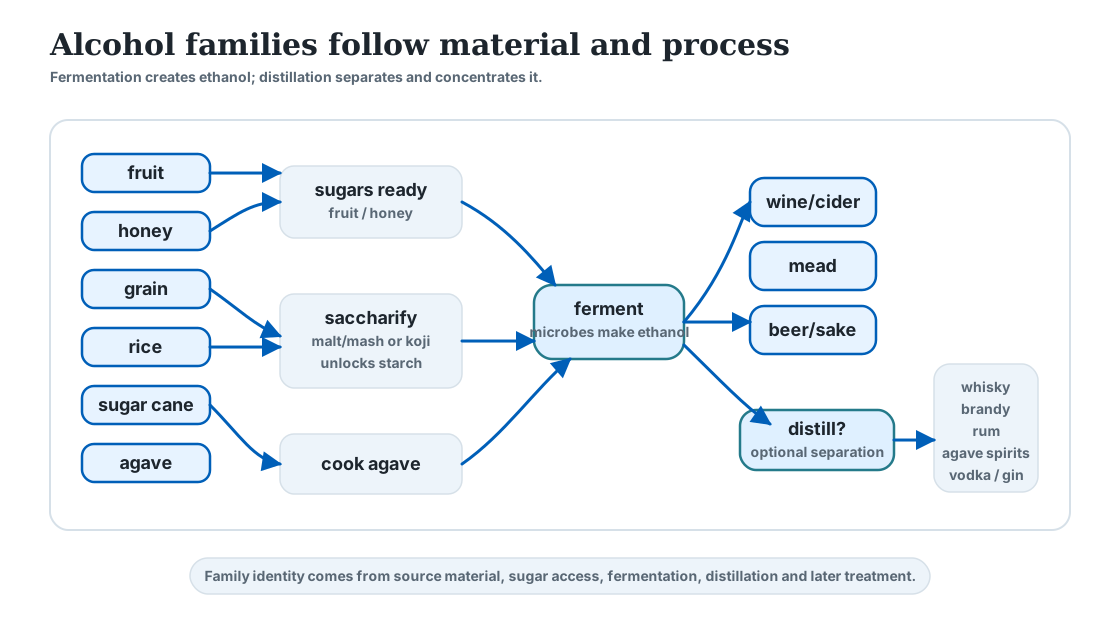
Follow the material and the process.
Almost every familiar alcoholic drink can be understood by asking four questions:
- Where did the fermentable sugar come from?
- How was that sugar made available to microbes?
- Was the fermented liquid distilled afterward?
- What happened after fermentation or distillation — aging, botanicals, blending, or nothing at all?
That framework explains most of the major families.
The molecule doing the intoxicating
The beverage alcohol humans normally mean is ethanol:
Ethanol is one member of the much larger chemical family called alcohols.
In beverages, ethanol is produced biologically when microorganisms metabolize fermentable sugars.
That process is fermentation.
Distillation comes later, if at all.
Main message: Fermentation creates ethanol. Distillation separates and concentrates an ethanol-containing mixture.
That distinction is the spine of this whole topic.
Start with the raw material
Different drinks begin with very different carbohydrate stores.
Fruit already contains substantial simple sugars.
Grapes can therefore be crushed into juice that yeast can ferment into wine.
Apples can become cider.
Honey is rich in sugars, but is usually diluted with water before fermentation into mead.
Grains and rice are different.
They store much of their carbohydrate as starch.
Yeast cannot simply attack a grain of starch and turn it directly into beer or sake.
The starch first has to be broken into smaller fermentable sugars — a process called saccharification.
Beer traditionally obtains those enzymes through malting and mashing grain.
Sake uses koji, rice inoculated with a mold of the genus Aspergillus, whose enzymes convert rice starch toward fermentable sugars.
So “made from grain” hides an important biochemical step.
Fermented drinks
If we ferment and then stop, we get families such as:
- beer;
- wine;
- cider;
- mead;
- sake.
Their differences arise from the starting substrate, how sugars become available, the microorganisms and fermentation conditions, and everything added or done around that process.
They are not simply the same ethanol diluted to different strengths.
The non-ethanol chemistry matters enormously to flavor.
Distilled spirits
Now take a fermented liquid and heat it in a still.
The vapor above an ethanol-water mixture is generally not the same composition as the liquid below it.
By condensing selected vapor, a distiller can produce a liquid with a higher ethanol concentration and a different mixture of volatile flavor compounds.
That is distillation.
This creates families such as:
- whisky — from fermented grain mash;
- brandy — from fermented fruit, juice, mash or wine;
- rum — from fermented sugar-cane material;
- vodka — highly rectified neutral spirit under the U.S. standard;
- gin — spirit whose defining flavor is juniper;
- tequila and mezcal — protected Mexican agave spirits with importantly different legal and production definitions.
The family identity is therefore not simply “strong alcohol.”
It is partly a history of what was fermented before distillation and what flavor the distillation process intentionally preserved or removed.
ABV
Alcoholic strength is commonly expressed as alcohol by volume, or ABV.
A bottle labeled:
40% ABVcontains ethanol equal to 40% of the stated beverage volume under the relevant measurement convention.
ABV is far more informative than describing a drink as merely “strong.”
Proof
In the United States:
So:
and:
This is a U.S. convention. Historical and international proof systems have not all used the same scale.
A compact family tree
A useful first approximation is:
```text SUGAR ALREADY AVAILABLE fruit → wine / cider honey + water → mead
STARCH MUST FIRST BE SACCHARIFIED grain → beer rice + koji → sake
THEN, OPTIONALLY:
fermented grain → distill → whisky fermented fruit/wine → distill → brandy fermented sugar-cane material → distill → rum neutral highly rectified spirit → vodka spirit + juniper-centered botanical character → gin cooked agave sugars → ferment → distill → tequila / mezcal ```
This map is simplified, but it gives the categories a mechanism.
Alcohol is not a recipe topic here
There are thousands of cocktails and recipes.
That is not what this Miscellany family is trying to preserve.
A named cocktail deserves space only if its invention, cultural role, legal history, chemistry or historical accident teaches something beyond the recipe itself.
The more durable questions are:
Why does whisky begin with grain but brandy with fruit?
Why does sake need koji?
Why can vodka be made from very different agricultural sources yet taste deliberately neutral?
Why are tequila and mezcal related but not interchangeable labels?
Those questions lead somewhere.