From ATP to Force: How Muscle Lifts a Weight
Suppose you lift a 100-pound weight through one vertical metre.
At the human scale, the physics is simple.
At the molecular scale, it is extraordinary.
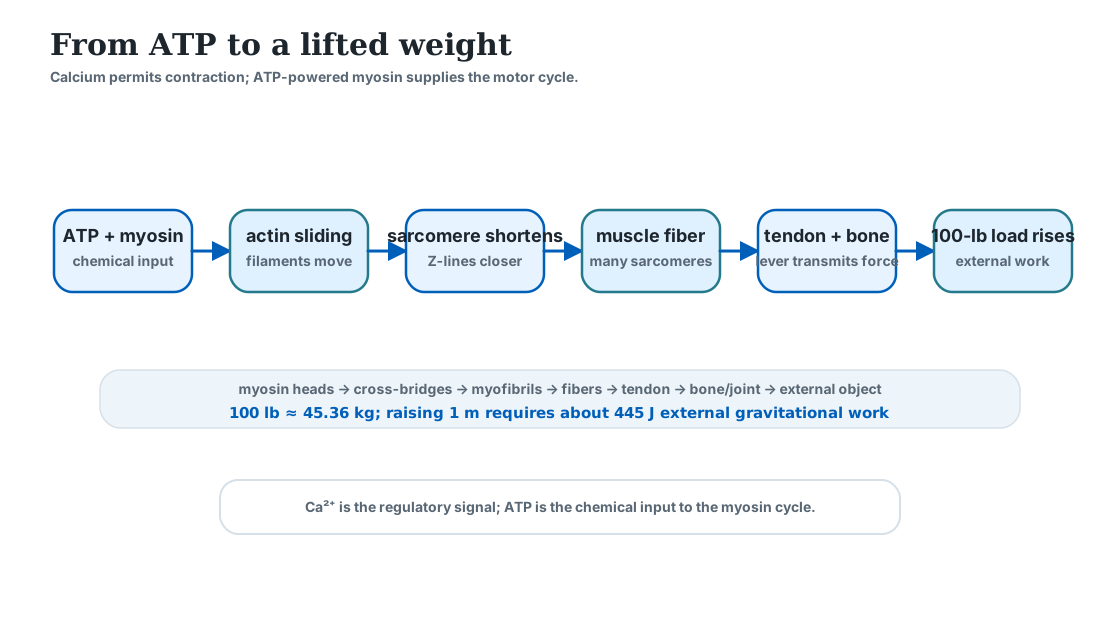
The causal chain is roughly:
food energy
→ ATP
→ myosin molecular motors
→ actin slides
→ sarcomeres shorten
→ muscle develops tension
→ tendon pulls bone
→ external load rises
This entry follows that chain from ATP to the moving weight.
Start with the ordinary physics
A 100-pound mass is approximately:
Raising it by:
against gravity requires external gravitational work:
so:
That is only about:
of external mechanical work.
That number can look absurdly small because a nutritional Calorie is a kilocalorie:
But 445 J is not the metabolic cost to the person.
The body must release more chemical energy because:
- muscles and limbs themselves move;
- joint geometry can require muscle force much larger than the external load;
- stabilizing muscles work too;
- ion gradients must be restored;
- molecular and tissue processes dissipate energy as heat.
So the physics calculation gives us a minimum external-work target, not “how many Calories your body burns.”
A nerve signal does not pull actin directly
Skeletal muscle contraction begins with electrical activation.
A muscle-fiber action potential travels along the membrane and into the transverse-tubule system.
That signal triggers calcium release from the sarcoplasmic reticulum.
The resulting rise in intracellular:
changes the regulatory state of the contractile filaments.
Calcium opens the gate
Thin filaments contain:
- actin;
- tropomyosin;
- troponin regulatory proteins.
At resting calcium concentration, tropomyosin helps prevent productive myosin binding along actin.
Calcium binds to the troponin complex.
Classic work by Fuchs and Briggs showed calcium binding to troponin at concentrations associated with activation of myofibrillar contraction.
The regulatory complex shifts, allowing productive actin-myosin interactions.
Calcium therefore does not supply the mechanical energy.
It is the control signal that permits the ATP-powered motors to engage.
Muscle does not contract because filaments themselves shrink
The famous 1954 work of Huxley, Niedergerke, Hanson and Huxley established the basis of the sliding-filament model.
Thick and thin filaments largely retain their lengths.
The sarcomere shortens because:
actin and myosin filaments slide farther past one another.
Thousands of sarcomeres arranged along myofibrils can therefore shorten the fiber without each protein filament simply collapsing like a spring.
Myosin is an ATP-powered molecular motor
Myosin heads project from the thick filament and interact transiently with actin.
A simplified cross-bridge cycle is:
1. ATP binds myosin
ATP binding weakens myosin's strong attachment to actin.
The head detaches.
2. ATP is hydrolyzed
Myosin hydrolyzes:
The chemical state of the motor changes and the head becomes “primed” into a different conformation.
3. Myosin binds actin
With the regulatory sites available, the primed myosin head can attach to actin.
4. Force-generating transition / working stroke
Product-release transitions are coupled to structural movement of the myosin motor.
The myosin head changes conformation and moves the actin filament relative to the thick filament.
This is the working stroke.
5. ADP leaves; new ATP is needed
After the strongly bound state, a new ATP molecule is required to promote detachment and begin another cycle.
This is a simplified Lymn–Taylor-style picture.
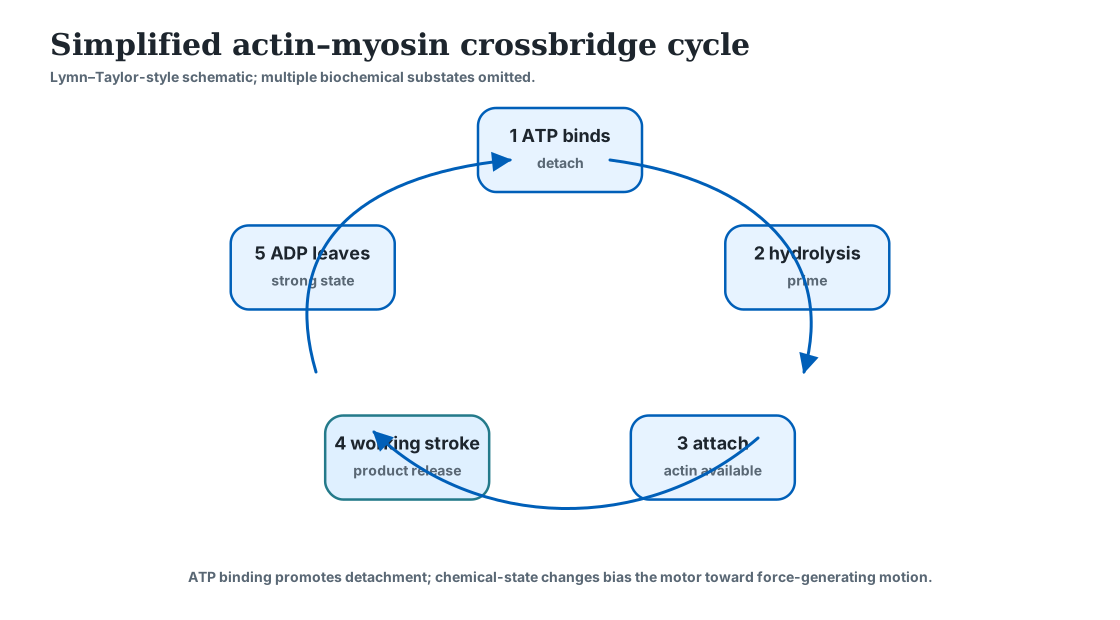
The molecular details contain more intermediate states than five cartoon steps.
But the important causal idea is correct:
ATP binding/hydrolysis changes the molecular interaction cycle; myosin converts those chemical-state changes into force and relative filament motion.
The motor's mechanics depend on load
Myosin is not a motor that makes one perfectly fixed motion regardless of force.
Reconditi and colleagues measured myosin-II working strokes in intact muscle under controlled loads.
The working stroke became smaller and slower at higher load.
That is exactly the sort of load dependence we expect from a real molecular motor operating in a mechanical system.
Molecular mechanics survives all the way up to whole-muscle force-velocity behavior.
From nanometres to a moving arm
One myosin working stroke moves at molecular scale.
That is obviously nowhere near one metre.
The scale-up occurs because enormous numbers of motors are organized hierarchically.
myosin heads
→ many cross-bridges in a sarcomere
→ many sarcomeres in a myofibril
→ many myofibrils in a muscle fiber
→ many fibers in a muscle
→ tendon
→ bone/joint
→ external object
Individual molecular displacements sum into tissue shortening and force.
The tendon transmits muscle tension to bone.
Bones and joints act as a lever system.
The force and shortening of the muscle therefore become external mechanical work.
Force is not the same thing as work
This distinction matters.
Mechanical work on an external load is:
If you hold a heavy dumbbell completely stationary:
so the dumbbell receives:
external mechanical work during that stationary interval.
Yet your muscle can consume substantial ATP.
Why?
Because physiological force maintenance is not an ideal rigid hook.
Cross-bridges cycle, calcium must be managed, ion gradients must be maintained, and stabilizing processes consume energy.
So:
zero external work does not mean zero metabolic energy use.
This is one reason converting “Calories burned” directly into external mechanical work is dangerous.
Where did the ATP come from?
The contraction entry begins with ATP, but the body cannot keep lifting by spending a tiny fixed pile of pre-existing ATP.
ATP is continually regenerated through:
- phosphocreatine buffering over short timescales;
- glycolysis;
- oxidative phosphorylation using carbohydrate, fat and other fuels.
That closes the loop back to bioenergetics.
The energy that raises the object was once:
- chemical free energy in food;
- transferred through metabolic intermediates;
- converted into ATP;
- converted by molecular motors into force and motion.
Main message: A muscle is a hierarchy of molecular machines. Calcium gives permission to contract; ATP-driven myosin supplies the molecular work; sliding filaments shorten sarcomeres; organized tissue and skeletal levers turn nanometre-scale events into a macroscopic lift.