Beyond Classical Logic
“Non-classical logic” sounds as if there were classical logic on one side and one alternative on the other.
There is not.
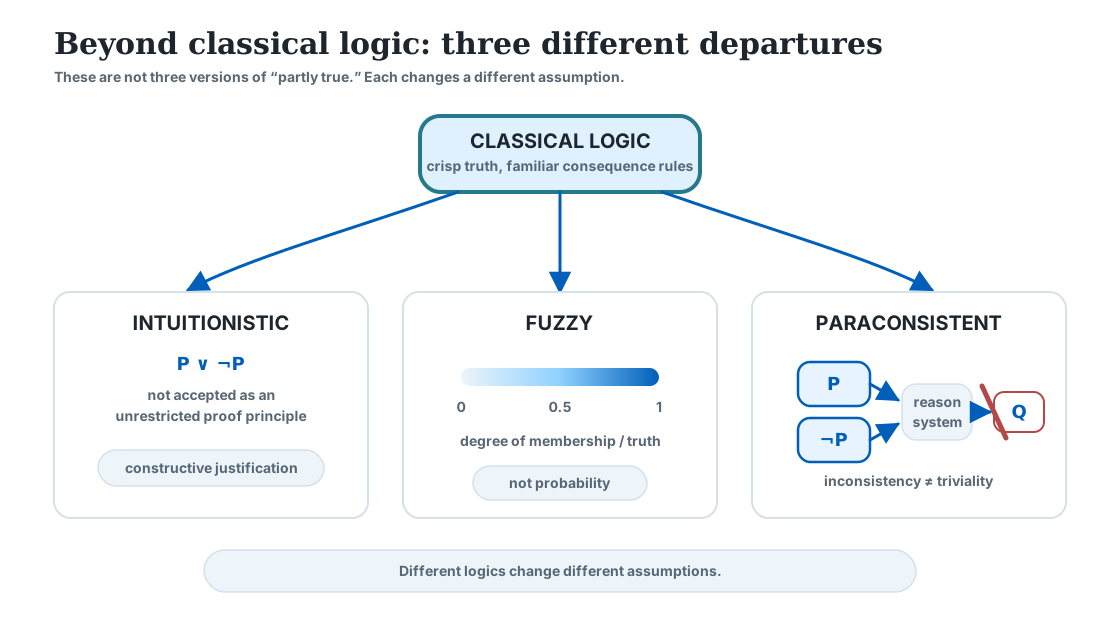
Different logics change different assumptions for different reasons.
Three especially useful examples are:
- intuitionistic logic;
- fuzzy logic;
- paraconsistent logic.
They are worth learning together precisely because they are easy to confuse.
First: what is the classical baseline?
Classical propositional logic contains familiar principles such as the law of excluded middle:
Classically, this means:
- either P or not-P;
- contradiction validates a principle often called explosion.
In words:
If a contradiction is available — P and not-P — classical logic allows any proposition Q to be derived.
Symbolically, after introducing the notation:
The symbol:
means roughly:
“can be formally derived.”
Why would contradiction be so destructive?
Because classical consequence is designed so that no model can make both P and not-P true together. Once the premises describe no admissible classical model at all, every conclusion is vacuously satisfied by all models of the premises — because there are none.
Different non-classical systems decide that some part of this package is not appropriate for a particular purpose.
Intuitionistic logic: require constructive justification
Intuitionistic logic grew from L. E. J. Brouwer's philosophy of mathematics and the later formal systems inspired by it.
One of its famous departures is that it does not accept the law of excluded middle:
as an unrestricted general principle.
That does not mean either of these:
- P is half true.
- The logic simply adds a third truth value called “unknown.”
The intuitionistic idea is much closer to proof or construction.
To establish:
one should be able to establish P or establish Q.
To establish:
one should, in the constructive spirit, have grounds that provide or construct an appropriate witness rather than merely prove abstractly that failure would lead to contradiction.
This changes some familiar classical inferences.
For example:
is not generally available intuitionistically.
Proving that P cannot be false is not always treated as the same thing as constructively establishing P.
This is a very different project from fuzzy logic.
Fuzzy logic: model graded membership and truth
Classical sets normally give a crisp answer:
x is a member of set A
or:
x is not a member of set A.
Lotfi Zadeh's 1965 theory of fuzzy sets allowed membership to vary continuously.
A membership function can assign:
For a fuzzy category such as “tall person,” an object might have membership degree:
rather than being forced immediately into TALL or NOT TALL.
Zadeh later developed fuzzy logic and approximate reasoning around related ideas of graded and linguistic truth.
This is useful for vague categories where boundaries are not naturally sharp.
Fuzzy degree is not probability
This distinction matters.
Suppose someone's membership in the fuzzy set “tall” is:
That does not mean:
There is a 70% probability that the person is secretly either tall or not tall.
Probability describes uncertainty about an outcome or state.
Fuzzy membership describes degree of membership under a graded category.
A person can be known with certainty to be 178 cm tall while a chosen fuzzy membership function gives that height a 0.7 membership in “tall.”
No uncertainty about the person's height is required.
Paraconsistent logic: contradiction without catastrophe
Now consider a completely different problem.
Suppose a database receives two reports:
Valve A is open.
and:
Valve A is not open.
Possible explanations include:
- sensors disagree;
- records were merged badly;
- the underlying information really is inconsistent.
In classical logic, unrestricted explosion makes contradiction dangerous:
for arbitrary Q.
So from contradictory valve data, the formal system can in principle derive an unrelated claim such as:
The Moon is made of cheese.
A paraconsistent logic blocks that unrestricted explosion.
It tries to allow:
P and not-P are both present
without forcing:
therefore everything whatsoever.
Newton da Costa's work on inconsistent formal systems made a key distinction between an inconsistent system and a trivial one.
An inconsistent system contains some A and not-A.
A trivial system proves everything.
Paraconsistent reasoning is designed so inconsistency does not automatically produce triviality.
This does not mean contradictions are good
Paraconsistent logic does not say:
contradictions do not matter.
It says:
a contradiction should not automatically destroy the entire inferential system.
You may still want to identify, isolate and resolve inconsistent information.
The logical point is that you can continue reasoning non-trivially while doing so.
Three different departures
These three logics are therefore solving very different problems.
| Logic | What motivates the departure? | What not to confuse it with |
|---|---|---|
| Intuitionistic | constructive justification/proof | “partly true” propositions |
| Fuzzy | vague or graded categories/truth | probability or uncertainty |
| Paraconsistent | inconsistent information without explosion | saying every contradiction is acceptable |
They should not be lumped together as:
alternatives where truth is less strict.
That description hides the interesting part.
Each system changes a different component of the classical package.
Why this belongs after modal logic
Modal logic taught us an important habit:
logical systems can differ because we change the semantics or structural assumptions underneath them.
Non-classical logic generalizes that lesson.
The familiar rules of classical logic are not simply “reason itself written down.”
They form an extraordinarily useful formal system with particular assumptions.
Change an assumption carefully, and you obtain a different system designed to preserve some kinds of reasoning while giving up others.
Main message: There is no single way to go “beyond classical logic.” Intuitionistic, fuzzy and paraconsistent logics modify different assumptions to solve different problems.