Blood Pressure Explained
A blood-pressure reading such as:
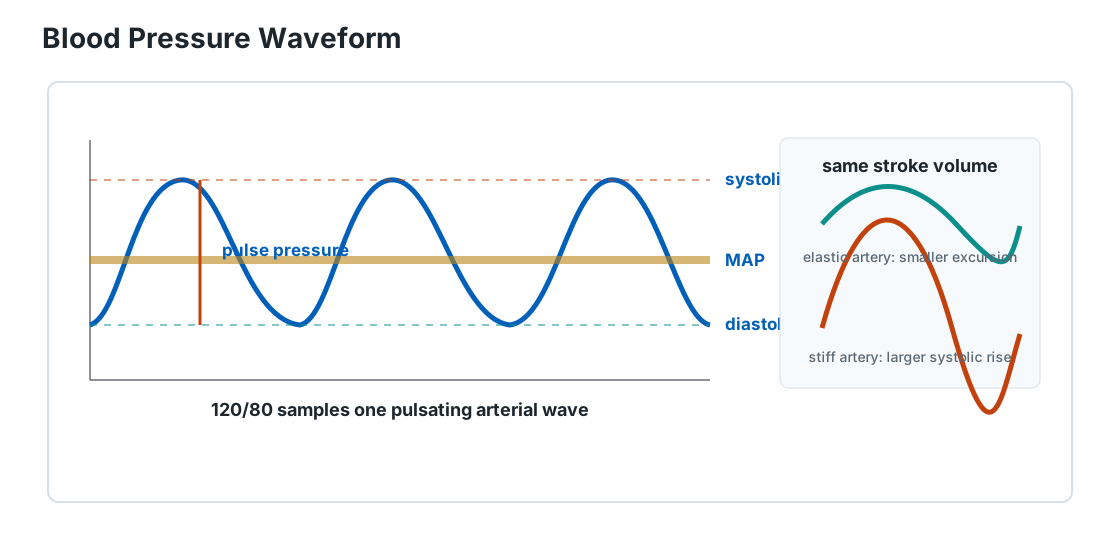
contains two measurements from one pulsating arterial pressure wave.
- Systolic pressure is the peak arterial pressure during ventricular contraction.
- Diastolic pressure is the lower pressure between beats while the ventricle relaxes and fills.
The unit mm Hg means millimetres of mercury, inherited from mercury-column pressure gauges.
What determines arterial pressure?
Blood pressure is not produced by a single variable.
At a useful first approximation:
Cardiac output is:
where:
- HR = heart rate
- SV = stroke volume, blood ejected per beat
Resistance depends strongly on arteriolar tone and vessel geometry.
Blood volume, kidney sodium handling, hormones, autonomic nervous activity, arterial stiffness and many other factors feed into this system.
Pulse pressure
Pulse pressure is:
For 120/80:
Pulse pressure depends partly on stroke volume and arterial compliance.
If large arteries become stiff, the same ejected blood volume produces a larger pressure rise, helping explain why systolic pressure and pulse pressure often increase with age.
Mean arterial pressure
For ordinary resting heart rates, a useful approximation is:
For 120/80:
This is an approximation because the heart spends more time in diastole than systole at normal resting rates. At very high heart rates the weighting changes.
MAP is useful physiologically because organ perfusion depends more closely on the average driving pressure across the cardiac cycle than on the systolic peak alone.
Current U.S. categories
Under the current ACC/AHA framework:
| Category | Systolic | Diastolic |
|---|---|---|
| Normal | <120 | and <80 |
| Elevated | 120–129 | and <80 |
| Stage 1 hypertension | 130–139 | or 80–89 |
| Stage 2 hypertension | ≥140 | or ≥90 |
The higher category wins if systolic and diastolic fall into different rows.
These are clinical classification thresholds, not biological cliffs. A reading of 129 and a reading of 130 are not suddenly different universes.
Cardiovascular risk rises continuously across populations; categories exist because treatment decisions need usable boundaries.
A blood-pressure reading is noisy
Blood pressure changes minute to minute with:
- exercise
- posture
- recent caffeine
- nicotine
- pain
- stress
- bladder fullness
- temperature
- sleep
- medications
- talking during measurement
This is why one casual reading is not a good estimate of usual blood pressure.
Current AHA home-measurement guidance emphasizes:
- use a validated upper-arm cuff
- use the correct cuff size
- avoid exercise, smoking and caffeine for 30 minutes beforehand
- empty the bladder
- sit quietly for at least 5 minutes
- feet flat, back supported
- arm supported at heart level
- do not talk during measurement
Repeated home measurements can help distinguish sustained hypertension from white-coat effects and can reveal masked hypertension.
Why cuff size matters
A cuff that is too small can artificially elevate the reading.
This is particularly important in larger arms. "My monitor says X" is only useful if the device and cuff are appropriate.
Severe readings
Current AHA guidance treats:
as severe hypertension.
If a reading is unexpectedly that high, repeat it after at least one minute.
If it remains that high and there are symptoms such as chest pain, shortness of breath, back pain, weakness/numbness, vision change or difficulty speaking, that is a hypertensive emergency and requires emergency care.
Big idea: A blood-pressure number is a sample from a dynamic pressure waveform. Its long-term meaning comes from repeated, correctly measured values and the person's overall cardiovascular context.
Misconceptions
- 120/80 is not "120 pressure plus 80 pressure"; they are peak and trough of one arterial cycle.
- Heart rate and blood pressure are different measurements.
- A single stressful reading does not establish chronic hypertension.
- A normal diastolic number does not cancel a high systolic number.
- Clinical thresholds are decision boundaries, not abrupt biological boundaries.