Braking: Hydraulic Force, Heat, and ABS
Brakes have two jobs that are easy to confuse: produce sufficient resisting torque at the wheels, and absorb energy without losing their intended behavior. The tire-road contact adds a third constraint: enough brake torque does not guarantee enough grip.
Pressure communicates force
In a conventional hydraulic brake, a pedal lever and often a booster apply force to a master-cylinder piston. A pressure increase travels through brake fluid to caliper pistons or drum-brake wheel cylinders. Disc pads clamp a rotating disc; drum shoes press against a rotating drum. Friction creates resisting wheel torque, while the stationary brake structure transfers its reaction to the suspension and body.
Ignoring height differences, flow losses, and compliance, the static pressure relation is
A larger receiving piston creates more force at the same pressure. It needs proportionally more displaced fluid for the same travel, so it does not multiply work. The hydraulic circuit principally transmits a command and clamping force; it does not provide the hundreds of kilojoules dissipated during a stop. Those come from the moving car. Pascal's principle and hydraulic work.
For an illustrative unboosted mechanism, 200 N at a 4:1 pedal lever gives 800 N at a 20 mm-diameter master piston. Its area is 3.14×10⁻⁴ m², giving 2.55 MPa. A 40 mm caliper piston has four times that area and develops 3,200 N.
For a simple floating single-piston caliper, the reaction draws the outer pad against the other disc face. Each pad has approximately 3,200 N normal force. With assumed friction coefficient 0.40 and effective friction radius 0.12 m, total disc braking torque is (2(0.40)(3200)(0.12)=307) N·m. The factor of two represents two friction faces, not a universal multiplier for every caliper design. These are explanatory dimensions, not sizing or service guidance.
A stop is an energy transfer
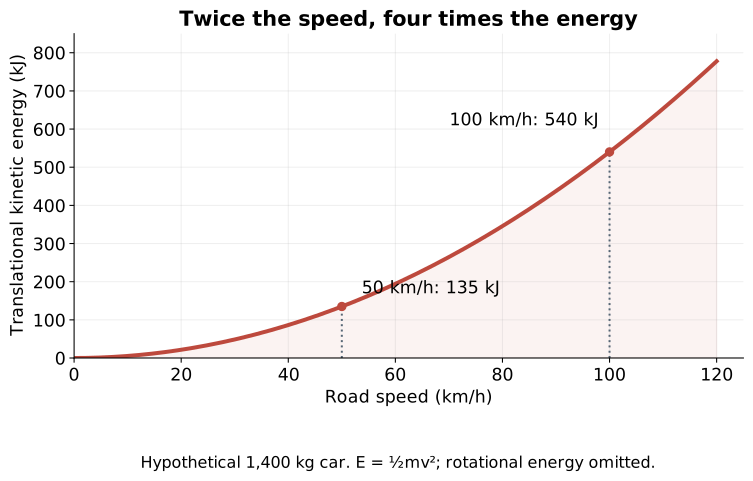
A hypothetical 1,400 kg car at 100 km/h has translational kinetic energy
At 50 km/h it has about 135 kJ: doubling speed quadruples energy. Wheel and drivetrain rotation add energy; drag and rolling resistance absorb some during the stop. Ignoring those corrections, dissipating 540 kJ in five seconds means 108 kW average thermal power. This can greatly exceed the engine's contemporaneous output because the brakes are emptying an energy store accumulated earlier.
If 70% of that energy entered two front discs with 12 kg combined mass and assumed specific heat 460 J/(kg·K), their average temperature increase with no cooling would be about (378000/(12×460)=68.5) K. Actual heat splits among pads, discs, hubs, tires, and air; surface temperatures are not uniform. The model illustrates why repeated stops differ from one isolated stop. Brake friction and fluid behavior depend on temperature, so torque capacity and heat capacity are distinct design questions.
Grip and load transfer
For an idealized level stop with constant effective tire-road friction coefficient μ, no aerodynamic contribution, and all tire capacity used, a≈μ g. Then
At 100 km/h and assumed μ=0.8, this gives 49.2 m of braking distance. It excludes driver reaction time and is not a real-world stopping-distance promise. Tire behavior, surface condition, slope, load, and control all matter.
Deceleration transfers normal load toward the front axle. The quasi-static load transfer is ΔN=mah/L, with center-of-mass height h and wheelbase L. For the 1,400 kg car at 0.8g, h=0.50 m and L=2.7 m, about 2.03 kN shifts from rear to front. Brake-force distribution must respect the changing axle grip. This transfer follows force and moment balance; eliminating visible body pitch would not eliminate it.
ABS regulates slip, not friction itself
Define a simplified braking slip ratio as (s=(v-Rω)/v), for positive vehicle speed away from zero. Rolling without longitudinal slip gives s=0; a locked wheel gives s=1. Tire force generally reaches a peak before complete lock, but the location and shape depend on the surface and tire.
ABS uses wheel-speed information and hydraulic valves to reduce, hold, and reapply brake pressure when a wheel tends toward lock. The point is to keep braking near usable tire capacity while preserving directional control. It cannot create friction, cancel inertia, or guarantee the shortest distance on every surface. NHTSA testing found longer ABS stops on loose gravel in its test conditions because locked tires can build a plowing wedge, at the cost of steering control. Bosch control mechanism and NHTSA surface tests.
Braking and cornering draw on the same finite tire-force capability. ABS and stability control manage that limitation; they do not remove it. This article explains the physics, not an emergency-driving or brake-service procedure.