Cardiovascular Risk: Probability, Not Destiny
Cardiovascular risk factors are often discussed as if each one were a verdict.
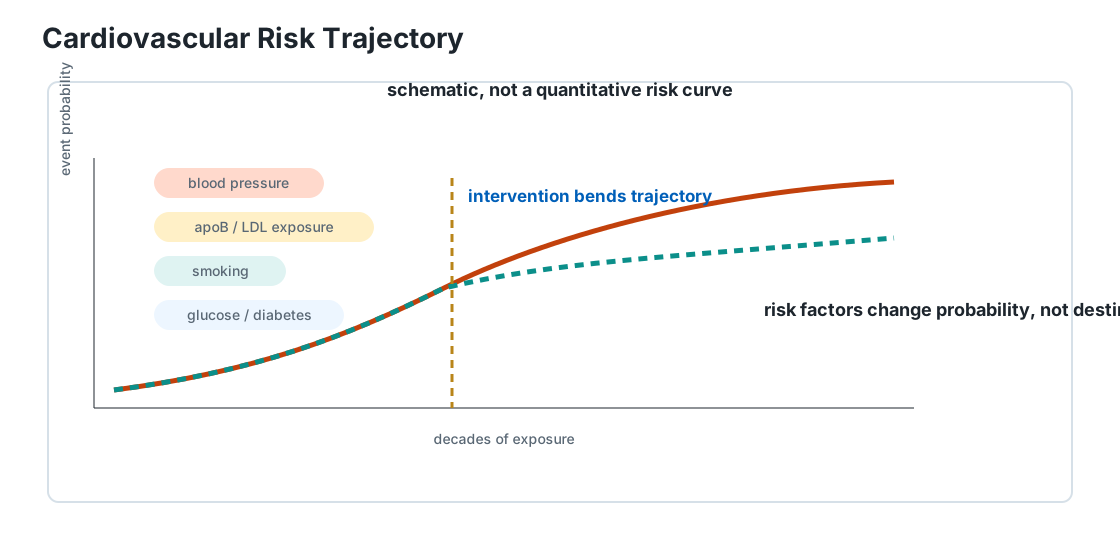
They are not.
They change probability over time.
A person with hypertension, obesity or high LDL does not have a scheduled heart attack. A person with "normal" numbers does not have zero risk.
The useful question is:
How do multiple exposures alter the chance of a future cardiovascular event, and which of them can be changed?
Risk factors compound
Important cardiovascular risk factors include:
- age
- blood pressure
- atherogenic cholesterol exposure
- smoking
- diabetes
- kidney disease
- body composition / adiposity
- physical inactivity
- family history and genetics
- sleep disorders
- inflammatory conditions
They do not simply add one point each.
Some interact biologically.
For example:
```text hypertension → greater arterial-wall mechanical stress
atherogenic lipoproteins → plaque formation
smoking → endothelial injury + thrombosis biology
diabetes → vascular and metabolic injury ```
Several mechanisms operating together can raise risk substantially.
Absolute and relative risk are different
Suppose an intervention lowers relative risk by 20%.
If baseline 10-year risk is 5%, a simplistic illustration would reduce risk to about 4% — an absolute reduction of ~1 percentage point.
If baseline risk is 25%, the same 20% relative reduction corresponds to about 20% — an absolute reduction of ~5 points.
The same relative effect can therefore matter very differently depending on starting risk.
Why age can dominate calculators
Cardiovascular events accumulate over decades, so age strongly influences short-term absolute risk.
A younger person can have substantial lifetime exposure to high blood pressure or LDL while still having a modest 10-year event probability.
That is one reason short-term calculators should not be interpreted as "nothing to worry about."
PREVENT
The current 2025 U.S. blood-pressure guideline uses the AHA PREVENT equations to help estimate cardiovascular risk in relevant treatment decisions.
Risk calculators are decision aids, not prophecies.
They are based on population data and cannot know every feature of an individual.
Modifiable does not mean easy
Calling a factor "modifiable" does not mean it is entirely voluntary.
Body weight, blood pressure, glucose regulation and smoking behavior are affected by biology, environment, medications, economics, sleep, mental health and other factors.
"Modifiable" simply means intervention can alter the exposure or its consequences.
Why treating one factor still matters
Risk factors are not all-or-nothing.
- Lowering blood pressure helps even if weight is still high.
- Lowering atherogenic cholesterol helps even if another risk factor remains.
- Improving fitness helps even without perfect body composition.
The practical goal is not to become a person with zero cardiovascular risk.
It is to shift several controllable probabilities in a favorable direction.
Main message: Cardiovascular risk is cumulative and probabilistic. Risk factors identify leverage points, not destiny.