Cardiovascular System: Pressure, Flow, and Oxygen Delivery
The cardiovascular system is often taught as a list of parts: heart, arteries, veins, capillaries.
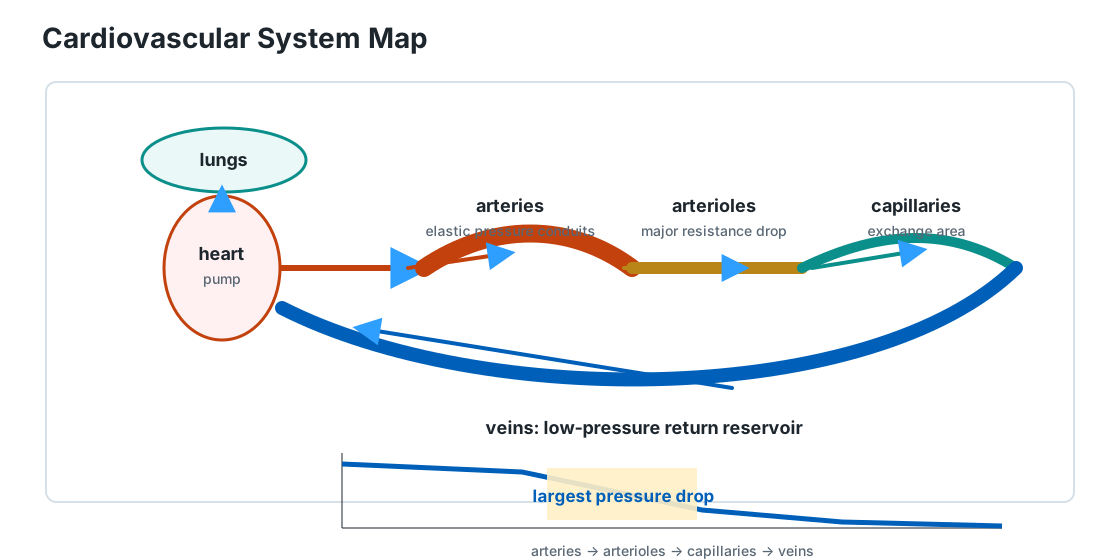
A better starting point is to ask what the system must accomplish:
deliver oxygen and nutrients to tissues, remove metabolic waste, and keep blood moving through an enormous branching network.
The heart supplies pressure. The vessels distribute that pressure, regulate resistance, and provide exchange surfaces.
Two pumps in series
The right side of the heart pumps blood through the lungs.
The left side pumps oxygenated blood through the systemic circulation.
Because these circuits are in series, over time the same average volume of blood must pass through each side. If one side persistently pumps less than the other, blood accumulates upstream.
Arteries are not just pipes
Large arteries receive blood directly from the beating heart.
Their elastic walls stretch during systole and recoil during diastole. This smooths a strongly pulsatile pump output into more continuous downstream flow.
As large arteries become stiffer with age and disease, systolic pressure and pulse pressure often rise.
Arterioles are the resistance valves
The largest controllable pressure drop occurs across small arteries and arterioles.
Their smooth muscle can constrict or dilate, changing radius.
For ideal laminar flow through a cylindrical tube, Poiseuille's relation gives:
The real circulation is more complicated than a rigid pipe, but the qualitative lesson is crucial:
small changes in vessel radius can produce large changes in resistance.
This is why arterioles are so powerful in controlling organ blood flow and systemic blood pressure.
Capillaries trade pressure for area
Individual capillaries are tiny, but there are enormous numbers in parallel.
Their combined cross-sectional area is huge, so average blood velocity falls dramatically.
Slow flow and thin walls favor exchange of oxygen, carbon dioxide, nutrients, water and signaling molecules with tissues.
Veins are the low-pressure reservoir
Veins return blood to the heart at much lower pressure.
They are highly compliant and contain a large fraction of the circulating blood volume at rest.
Skeletal-muscle contractions, one-way valves and breathing help venous return.
Pressure drives flow, resistance limits it
A useful circulatory analogue of Ohm's law is:
where:
- Q = flow
- ΔP = pressure difference
- R = vascular resistance
This is an organizing model, not a statement that blood vessels are rigid electrical resistors.
A high pressure can coexist with restricted flow if resistance is also high.
Oxygen delivery
Blood flow is only part of tissue oxygen supply.
A useful relationship is:
That distinction matters clinically. A blocked coronary artery can drastically reduce local heart-muscle oxygen delivery even when the blood elsewhere is well oxygenated.
Main message: The heart generates pressure, arterioles regulate resistance, capillaries exchange material, and veins return blood. Cardiovascular disease often begins when this pressure-flow system or its vessel walls are chronically altered.