Chaos: Sensitive Dependence Without Randomness
In ordinary speech, "chaos" means disorder.
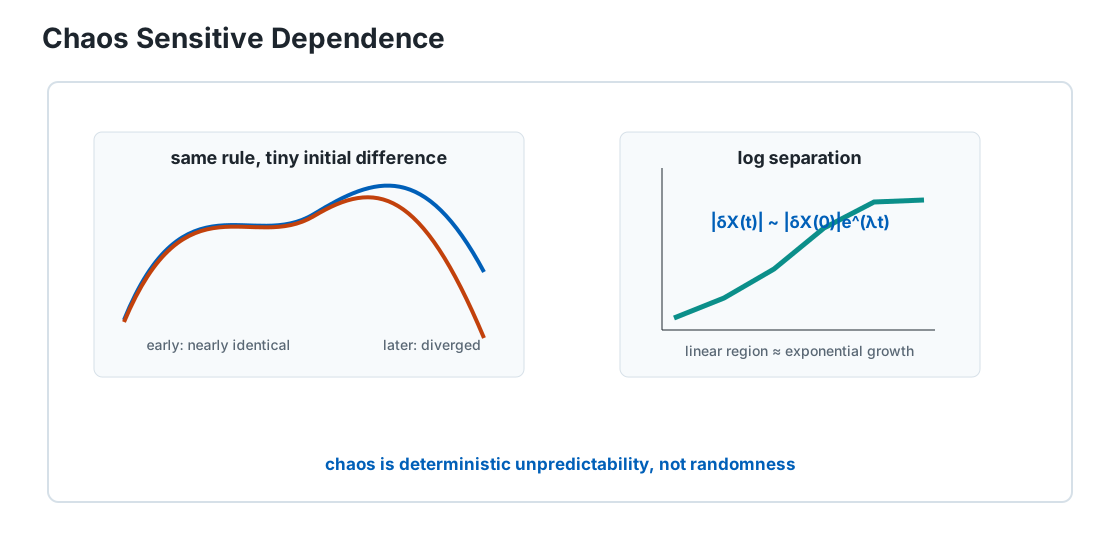
In dynamical systems, chaos is more specific.
A chaotic system follows deterministic rules but can show sensitive dependence on initial conditions.
Very small differences in starting state can grow until long-term trajectories become macroscopically different.
Deterministic
Suppose a state (X(t)) evolves according to a differential equation:
Given an exact state and the exact governing rule, the future is determined.
There is no dice roll in that statement.
Sensitive dependence
Take two initial states separated by a tiny amount:
In a chaotic regime, their separation may grow roughly like:
over an appropriate interval, where λ>0 is a positive Lyapunov exponent.
The exact mathematics is subtler than this one equation, but the mechanism is clear:
tiny uncertainty
→ repeated nonlinear amplification
→ loss of trajectory predictability
The predictability horizon
Suppose measurement uncertainty is reduced by a factor of 1,000.
That sounds enormous.
But if errors grow exponentially, this buys only an additional finite amount of prediction time:
Better measurement extends the horizon; it does not necessarily make the horizon disappear.
The butterfly effect
Edward Lorenz discovered this phenomenon dramatically in numerical weather modeling in the early 1960s.
Rerunning a weather calculation from rounded intermediate values produced a trajectory that eventually diverged enormously from the original.
This became associated with the "butterfly effect."
The idea is not literally:
one butterfly causes one tornado.
It is:
nonlinear systems can amplify extremely small differences so strongly that long-range detailed prediction becomes intrinsically limited by finite knowledge of the initial state.
Chaos is not randomness
- A shuffled deck is modeled probabilistically because we do not track microscopic details.
- Radioactive decay is fundamentally quantum-probabilistic.
- A double pendulum can be chaotic while following deterministic classical equations.
These are not the same kind of unpredictability.
Chaos is not merely complication
- A complicated system can be nonchaotic.
- A simple system can be chaotic.
The essential issue is the structure of the dynamics, not the number of parts.
Examples of systems with chaotic regimes include:
- double pendula
- driven nonlinear pendula
- fluid flows
- some population models
- weather models
Phase space
For a pendulum, knowing position alone is not enough.
You also need velocity.
A system's complete instantaneous state is represented in phase space.
For a simple pendulum:
(θ, ω)For a double pendulum:
(θ₁, θ₂, ω₁, ω₂)Chaos concerns how nearby trajectories in this state space evolve.
Strange attractors
Dissipative chaotic systems can evolve toward intricate structures called strange attractors.
- Lorenz's weather model produced the famous butterfly-shaped Lorenz attractor.
- The trajectory never exactly repeats, yet it remains confined to structured regions of phase space.
So chaos can contain geometric order.
Why chaos matters philosophically
Newtonian mechanics encouraged an ideal:
if we knew the complete present state exactly, perhaps the future would be calculable indefinitely.
Chaos leaves determinism intact while damaging the practical implication.
Finite measurement precision means long-term exact prediction can fail even when the governing laws are known.
That is a much more interesting result than "things are random."
Main message: Chaos is deterministic unpredictability produced by nonlinear amplification of tiny initial differences.