Classical Mechanics: The Map
Physics becomes much easier once the formulas stop looking like unrelated tricks.
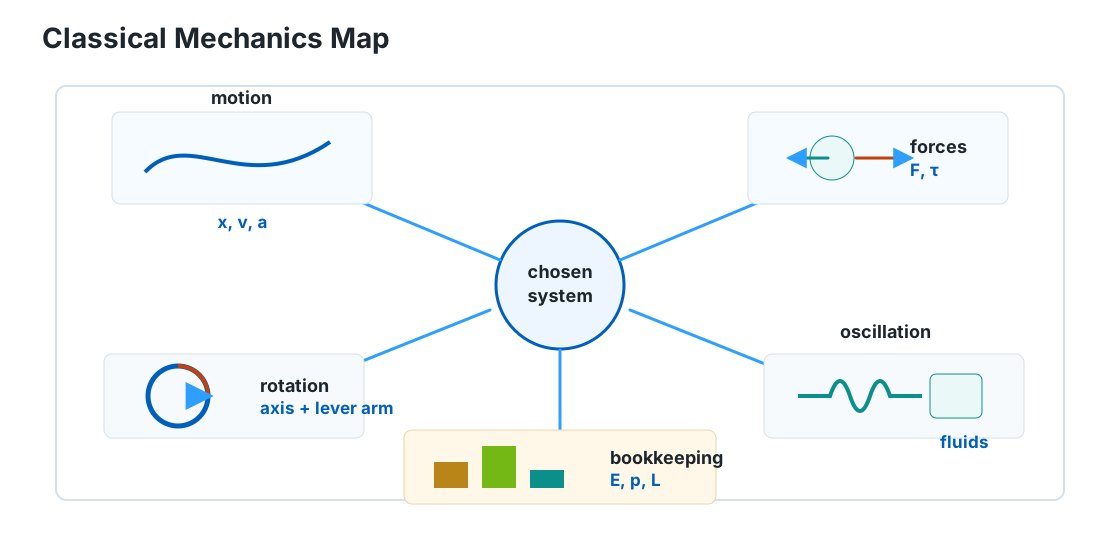
Classical mechanics repeatedly asks only a few kinds of question:
- How is the object moving? Position, velocity and acceleration are kinematics.
- What is interacting with it? Forces and torques describe interactions.
- What changes can be tracked without following every instant? Energy and momentum often let us jump directly between states.
- What changes when the object has size and can rotate? Translational ideas acquire rotational partners.
- What happens near a stable equilibrium? Many systems oscillate.
- What if the material itself flows? Fluids add pressure, buoyancy and flow constraints.
A good physics solution therefore starts before any equation is chosen.
1. Choose the system
"The system" is the part of the universe whose behavior you want to track.
If the system is a falling ball alone, Earth exerts an external gravitational force on it.
If the system is ball + Earth, gravity becomes an internal interaction and it is often more natural to talk about gravitational potential energy.
That choice is not bookkeeping trivia. It determines which conservation laws are useful.
2. Choose a representation
The same physical situation can be represented as:
- a sketch
- a motion diagram
- a free-body diagram
- a graph
- an equation
- an energy bar chart
- a momentum vector diagram
Experts switch among these representations constantly. A graph can reveal something an equation hides; a free-body diagram can expose a force that prose forgot.
3. Decide what changes and what is conserved
Several of mechanics' most powerful statements have the form:
Examples:
The algebra-based course often uses constant-force or constant-acceleration versions of these ideas. Calculus reveals that the familiar formulas are special cases of more general accumulation rules.
The main conceptual spine
A useful way to organize mechanics is:
motion
  ↓ asks why
forces
  ↓ can be accumulated through distance
energy
  ↓ can be accumulated through time
momentum
  ↓ extended objects add lever arms
rotation
  ↓ stable restoring forces produce
oscillation
Fluids reuse many of the same ideas — force, pressure, energy and conservation — but apply them to matter that can move and deform continuously.
Main message: Mechanics is not a bag of equations. It is a small collection of models for describing change, interaction and conservation.
Useful misconceptions to address
- A force is not required to keep an object moving at constant velocity.
- Energy is not "used up"; useful forms are transformed and often dispersed.
- Momentum conservation is a statement about a chosen system and its external impulse.
- Centripetal force is not a new kind of force; it is the inward net force required for curved motion.
- Conservation laws are not magic exceptions to Newton's laws. They are closely connected descriptions of the same physics.