Type 1 vs Type 2 Diabetes
Both Type 1 and Type 2 diabetes can produce high blood glucose, but the failure occurs in different places.
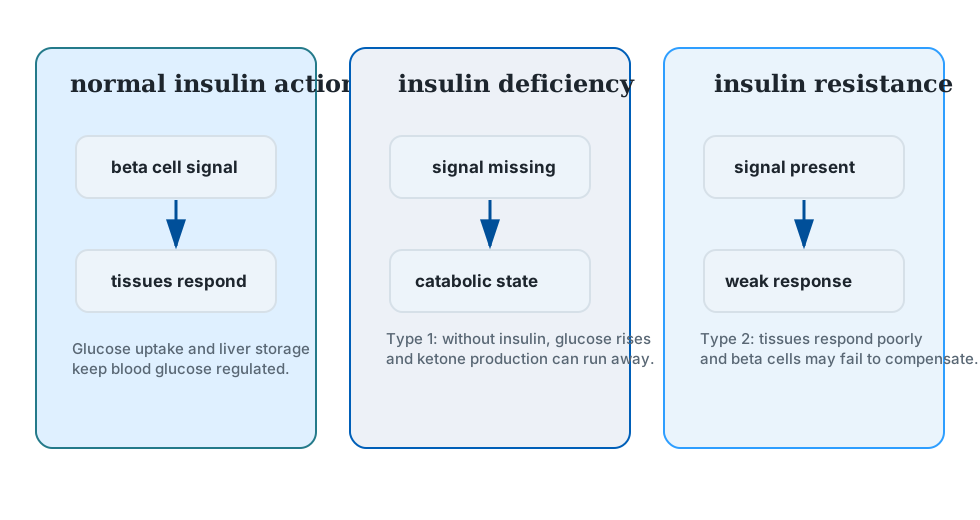
| Type 1 | Type 2 | |
|---|---|---|
| Primary failure | autoimmune destruction of beta cells | insulin resistance + progressive beta-cell dysfunction |
| Insulin | absolute or near-absolute deficiency | often high early, insufficient relative to resistance later |
| Typical mechanism | the signal is missing | tissues respond poorly and beta cells cannot eventually compensate |
| Ketosis risk | high if insulin is absent | usually lower, though DKA can occur |
| Treatment | insulin is required for survival | lifestyle + multiple drug classes; some people eventually require insulin |
Type 1: be explicit
Without replacement insulin, Type 1 diabetes is fatal. Lack of insulin does more than raise glucose: it removes the brake on lipolysis and ketone production, producing a catabolic "starvation despite glucose in the blood" state that can progress to diabetic ketoacidosis.
The insulin-producing beta cells live in tiny endocrine clusters scattered through the pancreas called the islets of Langerhans. Paul Langerhans first described these clusters as a medical student in 1869; he did not know their function. In 1893, Édouard Laguesse named them after Langerhans and proposed that they produced an internal secretion involved in blood-sugar control. In Type 1 diabetes, the autoimmune target is specifically the insulin-producing beta cells within these islets.
Before insulin, treatment largely meant extreme carbohydrate/calorie restriction to postpone death. NIDDK describes Type 1 diabetes before insulin as a fatal disease, commonly with survival only a year or two after diagnosis.
The 1922 transformation
Fourteen-year-old Leonard Thompson was the first diabetic patient to receive injected pancreatic extract in Toronto in January 1922. He was severely wasted and close to death. The first preparation had limited clinical effect; a more purified extract given later that month worked.
Another remarkable early patient, Elsie Needham, became the first child documented by the University of Toronto archive to recover from diabetic coma after insulin treatment in October 1922.
The often-retold image of doctors injecting an entire ward of comatose children who all awaken at once is dramatically memorable, but the archival evidence supports a series of extraordinary individual recoveries rather than that exact cinematic scene.