Distillation: Concentrating Alcohol and Flavor
Distillation has an almost magical reputation:
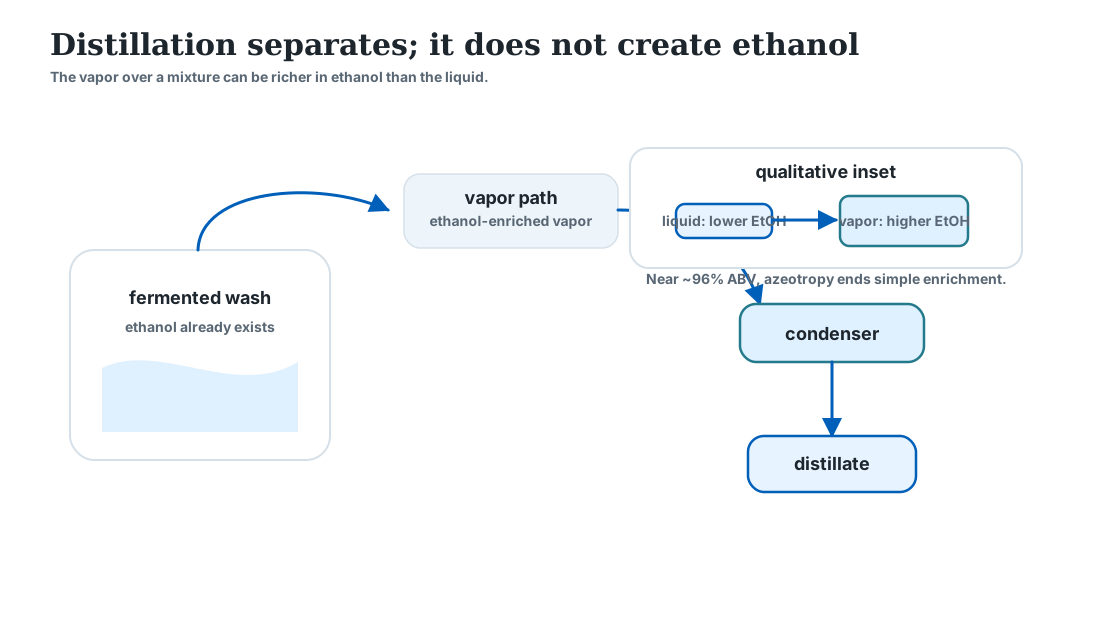
heat a weak fermented liquid and somehow strong spirit emerges.
The mechanism is ordinary physical chemistry.
The crucial fact is that the vapor above a liquid mixture need not have the same composition as the liquid itself.
Start with a fermented wash
Suppose fermentation has produced a liquid containing:
- water;
- ethanol;
- many smaller concentrations of volatile compounds;
- nonvolatile material.
The ethanol already exists.
The still does not manufacture it.
The still separates components based on their vapor-liquid behavior.
Main message: Fermentation is chemical production. Distillation is physical separation.
“Ethanol boils at 78 °C” is not enough
Pure ethanol boils at a lower temperature than pure water at the same pressure.
That fact helps build intuition, but beverage distillation is not simply:
ethanol reaches 78 °C and jumps out while water waits until 100 °C.
A fermented beverage is a mixture.
Ethanol and water both contribute to the vapor over a range of temperatures.
What matters is the equilibrium composition of the vapor compared with the liquid.
For much of the useful ethanol-water range, the vapor is richer in ethanol than the liquid.
If that vapor is collected and condensed:
fermented liquid
→ vapor richer in ethanol
→ condensed liquid with higher ABV
Repeated vaporization-condensation steps can produce progressively stronger spirit.
A pot still
A simple pot still has three conceptual jobs:
- boiler: heat the fermented liquid;
- vapor path: allow volatile material to leave the boiler;
- condenser: cool the vapor back into liquid.
The geometry, heating rate, reflux and deliberate collection choices change what arrives in the final distillate.
A pot still is therefore not merely a kettle attached to a pipe.
It is a device for controlling separation while retaining some desired flavor compounds.
A column still
A distillation column creates many repeated opportunities for vapor and liquid to exchange material.
Each theoretical separation stage can enrich more volatile components relative to less volatile ones.
This makes high rectification practical and helps explain why neutral-spirit production can reach much higher alcohol concentration and much lower distinctive raw-material character than a deliberately characterful pot-distilled spirit.
The U.S. standard for neutral spirits, for example, is built around very high distillation strength.
Vodka under current U.S. standards is a neutral spirit.
That legal definition is one reason “vodka is just any clear liquor” is wrong.
The azeotrope: why simple distillation hits a wall
Ethanol and water do something especially interesting.
At ordinary pressure they form an azeotrope near roughly 96% ethanol by volume.
Near that composition, the vapor and liquid no longer provide the useful enrichment ordinary distillation relies on.
So repeated ordinary ethanol-water distillation cannot simply march from:
96% → 97% → 98% → 99% → pure ethanolby the same mechanism.
Producing essentially water-free ethanol requires additional dehydration methods.
For beverage spirits this is mostly a conceptual boundary rather than a drinking target, but it is an excellent lesson in why “lower boiling point wins” is not an adequate theory of mixtures.
What happens to flavor?
A fermented wash contains many volatile compounds besides ethanol and water.
Different compounds are enriched or depleted differently during a distillation run.
Distillers therefore control:
- which parts of a batch run are collected;
- how much reflux occurs;
- how many effective separation stages are used;
- distillation strength;
- copper contact and still geometry in many traditional systems;
- subsequent blending and dilution.
The familiar language of heads, hearts and tails refers to practical cuts made through a batch distillation as the composition changes.
Do not imagine three perfectly separated bins of chemicals.
Volatile compounds overlap substantially.
The exact cut points are production decisions, not universal molecular boundaries.
Higher proof usually means less raw-material character — but not automatically none
A spirit distilled to very high alcohol concentration has undergone stronger separation.
That tends to strip away more congeners responsible for distinctive aroma and flavor.
This is one reason neutral spirits can begin from different fermentable agricultural materials yet converge toward deliberate sensory neutrality.
Whisky, brandy, rum and many agave spirits are generally designed to retain more identifiable character from fermentation and distillation.
The desired target is not always “maximum purity.”
Distillation is only half the story for an aged spirit
Freshly distilled spirit can change dramatically in a barrel.
Oak maturation is not simply:
liquid absorbs “oak flavor.”
Studies of whisky casks show transfer and transformation of multiple wood-derived compounds, including:
- vanillin-related compounds;
- syringyl-derived compounds;
- phenolic material;
- whisky lactones.
Charring and previous cask use alter what remains available for extraction.
A first-use charred barrel, a used bourbon barrel and an exhausted cask are chemically different environments.
The spirit also changes with time rather than merely accumulating one flavor molecule.
So an aged spirit is the product of:
fermentation
+ distillation
+ cask chemistry
+ time
The most useful misconception to discard
It is tempting to define spirits by strength:
wine/beer are weak; liquor is strong.
Strength is a consequence.
The deeper difference is that a spirit has undergone a separation process after fermentation.
That process changes both ethanol concentration and the chemical mixture responsible for aroma and taste.