Cooling and Lubrication: Keeping an Engine Alive
An engine is designed to operate hot, but not arbitrarily hot. It also needs moving surfaces to remain separated by films much thinner than the parts themselves. Cooling and lubrication are therefore controlled operating conditions, not optional accessories added after the power-producing mechanism.
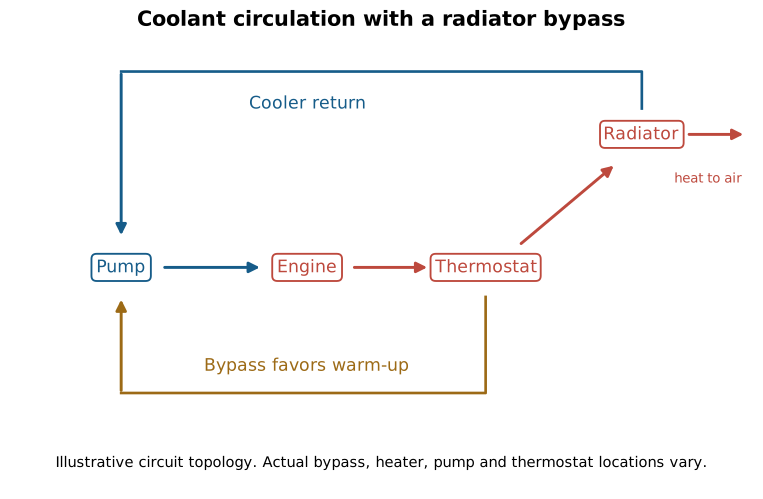
Heat generation and heat rejection must balance
Combustion gas transfers heat into the cylinder head, walls, pistons, and valves. Coolant collects part of that heat in passages around the engine; a pump circulates it to a radiator, whose tubes and fins transfer energy to passing air. A fan supplies airflow when vehicle motion alone is insufficient. Exhaust carries another major share of energy away. The radiator is not responsible for every joule that fails to reach the wheels.
A thermostat restricts the radiator path during warm-up, allowing a bypass path in common arrangements. As temperature rises, it increases radiator flow. This reduces warm-up time and helps regulate temperature; it is not merely a switch that makes cooling “on” or “off.” The exact plumbing differs among engines. The cabin heater is another coolant-to-air heat exchanger, often on a branch of the circuit. HELLA's circuit explanation.
At approximately steady state, a coolant heat balance is
If an illustrative circuit transports 30 kW with 1.0 kg/s coolant flow and assumed cp=3.6 kJ/(kg·K), its temperature rise through the engine is 8.3 K. Double the flow with the same heat input and the rise becomes 4.2 K. That does not prove the engine will run at half the temperature: radiator heat-transfer capability, airflow, thermostat position, ambient temperature, and other resistances still determine the absolute temperature.
This is an application of the first law. During warm-up the engine stores energy, so heat input and rejection need not yet match. At steady temperature, continued combustion requires continued energy output.
Pressure changes the boiling condition
A pressurized cooling system raises coolant's boiling temperature, while the liquid mixture changes freezing, boiling, corrosion, and heat-transfer behavior. Pressure does not itself refrigerate the engine. Its value is allowing a controlled liquid operating range with margin against boiling.
Vapor formation can impair local heat transfer and pump operation. Conversely, keeping an engine unnecessarily cold increases warm-up losses and changes clearances and lubricant behavior. No universal coolant temperature, mixture, or pressure setting follows from these general principles. They are design-specific, and this article is not an instruction to open or alter a hot pressurized system.
Oil supplies a film, not just slipperiness
A typical wet-sump engine draws oil from a sump through a pickup, pumps it through filtration and galleries, distributes it to bearings and other interfaces, and lets much of it drain back under gravity. The exact routing and filter bypass arrangements vary. Oil reduces friction and wear, carries heat and contaminants, and supports functions such as hydraulic valve mechanisms where fitted. MAHLE's oil-management overview.
A plain crankshaft bearing can carry a large load on a hydrodynamic film. The shaft runs slightly eccentric to the bearing, creating a narrowing gap. Rotation drags viscous oil into that wedge; the resulting pressure field supports the load and separates surfaces. Pump supply replenishes and cools the oil, but should not be confused with the much larger local load-supporting film pressure generated by motion. At low speed or during transitions, full-film separation may be incomplete and boundary lubrication matters. MAHLE's bearing-system explanation.
Flow, pressure, and viscosity are related but different
An oil pump supplies flow against the circuit's resistance. Measured gallery pressure depends on viscosity, clearances, speed, restrictions, and regulation. High pressure does not, by itself, demonstrate adequate flow everywhere. Nor does low resistance necessarily mean no useful lubrication: bearing performance depends on the film's geometry, speed, load, and lubricant properties.
Higher viscosity can support separation in some conditions but increases resistance and viscous losses; very viscous cold oil is not simply “extra protection.” Heating usually reduces viscosity, which changes flow and film thickness. A pressure-relief arrangement limits pressure rather than proving that more pressure is always desirable.
Takeaway: Cooling controls where heat goes and the temperature at which the machine works. Lubrication controls how loads cross moving interfaces. Both consume some power to make sustained useful power possible.