Entropy
Entropy is often introduced as “disorder,” but that metaphor fails surprisingly quickly. The more useful statistical idea is multiplicity: how many microscopic arrangements correspond to the same macroscopic state.
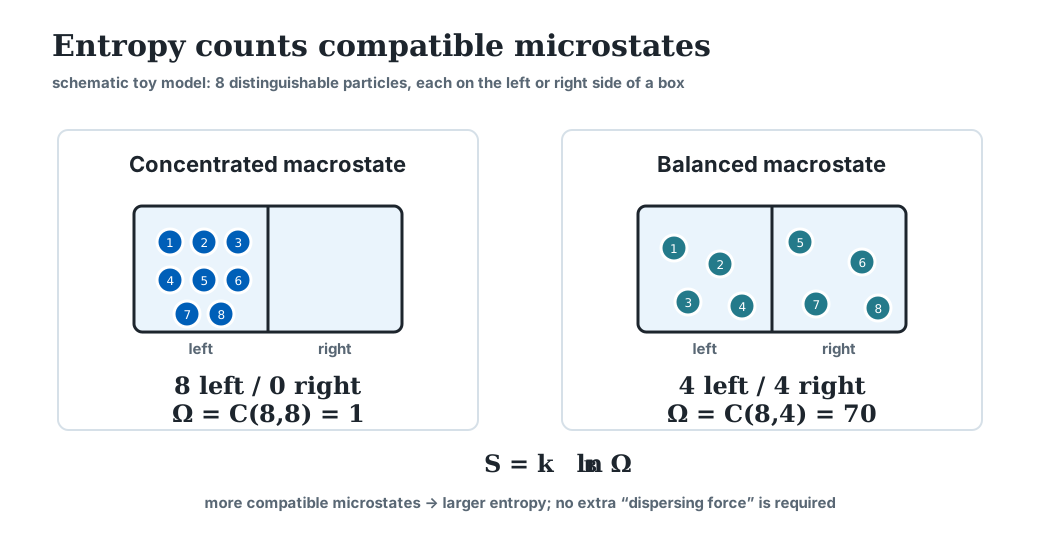
For a macrostate with Ω compatible microstates,
where k(B) is Boltzmann's constant.
Heat flows from hot objects to cold ones not because nature has a taste for mess, but because energy dispersed among many particles has overwhelmingly more compatible microstates than energy concentrated in a small subset. The reverse motion is not mechanically forbidden; for macroscopic systems it is simply fantastically improbable.
Big idea: The second law is statistical. In an isolated macroscopic system, evolution toward higher-entropy macrostates is overwhelmingly likely because there are vastly more microscopic ways to be there.
A local decrease in entropy is perfectly allowed. Refrigerators, organisms, crystals, and planets can become more ordered while increasing the entropy of their surroundings by an even larger amount.
A simple left/right particle model is useful because it makes Ω visible: one concentrated macrostate may have only one compatible arrangement, while a balanced macrostate can be produced by many distinguishable arrangements.