Fat vs Glycogen: Energy Density and Storage Tradeoffs
If biology cared only about storing the most food energy in the least mass, fat would appear to win easily.
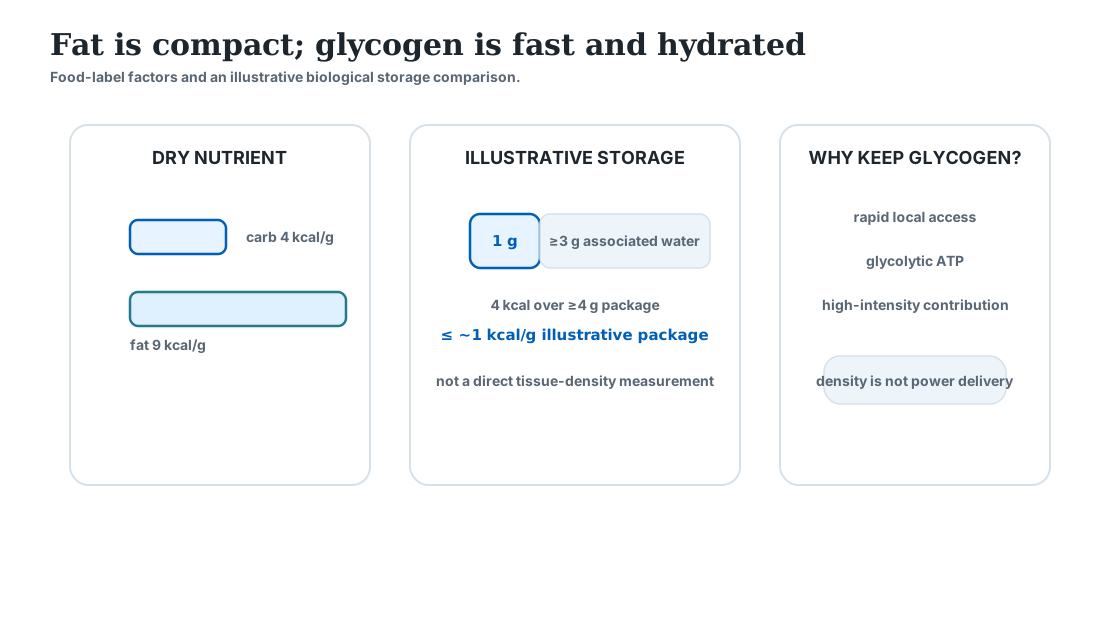
General food-energy factors use approximately:
for fat and:
for carbohydrate.
But biological storage makes the comparison even more dramatic — and also explains why organisms still keep glycogen.
First: what does 9 versus 4 mean?
U.S. food-label rules permit the familiar general factors:
- fat: 9 kcal/g;
- carbohydrate: 4 kcal/g;
- protein: 4 kcal/g.
These are practical metabolizable-energy factors used for food-energy calculation.
They are not statements that every chemically distinct fat molecule contains exactly the same bond energy or that caloric metabolism converts every joule identically.
For scale:
so the label factors correspond roughly to:
for fat, versus:
for carbohydrate.
Per gram of dry nutrient, fat therefore carries a little over twice the metabolizable food energy.
Why fat is chemically energy-dense
Fatty acids are highly reduced molecules.
- They contain many carbon-hydrogen bonds.
- They contain relatively little oxygen compared with carbohydrates.
Oxidizing that reduced carbon toward:
and reducing oxygen toward:
can therefore release substantial free energy.
- Carbohydrates are already more oxidized chemically.
- That is part of the reason their energy yield per gram is lower.
The water penalty changes the biological comparison
The dry-nutrient numbers miss a major storage difference.
- Triglyceride is hydrophobic.
- Adipose cells can therefore store large lipid droplets with relatively little water bound to each gram of triglyceride.
- Glycogen is a highly branched glucose polymer and is stored in a hydrated environment.
In a human exercise-recovery study using muscle biopsies, Fernández-Elías and colleagues concluded that each gram of muscle glycogen was stored with at least about 3 g of water under their measured conditions.
- The exact water association is not a universal fixed constant.
- It varies with physiological context and measurement.
- But it gives a useful scale.
An illustrative wet-package calculation
Suppose:
is associated with at least:
The carbohydrate contributes roughly:
while the combined glycogen-plus-associated-water package weighs at least:
So the carbohydrate portion supplies at most roughly:
of this illustrative wet package.
Do not interpret that as a direct measurement that “muscle glycogen tissue is exactly 1 kcal/g.”
It is a scale comparison showing why hydrated carbohydrate is a bulky storage strategy.
Triglyceride's practical mass advantage over glycogen can therefore be far larger than 9 versus 4 alone.
Why not store everything as fat?
Because organisms need more than a compact battery.
They also need power and accessibility.
Muscle glycogen sits inside muscle fibers, ready to support glucose metabolism without waiting for fatty-acid release from distant adipose tissue.
Glycolysis can generate ATP directly in the cytosol.
At high exercise intensities, carbohydrate contribution rises sharply.
In Romijn and colleagues' tracer study of trained cyclists, moving from low toward high fractions of maximal oxygen uptake increased plasma-glucose uptake and especially muscle-glycogen oxidation.
Fat stores contained vastly more total energy, yet high-intensity muscle increasingly drew on carbohydrate.
This is a classic engineering tradeoff:
energy density is not the same as power-delivery capability.
A large fuel tank is not automatically the best fuel source for every transient load.
Liver and muscle glycogen have different jobs
Another reason glycogen remains useful is location.
Liver glycogen
The liver can use glycogen to help defend blood glucose between meals.
That supports tissues that depend heavily on circulating glucose.
Muscle glycogen
Muscle glycogen is principally a local reserve.
A contracting muscle can draw on its own glycogen rather than treating the entire body as one undifferentiated fuel tank.
The same molecule therefore participates in two distinct physiological strategies depending on where it is stored.
Fat is superb long-duration storage
Adipose triglyceride combines:
- high chemical energy per dry gram;
- low associated water;
- enormous expandable storage capacity relative to glycogen.
That makes it extremely effective for long-duration energy reserve.
During fasting and lower-intensity activity, fatty-acid oxidation can supply a large fraction of whole-body energy needs.
The liver can also turn fat-derived carbon into ketone bodies, allowing some of that reserve to support tissues such as the brain during prolonged fasting.
Carbohydrate and fat are complementary
The durable comparison is therefore not:
FAT = GOOD
CARBS = BAD
or the reverse.
It is:
| Property | Glycogen/carbohydrate | Triglyceride/fat |
|---|---|---|
| Dry food-energy factor | ~4 kcal/g | ~9 kcal/g |
| Associated storage water | substantial | low |
| Compact long-term storage | poor | excellent |
| Rapid local muscle availability | excellent | useful but different mobilization/oxidation constraints |
| Can generate ATP through glycolysis before mitochondrial oxidation | yes | no |
| Major long-duration reserve | limited | yes |
Evolution retained both because they solve different design problems.
Main message: Fat is the compact energy warehouse; glycogen is a hydrated but rapidly accessible carbohydrate reserve. Biology trades storage density against speed, location and metabolic flexibility.