Fermented Drink Families: Beer, Wine, Cider, Mead and Sake
Beer, wine, cider, mead and sake all obtain their ethanol by fermentation.
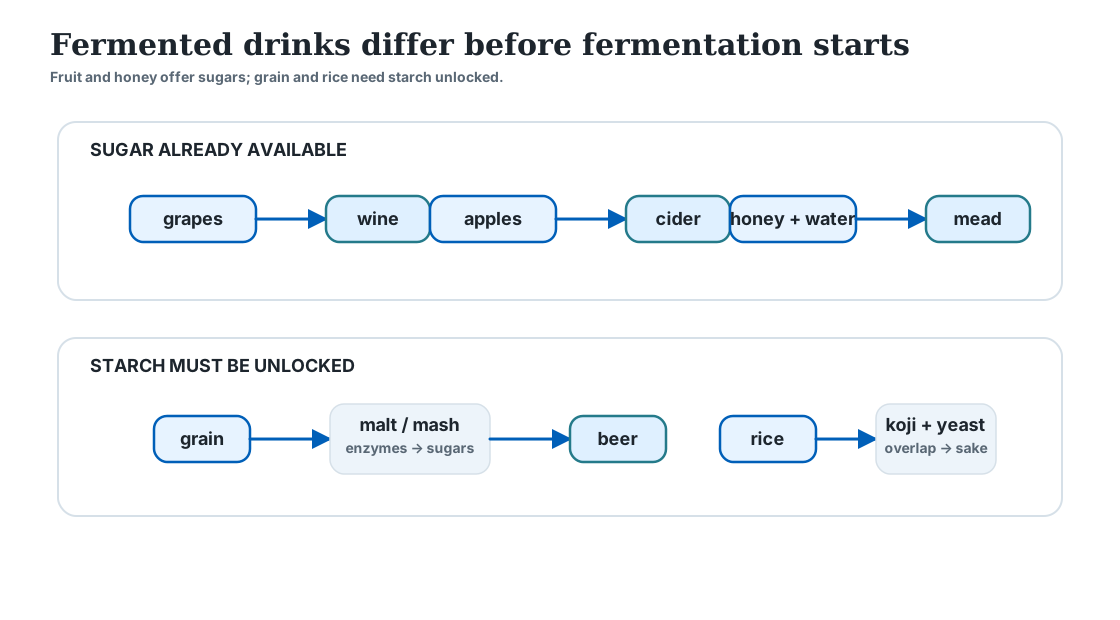
That does not make them minor variations on the same recipe.
Their starting carbohydrates are chemically different, and that changes the technology required before yeast can do its job.
The useful comparison
| Family | Main carbohydrate source | Is fermentable sugar already readily available? | Important extra step |
|---|---|---|---|
| Wine | fruit, especially grapes | largely yes | crush/press and ferment |
| Cider | apple or other pomaceous fruit juice | largely yes | juice extraction and fermentation |
| Mead | honey diluted in water | yes | dilution/nutrient/fermentation management |
| Beer | cereal grain | much is starch | malting/mashing saccharification |
| Sake | rice | much is starch | koji-driven saccharification |
This table is more useful than memorizing beverage colors.
Wine: fermentation begins close to the sugar
Ripe grapes contain fermentable glucose and fructose in their juice.
Crushing grapes therefore releases a sugar-rich medium in which yeast can ferment.
Winemaking can become enormously complex — grape variety, skin contact, oxygen, temperature, microbial ecology, aging and dozens of other choices matter — but the carbohydrate problem is comparatively straightforward:
the fruit has already built the sugar.
This helps explain why evidence for prehistoric grape wine can be detected from residues in ancient storage vessels without requiring evidence for a separate starch-conversion technology.
Cider: the same broad logic with apples
Cider begins with fruit juice rather than grain starch.
Apples provide fermentable sugars along with acids, aroma precursors, tannins and other chemistry that produce a completely different drink from grape wine.
Mechanistically, however, wine and cider share the convenient fact:
the plant has already converted its stored carbon into soluble sugars in the ripe fruit.
Mead: honey supplies sugar but not a complete microbial environment
Honey is extremely rich in sugar.
Dilute it with water and microbes can ferment those sugars.
That makes mead conceptually simple in the family tree:
honey
→ diluted sugar solution
→ fermentation
→ mead
Simple does not mean chemically featureless.
Honey source, yeast, nutrients, acidity, fermentation conditions and aging all affect the result.
The important classification point is that mead does not need a starch-saccharification step.
Beer: starch has to be unlocked
A cereal seed stores much of its carbohydrate as starch.
Yeast cannot efficiently ferment an intact starch reserve directly into ordinary beer.
Brewing therefore includes a biochemical preparation stage.
Traditional malting allows the grain's enzymatic machinery to develop.
Mashing then puts grain and water under conditions where enzymes break large starch molecules toward smaller fermentable sugars.
The resulting sugar-rich liquid is wort.
Then yeast performs alcoholic fermentation.
So beer is better understood as:
grain starch
→ malt/mash enzymes
→ fermentable wort sugars
→ yeast
→ beer
Hops can profoundly influence aroma, bitterness and stability, but hops do not explain where the ethanol comes from.
The grain's starch-derived sugars do.
Sake: rice starch, koji and yeast
Sake solves the starch problem differently.
Koji is made by inoculating steamed rice with a mold from the genus Aspergillus.
The enzymes produced in koji help convert rice starch into fermentable sugars.
Yeast then converts those sugars into ethanol.
An especially interesting feature is that saccharification and fermentation can proceed together in the fermenting mash.
This is often described as multiple parallel fermentation.
The phrase matters because it distinguishes sake from the oversimplified idea:
first make rice sugar, then later ferment it.
The processes overlap.
Why “rice wine” is useful and misleading
Calling sake “rice wine” tells a shopper:
this is a fermented drink rather than a distilled spirit.
That part is helpful.
Mechanistically, however, sake is not simply wine with rice substituted for grapes.
Grape juice already contains abundant fermentable sugar.
Rice provides a starch reserve that must be enzymatically converted.
In that sense, sake shares an important biochemical challenge with brewing even though the final processes and products are very different.
One molecule, many drinks
The ethanol molecule in all these beverages is the same.
The drinks are different because ethanol is surrounded by a different chemical history:
- different source plants;
- different sugar-access mechanisms;
- different microbial communities;
- different processing;
- different trace metabolites.
This is why ABV alone tells you almost nothing about what a fermented drink will taste like.
Main message: The fundamental divide among fermented drinks is often upstream of fermentation: fruit and honey provide accessible sugar, while grain and rice require technology to unlock starch first.