Festival™ Raspberry Cordyline
Festival™ Raspberry Cordyline is a compact, basal-branching cordyline grown mainly for its arching burgundy leaves edged in bright raspberry pink.

Unlike the tall, trunk-forming image many people have of cordylines, Festival selections branch from the base and form a dense fountain-like clump.
Monrovia lists the cultivar as Cordyline banksii × pumilio 'CorBzr01'
and notes ancestry involving C. australis, C. pumilio and C. banksii. Anthony Tesselaar Plants describes the Festival group as compact basal-branching plants rather than small palm-like trees.
A mature plant is roughly 3–3.5 ft tall × about 3 ft wide
rather than a towering cordyline.
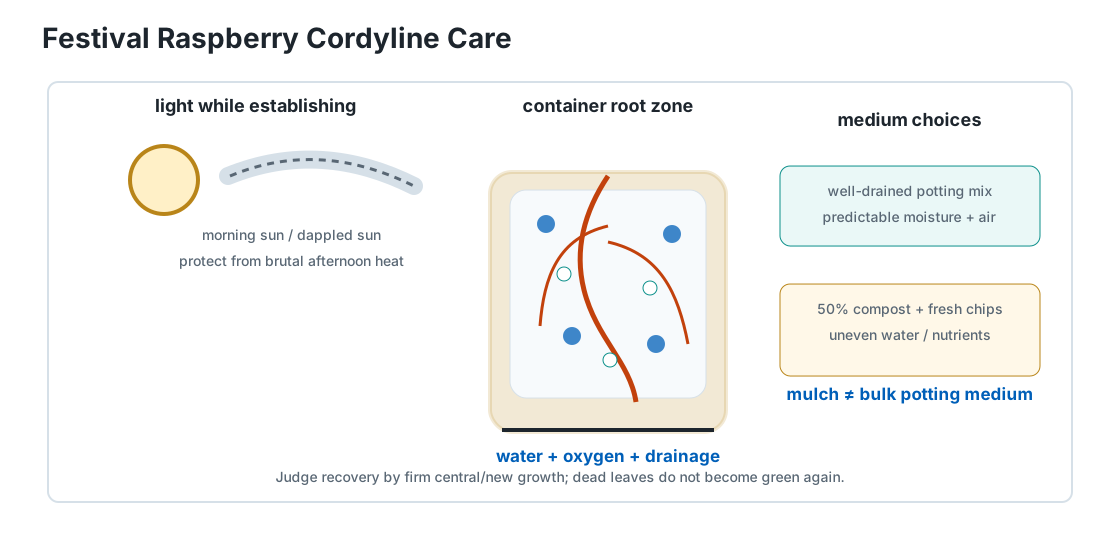
Light
The cultivar is adaptable, but its strongest practical niche is:
- bright shade
- dappled sun
- morning sun
- partial sun
Monrovia specifically describes Festival Raspberry as performing well in shaded areas or dappled sun and tolerating morning sun.
The breeder describes the broader Festival series as tolerating full sun through part shade.
Those claims are not really contradictory. Light tolerance depends strongly on climate.
In a mild coastal climate, more sun may be harmless.
In a hot inland summer, intense afternoon sun can add substantial heat and water stress, especially to a recently planted container specimen.
For a hot Bay Area garden, morning sun plus afternoon protection is a sensible conservative starting position.
Water
The watering requirement changes dramatically between establishment and maturity.
During the first growing season:
- water deeply and regularly
- do not allow a recently transplanted root ball to remain bone dry through prolonged hot weather
- let excess water drain rather than keeping the root zone continuously saturated
Once established:
- water demand drops
- the plant tolerates some drought, especially in mild coastal conditions
Monrovia's simplest practical instruction is:
water when the soil surface is dry.
The breeder similarly recommends thorough watering during hot weather until the plant is established, followed by low-to-moderate water needs.
The useful distinction: dry leaves do not always mean "needs more water"
Brown or collapsing leaves can result from both sides of the water problem.
Too dry / heat stress may produce:
- crispy tips or margins
- limp or folded leaves
- accelerated browning after hot weather
- dry medium through much of the pot
Too wet / poorly aerated roots may produce:
- persistent wetness
- decline despite apparently adequate water
- yellowing or soft collapse
- root/crown problems
The response should therefore be: check the root-zone moisture, rather than automatically: brown leaf → add more water.
Soil and drainage
Both Monrovia and the breeder emphasize well-drained soil.
The breeder says Festival cordylines can tolerate relatively poor soils but perform best in organically rich, well-drained soil.
For a container, the key physical requirements are:
- enough fine material to hold useful moisture
- enough pore space for oxygen
- rapid drainage of excess water
- a medium that does not collapse into a dense anaerobic mass after repeated watering
A commercial container/potting mix is the easiest baseline.
Wood chips: useful mulch, questionable bulk potting medium
Wood chips are excellent surface mulch because they reduce evaporation and slowly contribute organic matter.
They are not normally used as half of a fresh container root medium.
Large uncomposted woody particles can create an inconsistent root zone and their decomposition can temporarily immobilize nitrogen locally.
Container plants are better served by a purpose-designed potting medium whose air-filled porosity and water retention are reasonably predictable.
So a mixture that is roughly 50% compost / 50% fresh wood chips is not the mix I would deliberately choose for this cordyline.
That does not mean an established plant must automatically be ripped out immediately if it is growing well.
But if the plant is struggling, repotting into a well-drained container mix is a more sensible correction than continuing to micromanage watering around an awkward medium.
Compost is not the same thing as potting mix
Finished compost is nutrient-rich organic matter.
A potting mix is engineered primarily as a root environment.
Too much fine compost can remain wet and lose air space; too much coarse fresh wood can make water and nutrient behavior uneven.
The goal is not maximum organic matter.
It is water + oxygen + support + nutrients in a stable balance.
Containers
Festival Raspberry is particularly well suited to containers because of its compact clumping habit.
For a container:
- use a drainage hole
- do not allow the pot to sit permanently in standing water
- choose a pot large enough that the root ball is not baked dry within a few hours
- remember that terracotta/clay pots lose water faster through their walls than plastic or glazed pots
A clay pot can therefore be helpful for avoiding stagnant wetness, but it also dries faster during heat.
Heat and newly planted specimens
A newly planted plant is not physiologically equivalent to an established one.
Its root system has not yet colonized the whole container or surrounding soil.
During a hot spell, its leaves can lose water faster than the limited root system replaces it.
That makes the first weeks disproportionately vulnerable.
If a recently transplanted Festival Raspberry develops brown leaves after several very hot days and a drying interval, transplant/heat/water stress is a very plausible explanation.
Dead leaves do not recover.
The useful question is whether the central/new growth remains firm and healthy.
Feeding
Festival cordylines are not described as heavy feeders.
The breeder recommends a controlled-release fertilizer in spring.
In a fresh enriched potting mix, aggressive fertilization is unnecessary.
If a lot of fresh woody material is incorporated into the medium, nutrient behavior becomes less predictable — another reason not to use fresh wood chips as half the container mix.
Frost
Monrovia lists Festival Raspberry for USDA zones 8–11 and reports that it can survive moderate frost but may go dormant around 15 °F / −9 °C.
The San Francisco Bay Area is generally far more threatened by summer heat/drying and occasional local frost than by prolonged severe freezes.
Habit and seasonal behavior
Festival cordylines are evergreen in suitable climates.
Typical form:
- basal branching
- arching strap-like foliage
- compact clump
- roughly 1 m / 3 ft scale
Late spring to early summer can produce pale pink/white, fragrant flowers.
Practical recovery checklist for a stressed plant
If leaves suddenly brown after planting:
- Check the growing medium several inches down.
- Dry throughout → water thoroughly.
- Persistently saturated → improve drainage / reduce watering.
- Protect it from brutal afternoon sun while establishing.
- Do not remove healthy burgundy/raspberry leaves just because neighboring leaves look bad.
- Remove fully dead leaves cleanly once they are clearly dead.
- Judge recovery by new growth, not by whether damaged leaves become pretty again.
- If the medium is mostly compost plus fresh coarse wood chips and the plant continues to decline, repot into a proper well-drained container mix.
- Do not compensate for a structural soil problem with ever-more fertilizer or ever-more water.
Main message: Festival Raspberry is not especially fussy once established. The vulnerable period is establishment: give it a well-aerated, well-drained root zone, reliable water during heat, and protection from excessive stress until the roots spread.