Feynman-Style Explanation
The useful habit associated with Richard Feynman is simple: try to reconstruct an idea in plain language rather than hiding behind familiar words. When the explanation breaks, becomes circular, or depends on unexplained jargon, you have found a gap in your understanding.
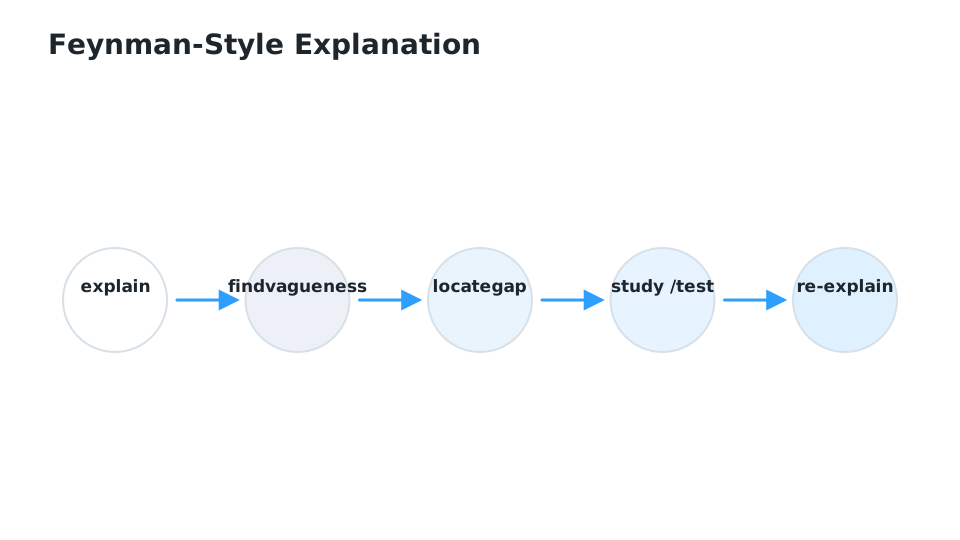
A practical loop is:
- choose the concept;
- explain it from memory as if to an intelligent beginner;
- mark exactly where you become vague or rely on a label;
- return to the source and repair the gap;
- explain it again more clearly, adding an example or analogy if it genuinely maps to the mechanism.
Big idea: Difficulty explaining is diagnostic data. The goal is not to make everything childishly simple; it is to discover whether you understand what the technical language is compressing.
A useful correction: the tidy four-step “Feynman Technique” circulating online was not a formal learning protocol published and named by Feynman himself. It is a later popularization inspired by his well-documented emphasis on rebuilding understanding, calculation, and plain explanation.
Also, fluent explanation can still be wrong. Retrieval, practice problems, prediction, experiments, and feedback are needed to test whether the explanation actually works.