Fuel by Tissue: Brain, Muscle, Heart, Liver and Red Blood Cells
The bloodstream can contain glucose, fatty acids, lactate, amino acids and ketone bodies at the same time.
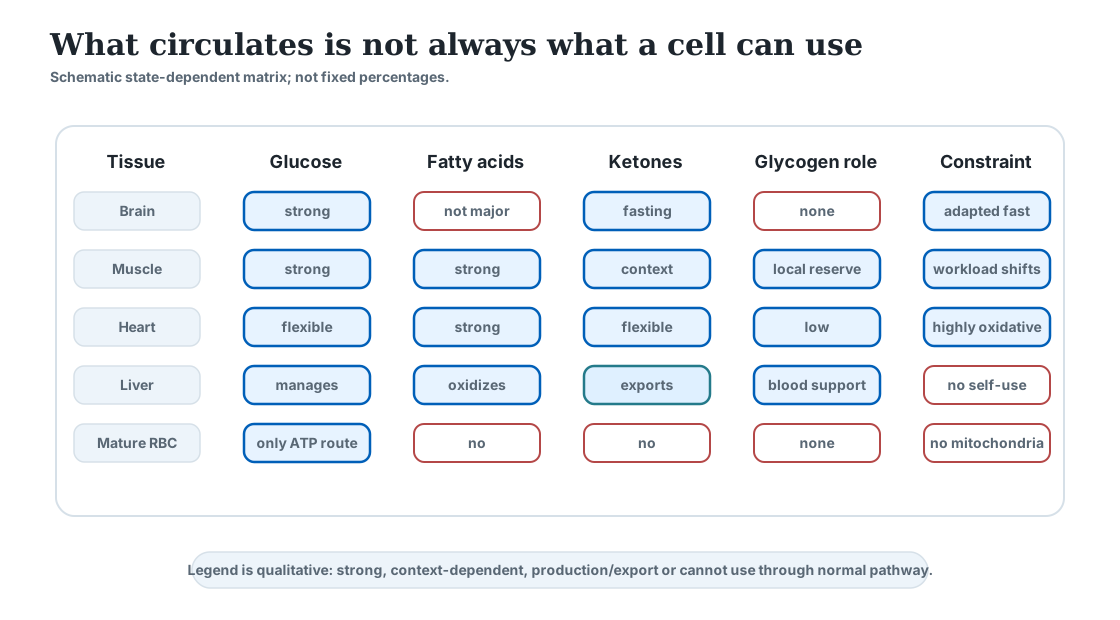
That does not mean every cell can use every fuel.
Fuel choice depends on cellular machinery.
A tissue's:
- enzymes;
- transporters;
- mitochondria;
- hormonal environment;
- local workload
can be as important as what is circulating in blood.
A useful overview
| Tissue | Representative fuel behavior |
|---|---|
| Brain | heavily glucose-dependent when fed; can shift strongly toward ketone bodies during prolonged fasting |
| Skeletal muscle | flexible mixture of carbohydrate and fat; carbohydrate contribution rises with high-intensity work |
| Heart | highly oxidative and metabolically flexible; consumes fatty acids prominently and can use ketones, lactate, acetate and other substrates |
| Liver | stores/releases glucose, oxidizes fatty acids, makes ketones; does not consume the ketones it makes through the normal SCOT pathway |
| Mature red blood cells | no mitochondria; ATP comes from glycolysis |
The table is a map of tendencies and capabilities, not a declaration that each tissue has one permanent preferred fuel.
Brain: glucose usually, ketones when fasting becomes prolonged
The brain has high continuous energy demand.
In the ordinary fed state, glucose is its dominant circulating fuel.
Long-chain fatty acids do not simply replace glucose across the blood-brain barrier as a general solution.
During prolonged fasting, however, the liver produces large quantities of ketone bodies.
The brain adapts by greatly increasing ketone uptake and oxidation.
The classic quantitative anchor comes from Owen and colleagues in 1967.
They catheterized cerebral vessels in three obese subjects after 5–6 weeks of starvation.
At that point:
- β-hydroxybutyrate;
- acetoacetate
had replaced glucose as the predominant measured fuels for brain metabolism.
Do not translate this into:
the fasting brain uses zero glucose.
It does not.
The striking result is that the brain can move a large fraction of its metabolism onto fat-derived ketone bodies, reducing how much glucose the body must manufacture during prolonged food deprivation.
Skeletal muscle: the mixture follows workload
Skeletal muscle is metabolically flexible.
At rest and during lower-intensity activity, fatty acids can contribute substantially to oxidation.
As intensity rises, carbohydrate — especially muscle glycogen — becomes increasingly important.
Romijn and colleagues studied trained cyclists at roughly 25%, 65% and 85% of maximal oxygen uptake.
At higher intensity:
- plasma-glucose uptake increased;
- muscle-glycogen oxidation increased greatly.
The body's enormous fat reserve did not prevent the contracting muscle from becoming more carbohydrate-dependent as power demand increased.
This distinction is worth keeping:
energy capacity and rate of ATP delivery are different engineering problems.
Muscle can also oxidize ketone bodies under suitable conditions, but fasting studies show ketones do not simply become the dominant exercise fuel merely because blood ketones are high.
Heart: a highly oxidative omnivore
The heart cannot take a metabolic holiday.
It contracts continuously and has dense mitochondrial machinery.
A large 2020 human study measured arterial and coronary-sinus metabolites in more than one hundred people.
In nonfailing human hearts, the investigators found prominent fatty-acid consumption and surprisingly little glucose uptake in their measured setting.
The heart also consumed:
- ketones;
- lactate;
- acetate;
- glutamate
with several substrates tracking circulating availability.
The lesson is not:
the heart burns only fat.
It is almost the opposite.
The human heart is an extremely oxidative, fuel-flexible organ whose substrate mix changes with supply and physiological/pathological state.
Liver: the fuel traffic controller
The liver's role is unusual because it often manages fuel for other tissues.
It can:
- store glucose as glycogen;
- release glucose from glycogen;
- perform gluconeogenesis;
- take up and oxidize fatty acids;
- make ketone bodies during fasting.
The ketone paradox
During fasting, liver mitochondria convert fat-derived acetyl-CoA into ketone bodies and export them.
But the liver lacks the normal SCOT/thiophorase step used by extrahepatic tissues to activate acetoacetate for oxidation.
So:
the liver makes ketones for everybody else and cannot eat its own product through the standard pathway.
That is an excellent example of metabolic division of labor.
Mature red blood cells: the oxygen carrier that cannot use oxygen for oxidative phosphorylation
Mature mammalian red blood cells lose their nuclei and mitochondria during development.
No mitochondria means no:
- citric-acid cycle as a mitochondrial ATP pathway;
- electron-transport chain;
- oxidative phosphorylation.
Their ATP therefore comes from glycolysis.
This creates one of the best physiological paradoxes in the topic:
A mature red blood cell transports oxygen around the body but cannot use that oxygen for its own mitochondrial ATP production.
Recent human red-cell metabolic work still treats glycolysis as the cell's exclusive ATP-generating route.
This is why maintaining blood glucose remains essential even during profound ketosis.
Some cells simply cannot solve their ATP problem by switching to fat or ketone oxidation.
“Available” is not the same as “usable”
Suppose blood contains:
- glucose;
- fatty acids;
- ketones.
A tissue still needs:
- a way to transport or otherwise receive the fuel;
- the enzymes needed to process it;
- the appropriate organelles;
- a metabolic state that permits the pathway to operate.
That is why whole-body fuel charts can be misleading.
The body is not one giant cell.
It is an ecosystem of specialized tissues exchanging substrates.
Main message: Metabolic flexibility belongs to tissues, not just to the bloodstream. What a cell can burn depends on its hardware.