Go: Territory, Influence, and 2,500+ Years of Continuity
Go is one of the oldest continuously played strategy games.
Its exact origin is unknown, but it developed in ancient China and is documented in Chinese texts more than two millennia ago. The International Go Federation describes a tradition extending more than 3,000 years, while more cautious modern histories emphasize that the precise origin date is uncertain.
The game is known as:
- weiqi in Chinese
- baduk in Korean
- igo / go in Japanese
The rules are startlingly small
Two players alternate placing black and white stones on intersections of a grid, normally:
19 × 19Stones do not move after placement.
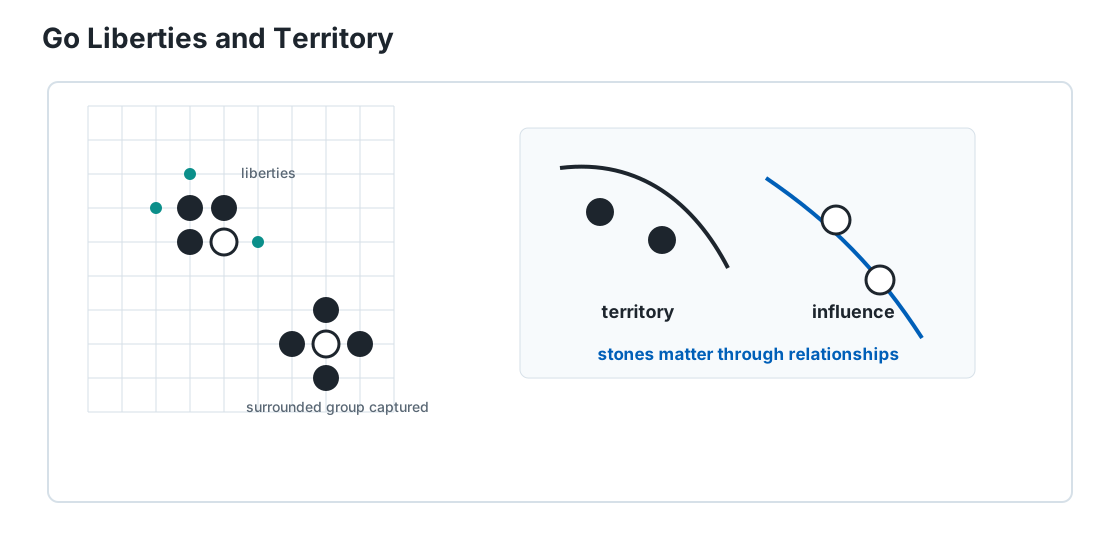
Connected stones share liberties — adjacent empty intersections.
A group with no liberties is captured.
The broader objective is to finish with more controlled territory/area under the applicable scoring rules.
From this emerge:
- local fights
- sacrifice
- life and death
- influence
- territory
- invasion
- reduction
- whole-board balance
Local certainty versus global judgment
A chess piece has a defined movement power.
A Go stone has almost no meaning in isolation.
Its value depends on relationships across the board.
A move can be:
- locally inefficient but globally urgent
- territorially small but strategically powerful
- sacrificial now but useful later
This is one reason Go is such a good example of emergent strategic complexity.
Capturing is not the objective
Beginners often focus on taking stones.
But a player can win while making few captures.
Captures matter because they affect:
- survival
- territory
- initiative
- shape
- influence
The game is fundamentally about controlling enough of the board efficiently.
Historical spread
Go originated in China and spread through East Asia.
It became deeply established in Korea and Japan.
In early modern Japan, official Go schools received Tokugawa patronage and helped formalize elite professional competition and ranking.
Modern professional organizations arose in the 20th century in Japan, China and Korea.
The board changed
Historical forms were not identical to modern Go.
Older Chinese play included different opening conventions, and early boards are associated with smaller grid sizes before 19×19 became standard.
This matters because "Go has been unchanged for 4,000 years" is too strong.
The strategic identity is ancient; every rule convention is not.
Go and AI
Go became a landmark in AI because brute-force search is difficult: the branching factor is enormous and evaluating an intermediate position is subtle.
AlphaGo's 2016 defeat of Lee Sedol became historically important not because computers had never played games well, but because Go had resisted earlier game-playing methods far longer than chess.
Modern Go professionals now use AI analysis extensively.
That is an unusual historical loop:
human game
→ centuries of human theory
→ AI learns superhuman play
→ human theory changes in response
Big idea: Go combines extremely small rules with enormous emergent complexity. Its continuity lies less in frozen rules than in a remarkably durable strategic core.