Gödel, Escher, Bach
The book in one sentence
Douglas Hofstadter's Gödel, Escher, Bach: An Eternal Golden Braid (1979) uses logic, music, visual art, formal systems, recursion, and playful dialogues to ask how meaning and a sense of self can emerge from rule-governed components that do not individually contain that meaning.
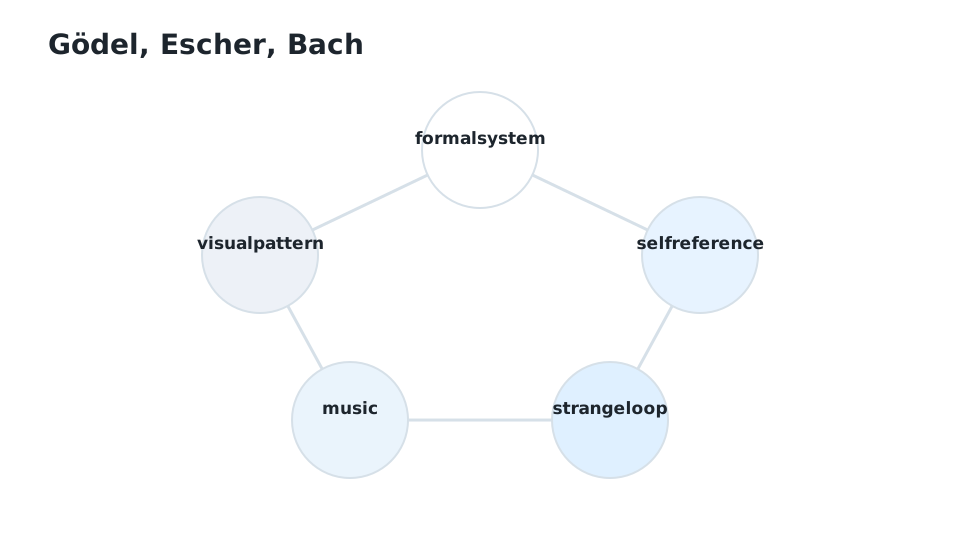
Main ideas
- Formal systems: symbols can be manipulated by explicit rules without the rules themselves understanding what the symbols mean.
- Levels and emergence: meaningful patterns can exist at a higher descriptive level even when lower-level components follow comparatively mechanical rules.
- Self-reference / strange loops: sufficiently rich systems can indirectly turn back on themselves; Hofstadter sees this recursive self-modeling as central to mind and selfhood.
- Gödel's incompleteness theorem: a sufficiently expressive, consistent formal arithmetic system cannot prove every arithmetic truth expressible within it. Gödel achieves the result through encoding that lets arithmetic make statements about arithmetic.
- Escher and Bach: self-reference, recursion, canon, fugue, figure/ground, and impossible structures are not decoration; they are analogies embodied in other media.
Structure map
The book alternates substantial chapters with Achilles-and-the-Tortoise dialogues whose form often demonstrates the chapter's idea. Rather than memorizing all 20 chapters, remember the progression:
- formal systems, proof, and meaning;
- recursion, self-reference, and Gödel numbering;
- minds, symbols, levels, and representation;
- strange loops and the possibility that a self emerges from circular higher-level patterns.
Worth remembering
Gödel's theorem is a precise theorem about formal systems. It does not by itself prove that human minds are magical, non-computational, or beyond machines. Hofstadter uses Gödelian self-reference as inspiration for a broader theory of minds; that broader philosophical move is not the theorem itself.