Guns, Germs, and Steel
The book in one sentence
Jared Diamond's Guns, Germs, and Steel (1997) asks why Eurasian societies came to dominate much of the modern world and argues that the deep causes lie primarily in geography, ecology, domesticable species, food production, disease exposure, and diffusion — not innate racial differences.
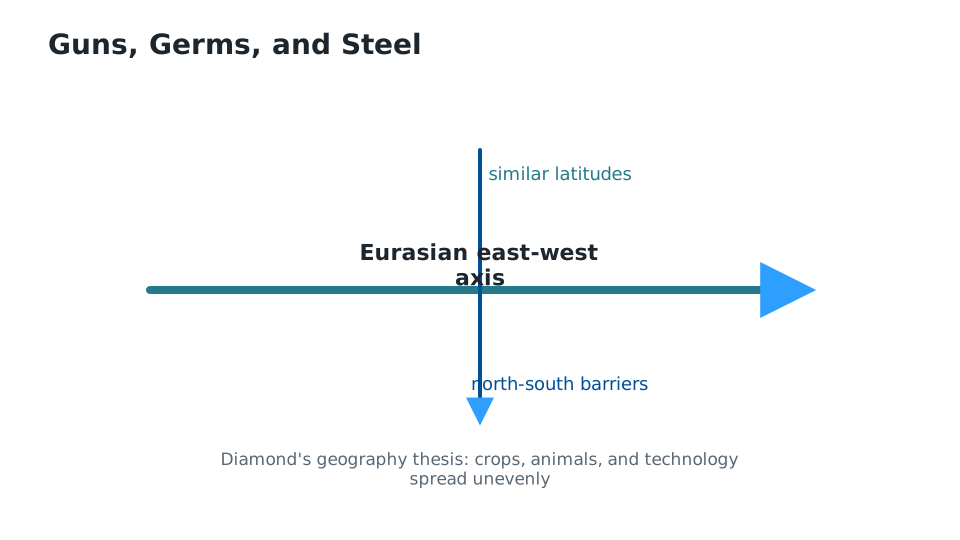
Main thesis
Diamond's causal chain is roughly:
geographic/environmental starting conditions → agriculture and animal domestication → denser populations + specialization + states/technology + epidemic diseases → uneven conquest power.
He emphasizes Eurasia's large east–west landmass, arguing that similar latitudes/climates made crops, animals, and technologies easier to spread than on continents with strong north–south ecological barriers.
Structure map
- begins with the historical inequality question (“Yali's question”);
- traces domestication and the origins/spread of food production;
- links food surpluses to germs, writing, political organization, and technology;
- applies the framework to continental/regional case studies and European expansion.
Worth remembering
The book's major virtue is forcing the explanation away from racial biology and toward long-run material conditions. Its major weakness is the same scale: historians and anthropologists have criticized the account as overly deterministic/reductionist, underweighting contingency, institutions, culture, human agency, and the messy regional evidence required to connect geography to specific historical outcomes.
Takeaway: Diamond proposed a powerful large-scale environmental explanation for historical inequality; the book is influential and memorable, but geography should not be treated as a complete or sufficient explanation of history.