History of Games: How Rule Systems Evolve
Games are unusually durable cultural objects.
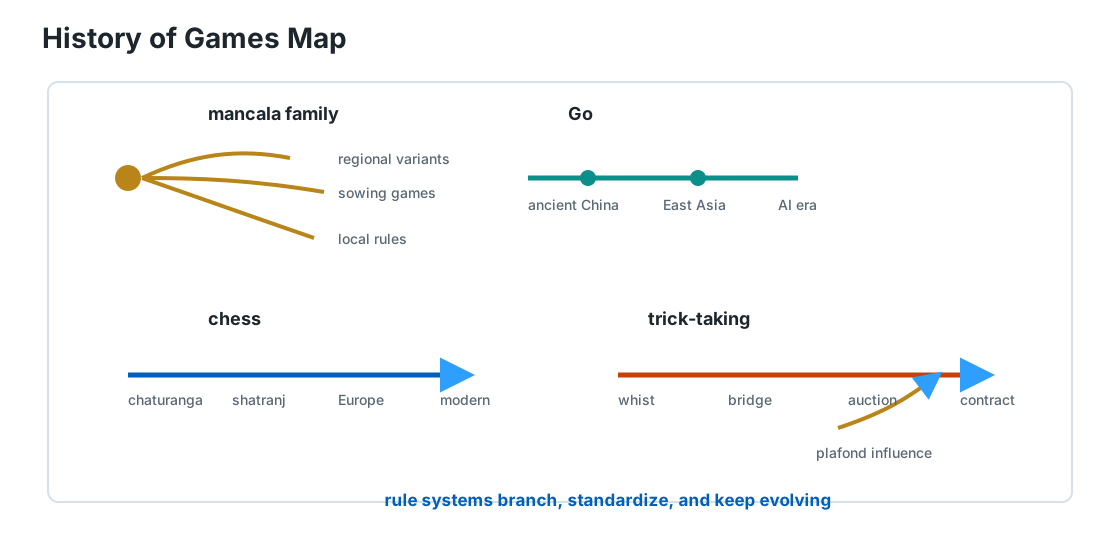
A palace, language, religion, empire, or technology can change beyond recognition while a game remains recognizable across centuries.
But games do not survive by remaining frozen. They survive by evolving while preserving a strategic core.
A game has several layers
It helps to separate:
- equipment — board, cards, stones, pieces
- rules — what moves are legal
- objective — what counts as winning
- information structure — what each player can see
- randomness — dice, shuffled cards, hidden deals
- strategy — the patterns strong players discover
- institutions — clubs, tournaments, rankings, written laws
These layers can change at different speeds.
Chess changed piece movement dramatically in late medieval Europe while preserving the idea of opposing armies and a threatened king.
Bridge inherited trick-taking from whist but transformed the pre-play auction and scoring so radically that bidding became a major game within the game.
Go's basic board and placement rules are strikingly stable, while professional institutions and opening theory changed enormously.
Mancala is not one game at all but a family of sowing games spread across Africa, Asia and elsewhere.
Games branch rather than march in a straight line
Historical diagrams often imply:
old game → new game → modern gameReal histories are messier.
Variants coexist. Rules travel across borders. Some innovations disappear. Others get standardized by influential communities.
The history of a game is therefore closer to biological evolution:
common ancestor
↙ variant A
↘ variant B
    ↘ standardized descendant
The analogy should not be pushed too far — people deliberately design rules — but branching inheritance is a useful mental model.
Standardization changes the game
Once rules are written down and competition becomes organized, small ambiguities matter.
Institutions can stabilize:
- legal moves
- scoring
- equipment dimensions
- clocks/time controls
- tournament conduct
- rankings
This does not end evolution. It changes where evolution happens.
Modern chess rules are stable, but opening theory changes.
Contract bridge laws are stable, but bidding systems continue to evolve.
Go's board is stable, but AI has changed elite strategic understanding.
Strategic depth can emerge from simple rules
Go is the most obvious example: a small number of placement and capture rules generates an immense strategic space.
Mancala games can use almost trivial equipment — pits and counters — yet produce difficult counting, timing and positional problems.
The lesson is broader:
complexity need not be written into the rules; it can emerge from interaction among simple rules.
Why these games survived
No single explanation fits all of them, but durable games tend to combine:
- easy-to-learn core rules
- repeated play with different outcomes
- visible skill improvement
- social transmission
- status or institutional support
- strategic depth beyond beginner play
Main message: The history of a game is the history of a rule system moving through cultures. What survives is usually not every detail, but a strategic identity strong enough to tolerate change.