Why HTT Beats TTH Head-to-Head
There are two different questions that are easy to accidentally mix up:
- How long do you wait for HTT by itself?
- If you race HTT vs TTH, which pattern appears first?
Individually, they are symmetric in an important sense: neither pattern has a proper prefix that is also a suffix, so each has expected waiting time
So HTT and TTH do not differ in their individual expected waiting times.
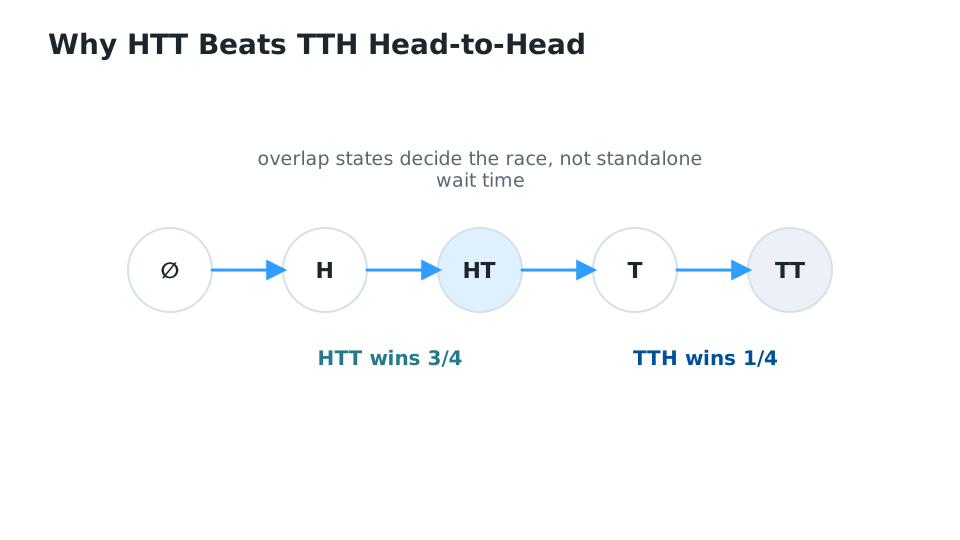
But in a direct race, HTT appears before TTH with probability 3/4.
The reason is overlapping partial progress. Once an H has appeared in the right state, the sequences of future flips that build toward HTT interact differently with the partial matches for TTH. The race is a small finite-state Markov process, not two independent eight-flip timers.
A particularly clean way to see it is to track the longest current suffix that is a prefix of either pattern. Solving the resulting states gives:
Big idea: Equal standalone waiting times do not imply equal head-to-head chances. Pattern races depend on how prefixes and suffixes overlap with each other.
This is the same family of phenomenon behind Penney's game, where a carefully chosen length-3 pattern can beat another pattern despite every specific three-flip string having probability 1/8 on any fixed block.