Hypertension: How High Pressure Causes Damage
Hypertension is not dangerous because an artery simply "cannot tolerate a big number."
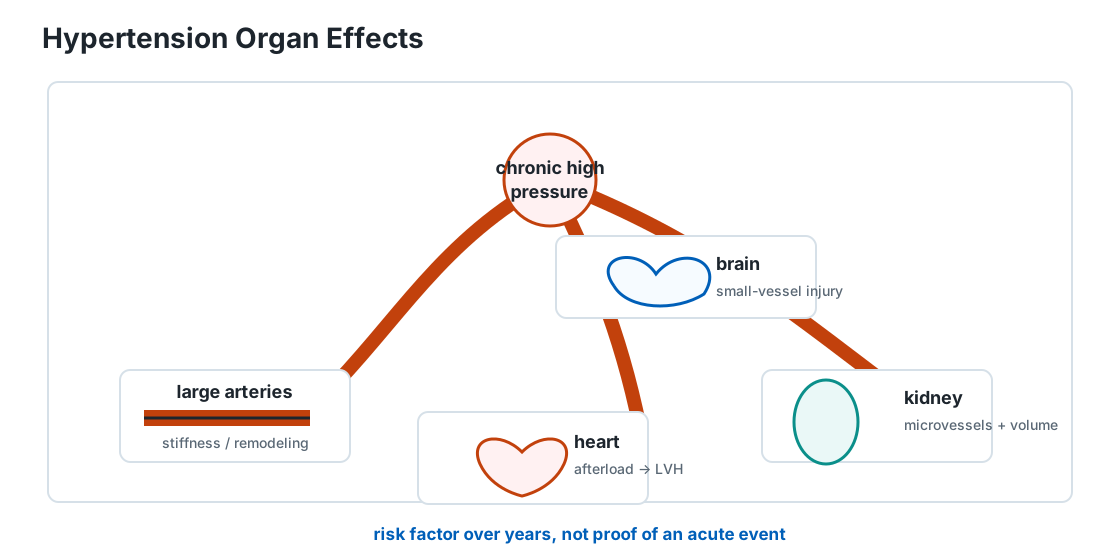
The important problem is chronic mechanical and biological stress across years.
Persistently elevated arterial pressure changes the heart, large arteries, small arteries, kidneys and brain.
The vessel wall feels stress
For a cylindrical vessel, Laplace-type reasoning gives a useful qualitative relationship:
Higher internal pressure increases the mechanical load borne by the vessel wall.
Real arteries are layered, elastic, active biological tissues rather than thin passive cylinders, but the direction of the effect is useful: higher pressure means more mechanical stress.
Arteries adapt — and the adaptation has costs
Small arteries exposed to persistent hypertension can remodel and thicken.
- That may initially help normalize wall stress, but thicker/narrower vessels can increase resistance and impair tissue perfusion.
- Large arteries can become stiffer, increasing pulse pressure and imposing a larger pulsatile load on organs.
Hypertension and arterial stiffness can reinforce one another.
The heart must pump against a larger load
The left ventricle ejects blood into the systemic arterial system.
Chronic high pressure raises afterload — the load the ventricle must overcome to eject blood.
The ventricular wall can hypertrophy.
At first this is an adaptation. Over time, a thickened ventricle can become stiff, fill poorly, demand more oxygen and contribute to heart failure.
The kidneys are both regulator and target
The kidneys regulate blood volume and sodium balance, making them central to long-term blood-pressure control.
But high pressure can also damage renal microvasculature.
Kidney disease can therefore cause or worsen hypertension, while hypertension can cause or worsen kidney disease — a feedback loop rather than a simple one-way relationship.
The brain's small vessels matter
- Chronic hypertension damages small cerebral vessels and is a major risk factor for both ischemic and hemorrhagic stroke.
- It is also associated with cerebral small-vessel disease and cognitive decline.
- The 2025 ACC/AHA guideline explicitly emphasizes blood-pressure treatment as part of protecting long-term brain health.
Why hypertension often feels like nothing
- Most chronic hypertension causes no reliable symptom.
- That is why symptoms are a poor screening tool.
- A person can feel completely normal while years of elevated pressure increase vascular risk.
- Conversely, headache or anxiety does not prove hypertension caused the symptom.
Risk is not destiny
Hypertension is a modifiable risk factor.
The 2025 guideline continues to classify ≥130/80 mm Hg as hypertension and generally targets <130/80 mm Hg in adults with hypertension, with medication decisions tailored to blood-pressure level, cardiovascular risk and comorbidities.
For stage 2 hypertension (≥140 systolic or ≥90 diastolic), current guidance generally recommends lifestyle intervention plus pharmacologic treatment; combination therapy is often used.
The biological point is more important than memorizing the drug algorithm:
lower chronic pressure reduces mechanical and vascular stress.
Stress and blood pressure
Acute psychological stress can temporarily raise heart rate, vascular tone and blood pressure through sympathetic activation.
But "stress caused my hypertension" is often too simple.
Long-term blood pressure emerges from genetics, kidneys, vascular biology, body composition, sleep, sodium intake, alcohol, medications, activity, autonomic tone and other influences.
Stress can matter without being the whole explanation.
Main message: Hypertension is dangerous mainly as a chronic exposure. It changes vessel walls and increases the workload on organs over years; it is a risk factor that can be measured and modified, not evidence that an acute catastrophe is happening right now.