Kinematics: Position, Velocity, and Acceleration
Kinematics describes motion without yet asking what causes it.
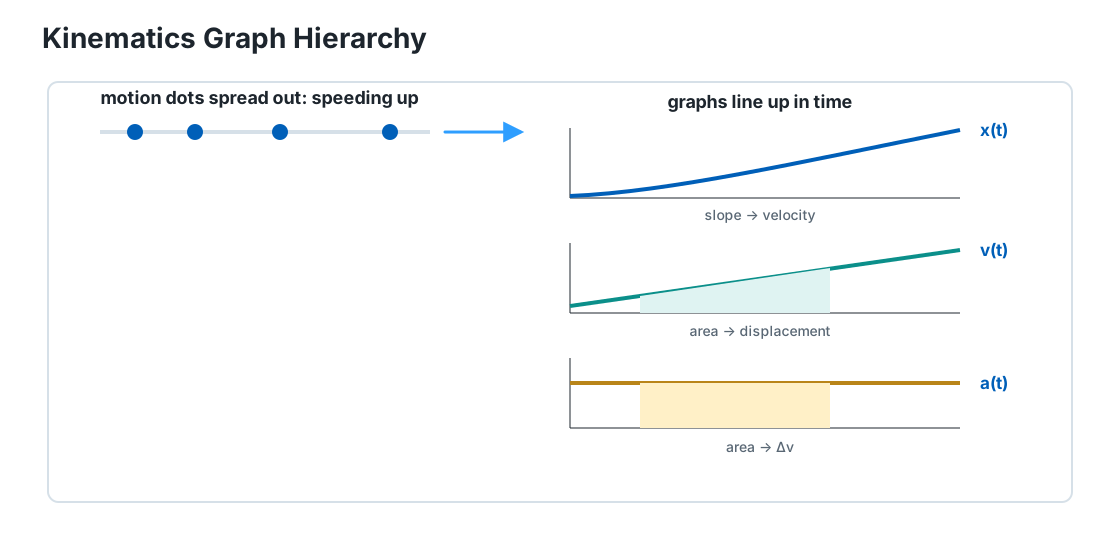
Three quantities form the core:
- position x: where an object is
- velocity v: how fast position is changing, including direction
- acceleration a: how fast velocity is changing
In one dimension:
for an average over a finite interval, while the instantaneous version is
Likewise,
on average, and
instantaneously.
The graph hierarchy
Kinematics becomes much clearer when graphs are read geometrically.
On a position-versus-time graph:
- slope = velocity
On a velocity-versus-time graph:
- slope = acceleration
- signed area = displacement
On an acceleration-versus-time graph:
- signed area = change in velocity
That relationship is more general than any memorized constant-acceleration formula.
Constant acceleration
If acceleration is constant:
where:
- x₀ = initial position
- v₀ = initial velocity
- a = constant acceleration
- t = elapsed time
These equations are convenient, but their constant-acceleration assumption matters.
A car accelerating hard from rest does not generally maintain the same acceleration all the way to highway speed. Air drag makes a falling object's acceleration depart from g as speed increases. The equations above stop being exact when a varies significantly.
Velocity and acceleration need not point the same way
A ball thrown upward has upward velocity while gravity gives it downward acceleration.
At the very top:
for an instant, but
near Earth's surface.
Zero velocity therefore does not imply zero acceleration.
Two dimensions: treat vectors as vectors
Projectile motion can be decomposed into components.
Ignoring air resistance near Earth's surface:
Horizontal and vertical motions share the same time coordinate but otherwise follow their own component equations.
This is why a horizontally fired projectile and a dropped object released from the same height hit the ground at the same time, assuming the ground is level and air resistance is negligible.
Physics C bridge
Calculus removes the need for constant acceleration.
Given acceleration as a function of time:
and then:
Differentiation goes the other way:
The familiar kinematic equations are what these integrals produce when a is constant.
Takeaway: Position, velocity and acceleration are not three formulas. They are a derivative/integral hierarchy describing how motion changes.
Quantitative anchor
At 9.8 m/s², an object in ideal free fall changes its downward velocity by about 9.8 m/s every second — roughly 22 mph of speed change per second.
Misconceptions
- Negative velocity does not mean slowing down.
- Negative acceleration does not automatically mean slowing down.
- A flat position graph means zero velocity, not zero position.
- A turning point can have v=0 while a≠0.