Cousins and “Removed”: The Rule That Actually Works
Kinship terminology becomes much easier if you stop memorizing phrases such as "second cousin once removed."
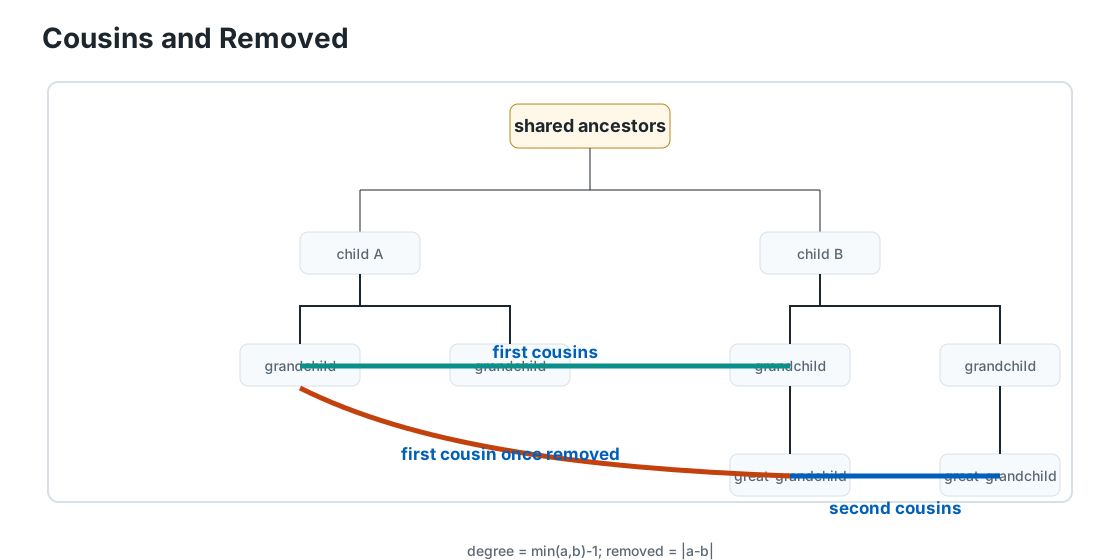
There is a simple rule.
For two people:
- find their nearest shared ancestor
- count how many generations each person is below that ancestor
- the smaller count determines the cousin number
- the difference between the counts gives the number of removals
More precisely, if the two generation counts are a and b:
cousin degree = min(a,b) - 1
removed = |a-b|
This formula assumes both people descend from the shared ancestor through different child lines; direct ancestor/descendant relationships use different terms.
First cousins
Two people share grandparents.
Each is two generations below the shared grandparents:
grandparent
↓
parent
↓
you
So:
a = 2
b = 2
Therefore:
min(2,2)-1 = 1They are first cousins.
Second cousins
Two people share great-grandparents.
Each is three generations below:
3 and 3Therefore:
3-1 = 2They are second cousins.
First cousin once removed
Suppose your grandparent is another person's great-grandparent.
You are two generations below the shared ancestor.
The other person is three generations below.
2 and 3Cousin degree:
2-1 = 1Removal:
3-2 = 1So the relationship is:
first cousin once removed.
Your cousin's child
Your first cousin's child is your first cousin once removed.
Your child and that person's child are second cousins to each other because they occupy the same generation relative to the shared great-grandparents.
This is the part people often mix up.
"Removed" means generation offset
"Removed" does not mean distant.
It tells you that the two people occupy different generation levels relative to their shared ancestor.
- Once removed = one-generation offset.
- Twice removed = two-generation offset.
Why "third cousin" can be more distant than "first cousin twice removed"
The two numbers measure different things.
- Cousin degree measures how far back the shared ancestral branch point lies.
- Removal measures generational mismatch.
So there is no single linear ladder:
first cousin
second cousin
third cousin
first cousin once removed
...
They describe a two-dimensional structure.
Takeaway: Cousin number is about the shared ancestor; "removed" is about generation difference.