Linear Momentum, Impulse, and Collisions
Momentum becomes especially powerful when forces are large, complicated, and short-lived — collisions, explosions, catches, impacts.
Linear momentum is:
It is a vector.
Impulse changes momentum
Newton's second law can be written:
Integrating over time:
For an approximately constant force:
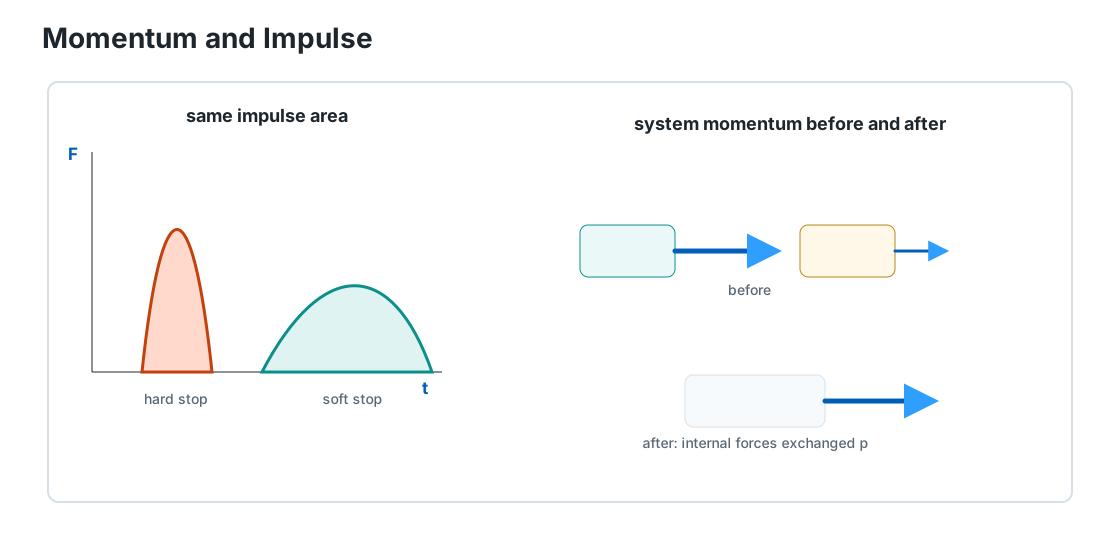
The area under a force-versus-time graph is therefore impulse.
Why airbags and crumple zones help
To stop a person, their momentum must change.
For the same Δp:
Increasing the stopping time reduces the average force.
That is the mechanical idea behind airbags, padding and vehicle crumple zones. They do not eliminate the required momentum change; they spread it over more time and often more distance.
Conservation of momentum
For a chosen system:
If external impulse is negligible:
Internal collision forces can be enormous and momentum can still be conserved, because the internal interaction forces exchange momentum within the system.
Collision types
Elastic collision
- momentum conserved
- kinetic energy conserved
Inelastic collision
- momentum conserved for an isolated system
- kinetic energy is not conserved as kinetic energy
Perfectly inelastic collision
- objects stick together afterward
Kinetic energy that disappears from the translational bookkeeping may become deformation, sound, thermal energy, vibration, rotation, or other internal energy.
Center of mass
For particles:
The center of mass of a system responds to net external force as though the total mass were concentrated there for translational motion:
This is why an exploding firework's fragments can fly in many directions while the system's center of mass continues along the trajectory determined by external forces.
Example: catching a ball
A 0.15 kg baseball moving at 40 m/s has momentum magnitude:
Stopping it in 0.010 s requires an average force magnitude around:
If the glove and arm move backward so stopping takes 0.050 s:
Same momentum change; five times the stopping time; one fifth the average force.
Physics C bridge
The force-time graph idea becomes exact through:
Calculus also makes variable-mass and continuous-system mechanics possible, although those are beyond the normal AP Physics C: Mechanics core.
Takeaway: Momentum is the natural bookkeeping quantity for interactions over time.