Mancala: A Family of Sowing Games
"Mancala" is often treated as the name of one board game.
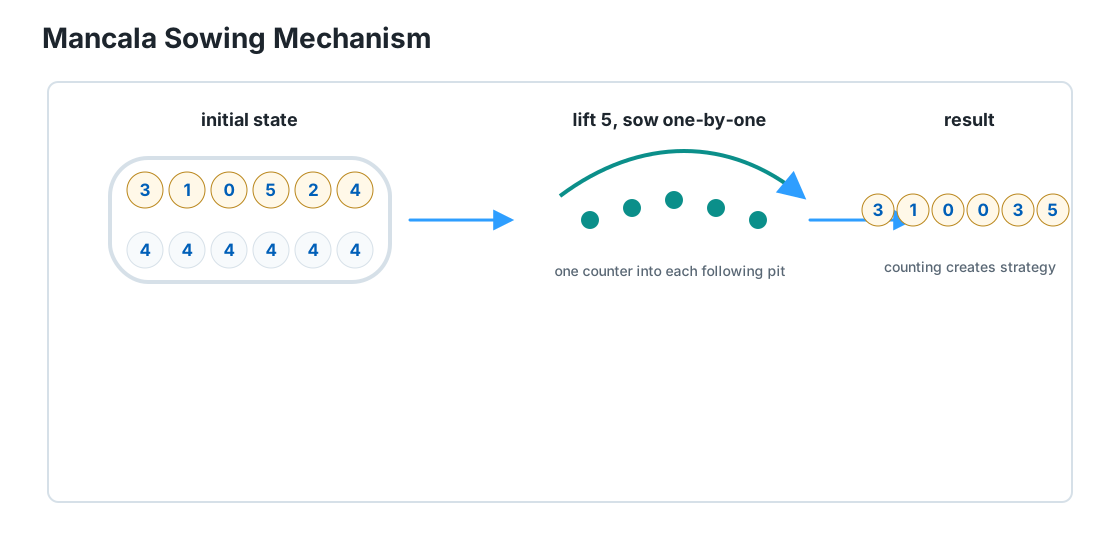
It is better understood as a large family of related sowing games.
The characteristic action is simple:
- take counters from one pit
- distribute — or "sow" — them one by one into subsequent pits
- apply capture or continuation rules determined by the particular variant
Boards, pit counts, direction of sowing, capture rules and winning conditions vary widely.
Minimal equipment, substantial strategy
A mancala board can be physically simple:
○ ○ ○ ○ ○ ○
○ ○ ○ ○ ○ ○
with seeds, pebbles, shells or other counters.
That simplicity is part of the family's durability.
The strategic problem is not moving a special piece. It is controlling future distributions.
A move changes several pits at once. The player is effectively manipulating a small discrete dynamical system:
current pit counts
→ sowing transformation
→ new pit counts
→ future capture possibilities
Counting therefore becomes strategy.
Wari / Oware
One important West African member of the family is usually called Oware or Wari.
A common form uses:
- 12 pits in two rows of six
- 48 seeds
- sowing around the board
- captures based on the number of seeds in opponent-side pits after a move
Exact rules vary by tradition and competition code, which is itself a useful warning:
"Mancala rules" is too vague; identify the specific game.
How old is mancala?
Mancala is certainly old and geographically widespread, but confident claims of extreme antiquity should be treated carefully.
Cup-shaped depressions found archaeologically can resemble game boards, but a row of cupules is not automatically proof that people were playing mancala.
The British Museum describes mancala as an ancient game family played across Africa, Asia, the Middle East, the West Indies and parts of South America, and its collections contain many historically documented boards. Archaeological claims about specific ancient boards should be presented as interpretations rather than automatic identification.
Spread and cultural variation
Mancala-family games occur across:
- much of Africa
- the Middle East
- South and Southeast Asia
- parts of the Caribbean and South America
The geographic breadth is one reason "the inventor of mancala" is not a useful historical question.
The family likely reflects long histories of migration, trade, local invention and rule adaptation.
Why the mechanism is interesting
Unlike chess or Go, the basic action redistributes many counters at once.
That gives mancala games a distinctive mathematical feel:
- modular counting
- state transitions
- tempo
- forced feeding/capture patterns
- long-range consequences from local redistribution
Takeaway: Mancala is not one ancient board game but a family of sowing games. Its strategic depth comes from transforming the whole distribution of counters with each move.