Metabolic Fuel Use
“Carb burning” and “fat burning” are useful shorthand.
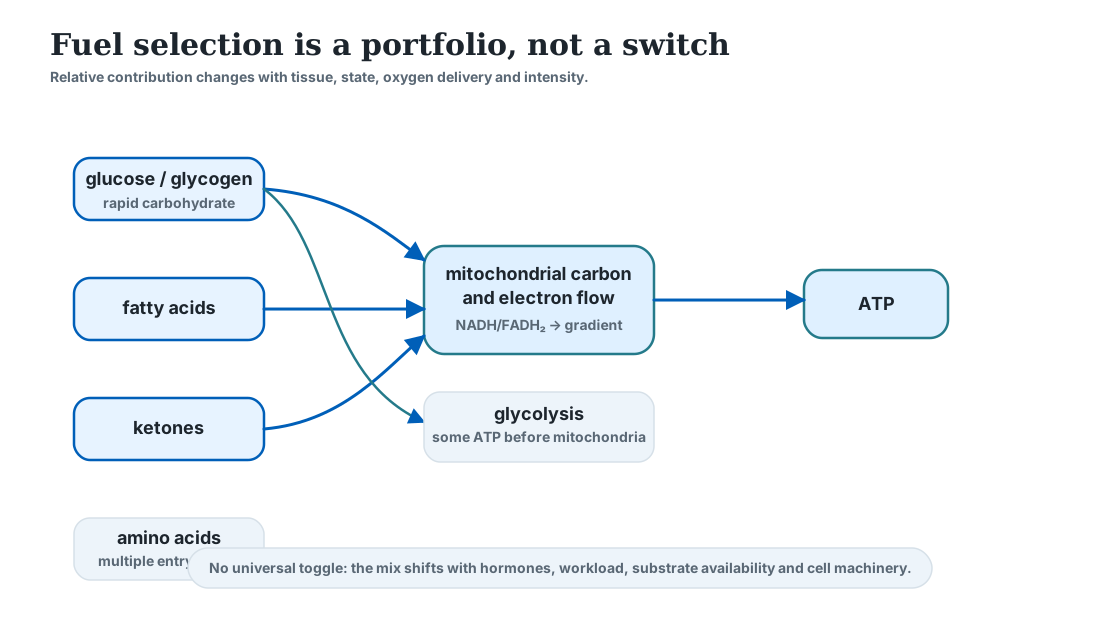
They are also a bad model if they make metabolism sound like a furnace with a two-position switch.
Human tissues normally use a mixture of fuels, and the mixture changes with:
- the tissue involved;
- fed versus fasting state;
- insulin and other hormones;
- exercise intensity and duration;
- oxygen delivery and mitochondrial capacity;
- what substrates are actually available in the blood;
- what enzymes and organelles that tissue possesses.
There is no single universally “best” biological fuel.
Different fuels solve different problems.
The main fuel forms
| Fuel | Main storage / transport form | Major strength | Important constraint |
|---|---|---|---|
| Glucose / glycogen | blood glucose; liver and muscle glycogen | rapidly accessible; glycolysis can make ATP without oxidative phosphorylation | limited glycogen stores; glycogen is stored with substantial water |
| Fatty acids / triglyceride | adipose triglyceride; intramuscular triglyceride; circulating fatty acids | extremely energy-dense long-term storage | complete oxidation is mitochondrial and depends on oxidative metabolism |
| Ketone bodies | produced by liver; circulate dissolved in blood | water-soluble export fuel made from fat-derived carbon during low-carbohydrate states | not every tissue uses them; liver makes but cannot consume them |
| Amino acids | primarily functional body proteins, not a dedicated fuel tank | carbon skeletons can enter oxidation or gluconeogenesis | using large amounts means consuming functional protein |
The table explains why evolution did not simply choose the molecule with the most calories per gram.
Biology needs storage, transport, speed, regulation and tissue compatibility as well as raw energy density.
Glucose and glycogen
Glucose travels readily in blood and can be used by many tissues.
Cells can obtain ATP from glucose through glycolysis in the cytosol.
If mitochondria and sufficient oxidative capacity are available, pyruvate-derived carbon can continue into mitochondrial oxidation, allowing much more ATP to be regenerated from the original glucose molecule.
But glycolysis itself can keep producing ATP without oxidative phosphorylation if the cell can regenerate the required NAD⁺.
That matters for tissues and situations where oxidative metabolism is limited or absent.
Glycogen
Animals store carbohydrate largely as glycogen.
Liver glycogen helps support blood-glucose homeostasis.
Muscle glycogen is a local fuel reserve for muscle.
That local reserve becomes especially valuable when ATP demand rises rapidly.
A classic tracer study by Romijn and colleagues compared trained cyclists exercising at approximately:
- 25% of maximal oxygen uptake;
- 65%;
- 85%.
As exercise intensity rose, plasma-glucose uptake and muscle-glycogen oxidation increased substantially.
Meanwhile, the contribution from circulating free fatty acids did not simply keep rising with workload.
At the highest intensity, muscle glycogen became a major contributor.
So:
“low intensity burns fat, high intensity burns carbs”
contains a grain of truth, but the real physiology is a changing mixture rather than an on/off switch.
Fat: the compact reserve
Most long-term stored energy is carried as triglyceride.
This solves a storage problem superbly.
Regulatory food-energy factors give a useful familiar comparison:
versus:
Those are practical metabolizable-food factors rather than exact universal molecular bond-energy constants.
Fat has another storage advantage: triglyceride is hydrophobic and can be packed with little associated water.
Glycogen is highly hydrated.
The practical difference in wet biological storage density is therefore even larger than 9 versus 4 suggests.
Fatty acids can be released from triglyceride, transported to tissues and oxidized in mitochondria.
They are excellent long-duration fuel.
But they are not interchangeable with glucose in every tissue or every workload.
Ketones: make fat-derived carbon easier to export
During low-insulin states such as fasting, the liver receives abundant fatty acids.
It oxidizes them and converts some of the resulting acetyl-CoA into ketone bodies:
- acetoacetate;
- β-hydroxybutyrate;
- acetone as a smaller non-energy by-product.
Acetoacetate and β-hydroxybutyrate circulate in water-rich blood far more conveniently than long-chain fatty acids do unaided.
Extrahepatic tissues can convert them back toward acetyl-CoA for oxidation.
The liver itself lacks the key SCOT/thiophorase step needed to consume the ketones it exports.
That division of labor is one of the best metabolic oddities in the current Miscellany.
The brain during prolonged fasting
The brain is normally heavily dependent on glucose.
But it is not permanently locked to glucose alone.
In a classic 1967 study, Owen and colleagues catheterized cerebral vessels in three obese people after 5–6 weeks of starvation.
β-hydroxybutyrate and acetoacetate had become the predominant measured fuels for brain metabolism.
This does not mean the brain's glucose requirement falls to zero.
It means prolonged fasting causes a major shift toward ketone use, helping reduce the need to manufacture all cerebral fuel as glucose.
Protein is usable fuel, but not a dedicated fuel store
Amino-acid carbon skeletons can enter metabolic pathways at several points.
Some can support gluconeogenesis.
Others can be oxidized.
But it is misleading to talk about a human “protein tank” analogous to glycogen or adipose triglyceride.
Most body protein is there to do something:
- contract muscle;
- catalyze reactions;
- provide structure;
- transport molecules;
- participate in signaling.
Using significant protein for energy therefore consumes functional material.
This is one reason metabolic adaptation during fasting that reduces glucose demand can help spare body protein.
Blood availability does not guarantee tissue usability
A fuel can be abundant in blood while a particular cell cannot use it.
Three striking examples:
- mature red blood cells have no mitochondria and therefore depend on glycolysis for ATP;
- the liver produces ketone bodies but cannot oxidize them through the normal SCOT-dependent pathway;
- the brain can use far more ketone during prolonged fasting than in the fed state.
Fuel selection is therefore partly a whole-body problem and partly a cell-biochemistry problem.
Why biology keeps multiple fuels
It is tempting to tell a tidy evolutionary story:
first came carbohydrate, then fat evolved for storage, then ketones evolved for famine.
The evidence does not justify such a simple historical sequence.
What we can say much more confidently is that the fuel systems have complementary functional tradeoffs.
- Glucose/glycogen: accessible, distributable and capable of supporting rapid glycolytic ATP supply.
- Triglyceride/fatty acids: exceptionally compact long-term storage.
- Ketones: water-soluble export fuel from fat-derived carbon during low-carbohydrate states.
- Amino acids: usable when needed but normally valuable as functional material.
Evolution had no reason to converge on one fuel if multiple chemical solutions made the organism more robust across meals, sleep, exercise and food scarcity.
Main message: Fuel selection is a portfolio, not a switch. The body trades energy density, accessibility, oxygen/mitochondrial requirements, transport chemistry and tissue specialization against one another.