Modal Logic and Kripke Worlds
Predicate logic lets us say surprisingly complicated things about the actual situation:
Every cat is a mammal.
Someone knows Alice.
Every planet orbits a star.
But ordinary reasoning also contains words such as:
- must
- might
- necessarily
- possibly
- could have been
- cannot be.
These do something different. They compare what is actually true with alternative ways things could be.
That is the job of modal logic.
Necessity and possibility
Suppose P means:
The door is locked.
Modal logic adds two useful operators.
Necessary P:
Read this aloud as:
“necessarily P”
or:
“P must be true.”
Possible P:
Read this as:
“possibly P”
or:
“P could be true.”
The box and diamond are not magic punctuation. Their meaning comes from considering alternatives.
Possible worlds
Imagine the current situation plus several alternative situations:
- in one, the door is locked;
- in another, it is unlocked;
- in another, the key is somewhere else.
Modal logicians call these alternatives worlds.
A “world” here does not have to mean a literal science-fiction parallel universe.
It can simply mean:
one complete state or alternative that the model is considering.
That abstraction is powerful because the same machinery can later represent different things: alternative physical situations, future moments, states compatible with what someone knows, or normatively ideal situations.
The arrows matter
Not every world necessarily counts as a relevant alternative from every other world.
So we draw arrows.
If world w has an arrow to world v, write:
and read it roughly as:
“v is accessible from w.”
The symbol R is the accessibility relation.
The interpretation of that arrow depends on what kind of modality we are modeling. For ordinary possibility it may mean:
v is an alternative we count as possible from w.
Later it might mean:
v is a possible future of w.
or:
v is compatible with what Alice knows at w.
For now, the important idea is simply that arrows determine which worlds get checked.
Necessity means checking every accessible world
At a world w:
is true when P is true at every world accessible from w.
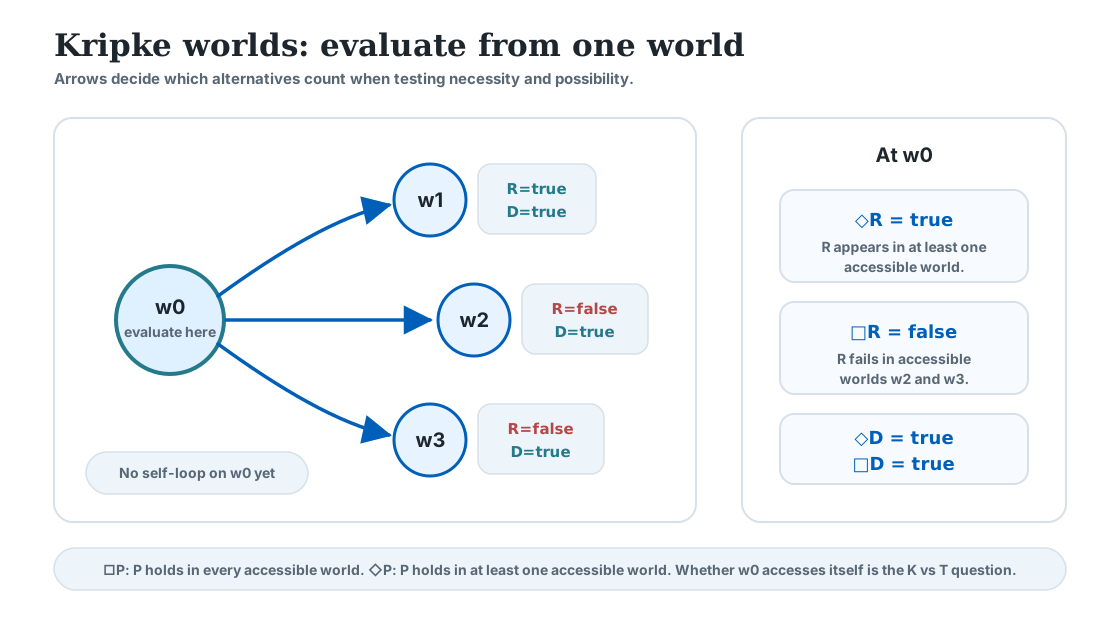
Suppose w can access three worlds:
- w₁: P is true
- w₂: P is true
- w₃: P is true
Then at w:
is true.
But if P is false at even one accessible world, then P is not necessary at w.
Necessity is therefore a kind of universal claim:
check all the relevant alternatives.
Possibility means finding one accessible world
At w:
is true when P is true at at least one accessible world.
So if:
- w₁: P is false
- w₂: P is false
- w₃: P is true
then:
is true at w.
Possibility is therefore an existential claim:
find at least one relevant alternative where P works.
That should feel familiar from predicate logic:
∀meant “for every”∃meant “there exists”□behaves like “in every accessible world”◇behaves like “in at least one accessible world.”
That connection is one reason the earlier entries were worth learning first.
Frame versus model
Two technical terms are worth keeping.
A Kripke frame gives us:
- a set of worlds;
- the accessibility arrows between them.
Think:
the map, but not the facts written on it.
A Kripke model adds a valuation telling us which propositions are true at which worlds.
Think:
the map plus the labels saying what is true at each location.
This distinction is another version of the syntax/semantics theme from the first Logic entry.
A worked example
Suppose world w₀ can access w₁,w₂,w₃.
Let R mean:
It is raining.
And suppose:
- w₁: R is true
- w₂: R is false
- w₃: R is false
At w₀:
is true, because at least one accessible world has rain.
But:
is false, because rain does not occur in every accessible world.
Now let D mean:
The device is powered.
If D is true at all three accessible worlds, then at w₀:
is true.
The graph plus the truth labels gives us the answer mechanically.
Necessity and possibility are duals
There is a useful relationship:
Read it in words:
P is possible exactly when it is not necessary that P is false.
Likewise:
P is necessary exactly when it is not possible for P to be false.
This is worth understanding rather than memorizing.
If there is no accessible world where P fails, P survives every relevant alternative.
That is necessity.
Does the current world see itself?
Not automatically.
This is one of the important subtleties of Kripke semantics.
A world can have an arrow to itself, but the basic framework does not require that.
If every world does access itself, the relation is called reflexive.
Why might that matter?
Because if the actual world counts among its own relevant alternatives, then:
must hold.
If P is necessary, P must actually be true here.
That apparently obvious principle is not built into the weakest modal system.
It is what separates the modal system T from the weaker system K.
That is our next entry.
A strange edge case
Suppose a world has no accessible worlds at all.
Under the standard semantics:
- ◇P is false — there is no accessible world where P is true;
- □P is true for every P — there is no accessible counterexample.
The second result can feel bizarre.
It is the same logic behind the mathematical statement:
Every unicorn in this empty room is blue.
There is no unicorn that violates the claim.
This is called vacuous truth.
It is a useful reminder that formal semantics can produce consequences that differ from conversational intuition.
Main message: Modal logic turns “must” and “might” into questions about a graph of alternatives. The worlds say what alternatives exist; the arrows say which alternatives matter from where we are.