Modular Arithmetic: Numbers on a Clock
A clock forgets complete turns. Starting at 10 on a twelve-hour clock and moving forward 5 hours lands at 3: 10+5=15, but 15 and 3 differ by one full turn of 12.
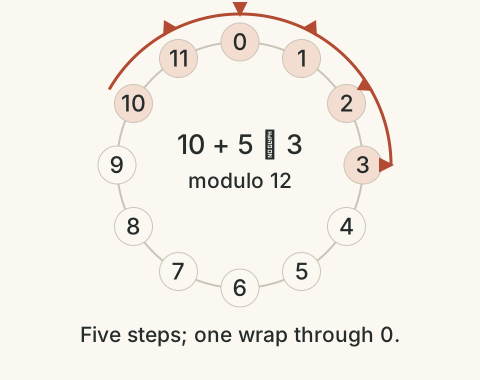
Modular arithmetic formalizes that kind of forgetting. The modulus n is a positive integer specifying the turn size. We write a≡ b (mod n), read “a is congruent to b modulo n,” when n divides a-b. Equivalently, a and b have the same remainder. Congruence is not ordinary equality: 15 is not 3, even though they occupy the same place modulo 12.
Choosing a representative
The usual representatives modulo n are 0,1,…,n-1. On our clock, 0 corresponds to the dial's 12. Negative numbers work too: -1≡11 (mod 12), because their difference is -12. Moving backward one step from 0 lands at 11.
For the RSA example later:
The phrase “343 modulo 55” commonly asks for the representative 13; the congruence statement describes a relationship between integers.
Reduce along the way
Adding or multiplying congruent numbers preserves congruence. Suppose a=r+kn and b=s+ℓ n. Their sum differs from r+s by a multiple of n; their product differs from rs by a multiple of n too. This is why intermediate remainders are safe:
The full product is 323, which also leaves remainder 11. Reduction avoids carrying irrelevant complete turns through a long calculation.
Division needs more care. Modulo 12, 2×1≡2×7, although 1≢7. Cancelling the 2 loses information because multiplication by 2 merges different residues. We will learn which numbers can be safely “divided by” using modular inverses. First, the Euclidean algorithm supplies the test for whether an inverse exists.