Myocardial Infarction: What a Heart Attack Actually Is
A myocardial infarction (MI) is death of heart-muscle cells caused by prolonged ischemia.
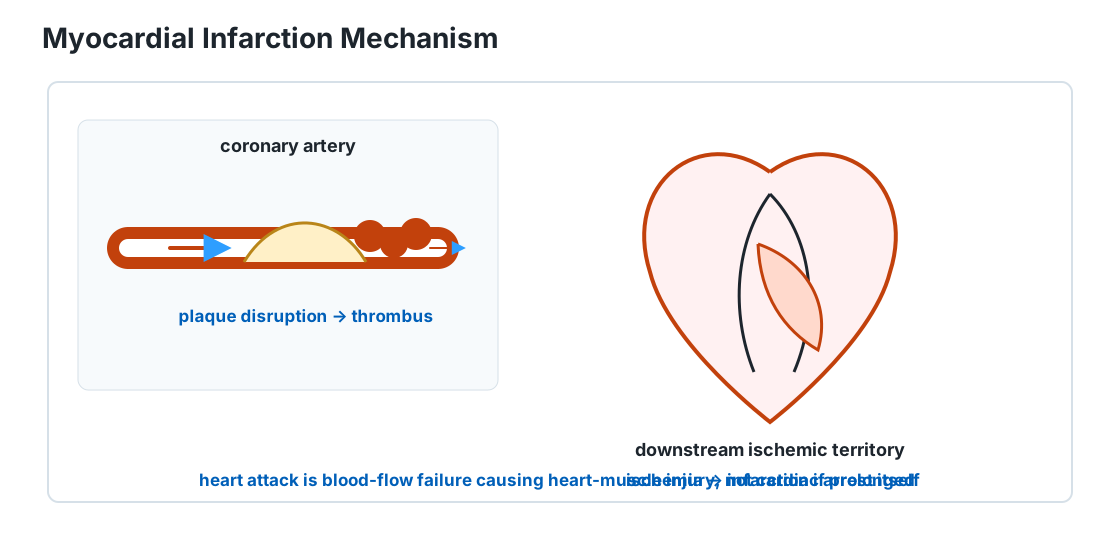
It is not simply "a blocked artery," and it is not the same thing as cardiac arrest.
The usual causal sequence in acute coronary syndrome is:
atherosclerotic plaque disruption or erosion
→ coronary thrombus
→ abrupt fall in downstream blood flow
→ myocardial ischemia
→ irreversible cardiomyocyte injury
Ischemia versus infarction
Ischemia means blood flow is insufficient for the tissue's metabolic needs.
If restored quickly enough, ischemic myocardium may recover.
Infarction means tissue injury has progressed to cell death.
Time matters because the myocardium downstream of an occluded coronary artery cannot store enough oxygen to continue normal aerobic metabolism for long.
Why heart muscle is vulnerable
Cardiomyocytes continuously require ATP for:
- ion pumps
- electrical stability
- calcium handling
- contraction and relaxation
With inadequate oxygen:
- oxidative phosphorylation falls
- ATP production drops
- ion gradients deteriorate
- contraction fails
- electrical instability increases
- prolonged ischemia causes necrosis
The bioenergetics entries therefore connect directly to heart attack.
Acute coronary syndrome
Current cardiology groups several unstable coronary presentations under acute coronary syndrome (ACS).
These include:
- unstable angina
- NSTEMI
- STEMI
The 2025 ACC/AHA ACS guideline treats STEMI and NSTEMI within one acute-coronary-syndrome framework.
STEMI and NSTEMI are not simply "big" and "small" heart attacks
The names refer initially to ECG patterns.
A STEMI has the characteristic ST-segment elevation pattern associated with acute coronary occlusion in the appropriate clinical setting.
An NSTEMI does not have diagnostic persistent ST elevation but has myocardial injury consistent with ischemia, commonly detected with cardiac troponin.
NSTEMI can still involve substantial myocardial damage.
Troponin
Cardiac troponins are proteins involved in contraction.
Damaged cardiomyocytes release troponin into the blood.
Modern high-sensitivity troponin measurements are central to diagnosing myocardial injury, but:
elevated troponin means myocardial injury; it does not by itself prove plaque-rupture MI.
Other conditions can injure the myocardium.
Clinical symptoms, serial troponin changes, ECG findings and context are interpreted together.
Heart attack versus cardiac arrest
A heart attack is principally a blood-flow problem causing myocardial injury.
A cardiac arrest is failure of effective cardiac pumping, usually because the heart's electrical/mechanical activity cannot sustain circulation.
An MI can provoke dangerous arrhythmias and cause cardiac arrest.
But many people with an MI never arrest, and cardiac arrest can occur for reasons other than MI.
Why reopening the artery matters
The central emergency treatment principle is reperfusion: restore blood flow to threatened myocardium as rapidly as appropriate.
Modern management may include antiplatelet/antithrombotic treatment and coronary angiography with percutaneous coronary intervention, depending on the ACS type and clinical situation.
The educational point is:
threatened myocardium is a time-dependent biological system, not merely a plumbing blockage.
A useful scale
A resting human heart beats roughly 100,000 times per day.
Its muscle therefore has a nearly continuous energy requirement and extraordinarily rich coronary blood supply.
Interrupt that supply to one region and loss of function can begin quickly.
Main message: A heart attack is prolonged ischemic injury to myocardium, usually caused by acute coronary thrombosis on an atherosclerotic plaque. The emergency is loss of oxygen delivery; infarction is the resulting cell death.
Misconceptions
- Heart attack ≠ cardiac arrest.
- Atherosclerosis ≠ acute MI.
- A narrowed artery does not automatically mean infarction.
- Troponin elevation ≠ automatically a type 1 plaque-rupture MI.
- NSTEMI does not mean "not serious."