Origins of Civilization: From Homo sapiens to the Bronze Age Collapse
Civilization is extraordinarily recent. Homo sapiens has existed for roughly 300,000 years, but agriculture, permanent large settlements, cities, states, and writing are concentrated in roughly the last 12,000 years. For almost all of our species' history, humans lived without cities, kings, bureaucracies, or written records.
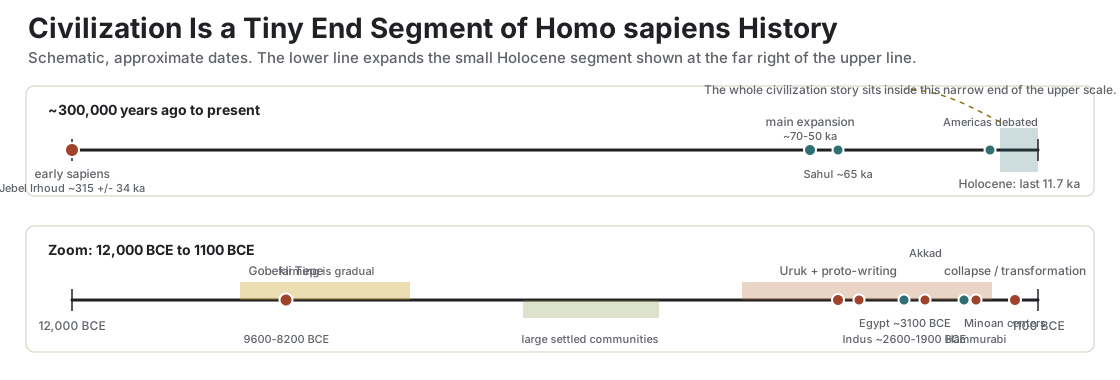
If 300,000 years of Homo sapiens history were compressed into one 24-hour day:
- the last Ice Age ends and the Holocene begins only in roughly the final 56 minutes;
- the earliest Near Eastern farming communities occupy roughly the final 45-55 minutes;
- Uruk and the first Mesopotamian writing appear only in roughly the final 25 minutes;
- the Late Bronze Age collapse occurs only about 15 minutes before midnight.
The useful story is therefore not "humans slowly became civilized." It is how a highly adaptable, mobile species spent hundreds of millennia as foragers, spread across the planet, and then, under particular ecological and social conditions, repeatedly developed food production, dense settlements, institutions, cities, and states.
A timeline worth keeping in your head
- ~300,000 years ago: early Homo sapiens in Africa. Fossils from Jebel Irhoud, Morocco, date to about 315 +/- 34 thousand years ago and show an early mosaic of Homo sapiens traits. Current evidence argues against a single tiny "birthplace" for the species; populations across Africa probably contributed to its emergence.
- ~70,000-50,000 years ago: the major successful expansion beyond Africa. There were earlier excursions, but most ancestry of living non-African populations derives from a later expansion in this broad window.
- By ~65,000 years ago: people in Sahul / northern Australia. Madjedbebe provides evidence of human occupation around 65 ka, although the exact chronology of the earliest settlement of Sahul remains an active research area.
- Late Pleistocene: settlement of the Americas. The exact first arrival remains debated; secure widespread evidence is later than much of Eurasia and Sahul. One exact "first American" date should not be treated as settled.
- 11,700 years ago: the Holocene begins. Warmer post-glacial conditions form the environmental backdrop for many early agricultural transitions, though climate alone did not "cause civilization."
- 9600-8200 BCE: Gobekli Tepe. Monumental communal structures were built by hunter-gatherers in Upper Mesopotamia. This is an important warning against the simplistic idea that farming had to come before large-scale coordinated construction or ritual organization.
- Roughly 10th-8th millennia BCE: farming develops in Southwest Asia. Domestication and food production were processes, not a one-day invention. Agriculture also arose independently elsewhere in the world.
- 7th millennium BCE and after: increasingly large settled communities. Places such as Catalhoyuk show dense settlement without simply looking like later palace-and-king cities.
- Late 4th millennium BCE: Uruk becomes a true city. By about 3200 BCE, Uruk was the largest settlement in southern Mesopotamia and perhaps the world.
- ~3300-3200 BCE: earliest Mesopotamian writing. Proto-cuneiform emerged in an administrative setting: accounting, goods, and labor. Writing was not invented because someone wanted to write literature.
- ~3100 BCE: political unification of Egypt. Early dynastic Egypt becomes one of the world's major territorial states; Egyptian writing developed independently from the Mesopotamian system, although the regions interacted.
- ~2600-1900 BCE: mature Indus / Harappan urban civilization. Large planned cities and long-distance trade flourished; its script remains undeciphered.
- ~2334 BCE onward: Akkadian imperial expansion. Sargon and successors built an unusually large territorial state over Mesopotamian city-state traditions. Absolute early Mesopotamian dates vary by chronological system, so fake precision is a trap.
- ~1900 BCE: Minoan palace centers flourish on Crete. Knossos and other centers concentrated economic and political activity and participated in growing eastern Mediterranean exchange.
- Hammurabi, ~1792-1750 BCE: Babylon becomes a major territorial power. His famous stele records legal judgments and royal ideology; calling it simply "the first law code" is misleading.
- ~1600-1200 BCE: interconnected Late Bronze Age eastern Mediterranean. Egypt, Hittites, Mycenaean polities, Levantine cities, Cyprus, and Mesopotamian powers were linked by diplomacy, shipping, metals, prestige goods, and political marriage.
- ~1250-1150 BCE: Late Bronze Age collapse / transformation. Multiple major centers declined or were destroyed. No single explanation, including "Sea Peoples," drought, earthquakes, rebellion, or trade failure, adequately explains every region.
The real transition was not one invention
Avoid imagining a universal ladder:
hunter-gatherers -> farming -> villages -> cities -> civilizationReality was messier.
- Some hunter-gatherers built monumental structures.
- Farming developed gradually and independently in multiple regions.
- People could farm without cities.
- Dense settlements did not always have kings or states.
- Writing appeared after complex institutions already existed.
- Some sophisticated societies functioned without writing.
- Urban systems could shrink, fragment, or disappear.
The important mechanism is positive feedback. Reliable food surpluses can support higher population density and occupational specialization. Dense populations can support institutions, storage, redistribution, defense, and infrastructure. Those institutions can in turn organize more production and trade. But the same interdependence can also create fragility.
How do we know any of this?
For prehistory there are no historians writing down what happened. The evidence comes from multiple independent methods:
- archaeology: settlements, burials, tools, food remains, architecture, and material exchange;
- stratigraphy: what lies above or below what;
- radiometric dating: especially radiocarbon for once-living material within its useful range;
- dendrochronology: tree rings can provide calendar-year anchors in suitable regions;
- ancient DNA: ancestry, population movement, and admixture;
- stable isotopes: diet, mobility, climate, and origin of materials;
- palaeoenvironmental evidence: pollen, lake cores, speleothems, and sediments;
- written records: enormously informative once writing appears, but biased toward literate institutions and surviving material.
The strongest historical reconstructions usually come from convergence: different evidence types independently pointing toward the same model.
What the evidence does not establish
- There was no single moment when "civilization began."
- There was no single inevitable sequence every society followed.
- Monumental construction does not prove kings, states, or organized religion in the later institutional sense.
- The first surviving written record is not necessarily the first time an idea or practice existed.
- The earliest site yet discovered is not automatically the first site that ever existed.
- The Bronze Age world did not collapse everywhere simultaneously or for one proven cause.
Main message: Civilization occupies only the final sliver of human history. The remarkable change was not a sudden increase in human intelligence. It was the emergence of new ecological, demographic, and institutional feedback loops--food production, settlement, specialization, administration, trade, and political organization--that allowed much larger groups of humans to coordinate, compete, and depend on one another.