Oscillations and Simple Harmonic Motion
Many systems displaced from a stable equilibrium experience a force pushing them back toward it.
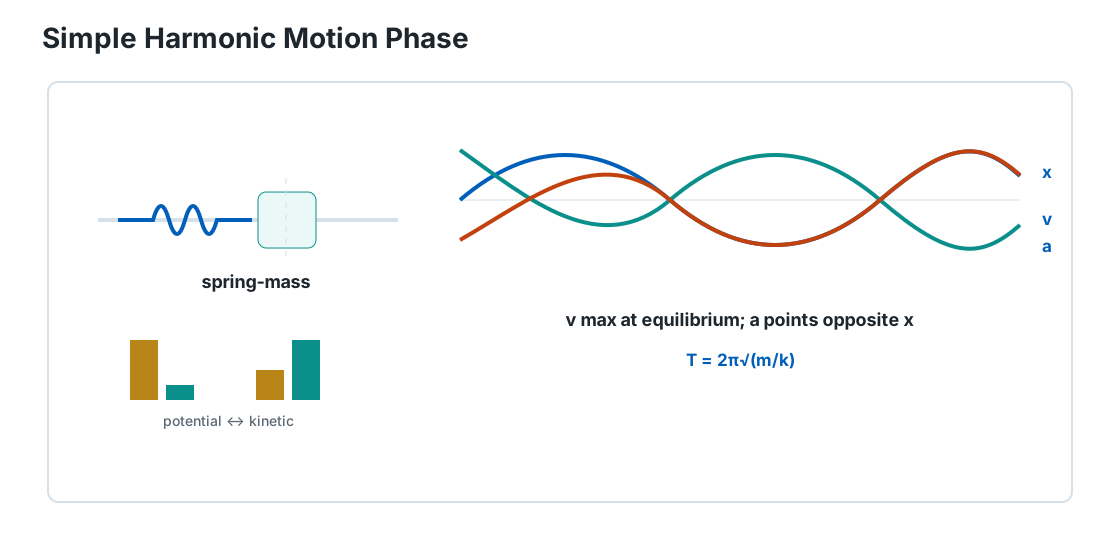
If that restoring force is approximately proportional to displacement:
the system performs simple harmonic motion.
The minus sign matters: the force points opposite the displacement.
Spring-mass oscillator
Newton's second law gives:
or:
A function whose second derivative is proportional to its negative is sinusoidal:
with:
Therefore:
A stiffer spring gives a shorter period. A larger mass gives a longer period.
For the ideal linear oscillator, amplitude does not appear in the period.
Energy trades form
For an ideal spring-mass oscillator:
At maximum displacement:
- speed is zero
- spring potential energy is maximum
At equilibrium:
- displacement is zero
- speed is maximum
- kinetic energy is maximum
Energy continually moves between potential and kinetic forms.
Pendulum
For a simple pendulum of length ℓ, the exact restoring torque contains:
For small angles in radians:
That approximation makes the equation linear and gives:
The familiar amplitude-independent period is therefore an approximation. At large amplitudes the period grows.
Why simple harmonic motion is everywhere
Near a stable equilibrium, many smooth potential-energy curves look approximately parabolic:
Differentiate:
So small disturbances around stable equilibria naturally produce approximately harmonic motion.
That is why springs, pendulums, vibrating molecules, suspension systems, musical instruments and many electrical systems share similar mathematics.
Real oscillators
Real systems may include:
- damping, which removes mechanical energy
- driving, which supplies energy periodically
- resonance, when driving couples efficiently to the system's natural motion
- nonlinear effects at large amplitudes
The ideal oscillator is powerful precisely because it is the first approximation to many real systems, not because the world is perfectly sinusoidal.
Physics C bridge
Calculus is not merely an optional decoration here. The defining equation is differential:
The sinusoidal solution follows from the structure of the equation.
This is one of the clearest places to see what calculus contributes to mechanics: it turns a local law about acceleration at each instant into an entire motion through time.
Takeaway: Simple harmonic motion is what stable systems often do when displaced only a little from equilibrium.