Out of Africa: How Homo sapiens Spread Across the World
"Out of Africa" sounds like one migration: modern humans evolve in Africa, leave once, and replace everyone else. The evidence now shows something much more interesting.
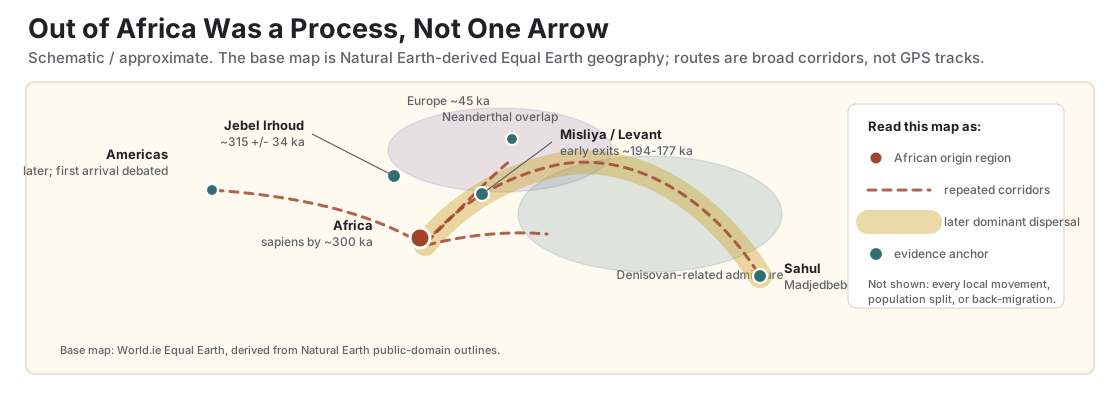
Homo sapiens evolved in Africa at least ~300,000 years ago. Populations left Africa more than once. Some early expansions probably disappeared or contributed little to people living today. A later expansion, roughly 70,000 to 50,000 years ago, accounts for most ancestry of present-day populations outside Africa, and those migrants interbred with Neanderthals and Denisovans rather than simply replacing them.
There is an additional source of confusion: Homo sapiens was not the first human lineage to leave Africa. Earlier Homo populations had already reached Eurasia by roughly 1.8 million years ago.
First: Homo sapiens did not arise at one obvious point on the map
Jebel Irhoud in Morocco preserves fossils associated with early Homo sapiens dated to 315 +/- 34 thousand years ago. Other important early fossils occur in eastern and southern Africa.
The modern picture is therefore increasingly pan-African: traits associated with Homo sapiens accumulated in populations distributed across Africa, connected intermittently by gene flow, rather than our species suddenly appearing in one isolated "Garden of Eden" population.
This matters because "Out of Africa" begins with a network within Africa.
There were early exits
The famous successful expansion was not the first excursion.
- A Homo sapiens maxilla from Misliya Cave, Israel, has been dated to roughly 177,000-194,000 years ago.
- Skhul and Qafzeh in the Levant preserve Homo sapiens from roughly the 120,000-90,000-year range.
- Genetic evidence also points to contacts between early Homo sapiens and Neanderthals before the later major expansion.
These populations prove that humans crossed out of Africa earlier than the ancestors of most living non-Africans.
What happened to those early groups is less clear. Some probably died out, retreated, or were absorbed into other populations. "Failed dispersal" is useful shorthand genetically, but it does not mean the people failed at living: some populations persisted outside Africa for many generations while leaving little detectable ancestry in people today.
The expansion that left the largest genetic legacy
Genetic and archaeological evidence points to a later expansion, broadly ~70-50 thousand years ago, from which most present-day non-African ancestry derives.
Do not force the literature into one exact year. Different genetic models and archaeological datasets emphasize somewhat different dates. The robust idea is:
early exits happened
+
a later expansion became demographically dominant
Recent work also suggests the people involved had already expanded into a wider variety of African environments before the successful Eurasian expansion. Ecological flexibility--living in forests, grasslands, and increasingly arid settings--may have been part of what made later range expansion sustainable.
It was not replacement without mixing
When Homo sapiens entered Eurasia, other human populations were already there.
Neanderthals occupied Europe and western/central Eurasia. Denisovan-related populations lived farther east.
Homo sapiens interbred with them.
- Most living people with substantial non-African ancestry carry roughly 1-2% Neanderthal ancestry.
- Denisovan ancestry is especially substantial in some populations in Oceania and parts of Asia.
- Ancient individuals sometimes had Neanderthal ancestors only a few generations back.
So human evolution is not a neat branching tree in which lineages separate forever. It is partly a braided stream: populations split, meet again, and exchange genes.
How did people actually get out?
Two broad geographic corridors are often discussed:
- north through northeastern Africa, Sinai, and the Levant;
- across or around the southern Red Sea into Arabia, especially when sea level and climate made the crossing and surrounding environment more favorable.
But a map with one thick arrow is misleading. Arabia repeatedly became greener during Pleistocene humid phases. Archaeological evidence in the Nefud Desert records multiple hominin expansions at different times.
The better mental image is:
repeated movements through changing corridors
rather than
one heroic march out of Africa
Climate changed the permeability of routes; it did not mechanically determine migration.
How fast did the world fill?
Useful anchors, with uncertainty left visible:
- Africa: Homo sapiens present by ~300 ka.
- Southwest Asia: Homo sapiens present well before 100 ka, including the much earlier Misliya evidence.
- Major ancestry-forming expansion: broadly ~70-50 ka.
- Sahul / northern Australia: archaeological evidence at Madjedbebe around 65 ka, though details of the earliest Sahul chronology remain debated.
- Europe: sustained Homo sapiens presence by roughly 45 ka, overlapping with Neanderthals.
- Americas: later still; the exact first arrival remains disputed. There is secure widespread evidence by roughly 15 ka and evidence under active debate that may push initial presence earlier.
These dates are not checkpoints along one route. Different groups moved, split, stalled, mixed, and sometimes disappeared.
Genetics gives us a second archaeological record
Fossils and tools tell us where people were.
DNA can reveal relationships that archaeology alone often cannot:
- shared ancestry;
- population splits;
- bottlenecks;
- back-migration into Africa;
- interbreeding with Neanderthals and Denisovans;
- ancient populations that left little or no direct descendants.
But genetic dates are model-dependent estimates, not timestamps from a migration diary. The best reconstructions combine genes with fossils, archaeology, palaeoclimate, and geography.
What the evidence does not establish
- There was not one single Homo sapiens exodus.
- Homo sapiens was not the first Homo lineage outside Africa. Earlier humans were in Eurasia by ~1.8 million years ago.
- We do not know one exact route used by all successful migrants.
- We do not have one universally agreed exact date for the ancestry-forming expansion.
- Modern humans did not simply replace Neanderthals and Denisovans without interbreeding.
- The evidence does not support biological "races" as ancient separate human branches. Human populations have repeatedly split, mixed, and exchanged genes.
Main message: Out of Africa was a process, not an event. Homo sapiens emerged through interconnected African populations, made repeated excursions beyond the continent, and eventually underwent a later demographic expansion that spread widely across Eurasia and beyond. The people involved met and interbred with other human lineages. The result is not a simple tree but a history of movement, extinction, survival, and reconnection.