Philosophy Timeline
This timeline is a navigation spine, not a claim that philosophy is one Western relay race from Greece to Europe. India, China, the Islamic world, Africa, and other traditions have independent and interacting histories that deserve fuller entries as the Miscellany grows.
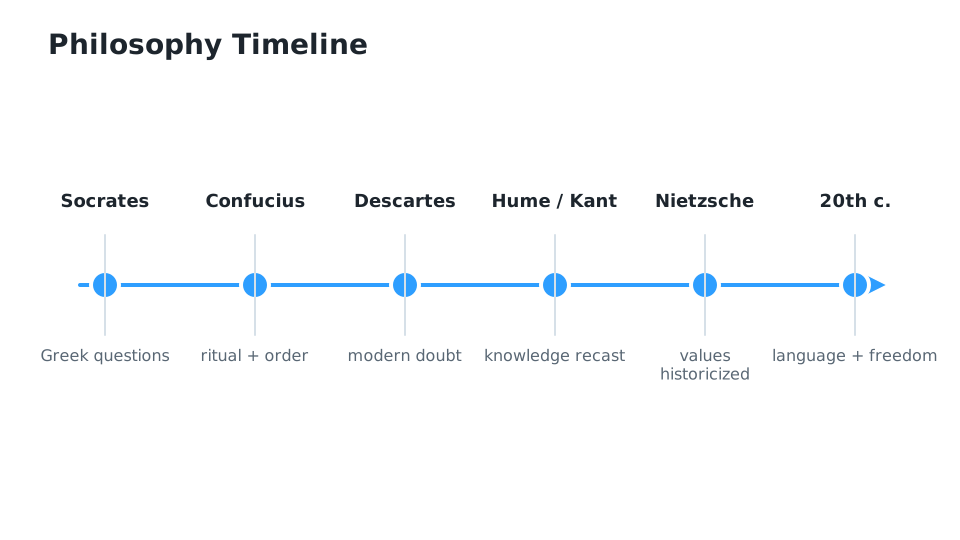
Useful anchors for the current corpus:
- 6th–5th centuries BCE: Confucius in China; pre-Socratic inquiry in Greece.
- 5th century BCE: Socrates turns philosophical pressure toward ethics, definitions, and examination of belief.
- 4th century BCE: Plato and Aristotle build extraordinarily influential systems spanning knowledge, reality, ethics, politics, logic, and nature.
- Hellenistic period: schools such as Epicureanism and Stoicism make philosophy explicitly therapeutic — how to live under uncertainty.
- Medieval period: Christian, Jewish, and Islamic philosophers synthesize/rework Greek philosophy around God, reason, revelation, law, and metaphysics. This is a major gap in the current entry set.
- 17th–18th centuries: rationalism and empiricism — Descartes, Hume and others — sharpen questions about knowledge, mind, causation, and science.
- Kant (18th century): attempts to explain how objective experience/science are possible while accepting Hume's challenge to naive metaphysics.
- 19th century: Nietzsche and others destabilize inherited accounts of morality, history, religion, subjectivity, and meaning.
- 20th century: analytic philosophy emphasizes logic/language/argument in diverse ways; phenomenology, existentialism, and later continental traditions emphasize experience, freedom, history, power, interpretation. Wittgenstein and Beauvoir sit in very different parts of this landscape.
Takeaway: Philosophical history is better remembered as recurring questions being reframed than as a sequence where each philosopher simply “replaces” the previous one.