From AP Physics 1 to Physics C Mechanics: What Calculus Adds
AP Physics 1 and AP Physics C: Mechanics describe largely the same classical-mechanics world.
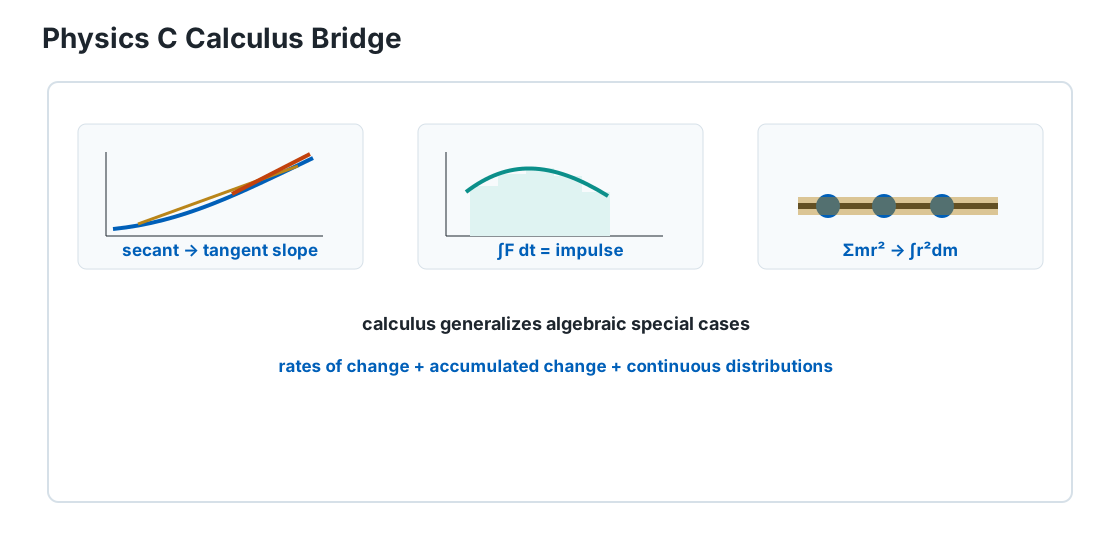
The major difference is not that Physics C has an entirely different set of physical laws. It is that calculus removes many of the simplifying assumptions needed in an algebra-based treatment.
The bridge can be summarized by two mathematical ideas:
- derivatives describe local rates of change
- integrals accumulate small changes
Motion
Algebraic special case for constant acceleration:
General form:
so:
Then:
and:
Force and momentum
The most general Newtonian form for a particle is:
Integrate through time:
Impulse is literally accumulated force over time.
Work and energy
For a variable force:
That accumulated work changes kinetic energy:
For a conservative force in one dimension:
Potential-energy graphs therefore encode force directly in their slopes.
Rotation
Moment of inertia for discrete masses:
For a continuous body:
The geometry of the mass distribution enters through the integral.
Oscillations
Hooke's law plus Newton's second law gives:
The entire sinusoidal motion is a solution of that differential equation.
Physics 1 can use the resulting period formula. Physics C can show more clearly why the result exists.
Calculus also exposes assumptions
The important upgrade is not "harder math."
It is the ability to ask:
- What if acceleration varies?
- What if force changes with position?
- What if torque changes through the motion?
- What if mass is distributed continuously?
- What function has this rate of change?
That makes the physical model more general.
A compact translation table
| Physics idea | Algebra-based form | Calculus form |
|---|---|---|
| velocity | Δx/Δt | dx/dt |
| acceleration | Δv/Δt | dv/dt |
| impulse | FavgΔt | ∫ F dt |
| work | Fdcosθ for constant F | ∫vec(F)· dvec(r) |
| force from potential | compare energy changes | -dU/dx |
| moment of inertia | Σ mr² | ∫ r²dm |
What does not change
Calculus does not replace physical reasoning.
A beautifully evaluated integral based on the wrong system, wrong force diagram, wrong sign convention or wrong conservation assumption is still wrong physics.
The hierarchy remains:
- understand the physical system
- choose a model
- represent it
- write the governing relation
- only then do the mathematics
Main message: Physics C mostly deepens mechanics by replacing special-case finite formulas with derivative, integral and differential-equation forms of the same underlying ideas.