How Plants Store and Spend Energy
Animals have an obvious energy-storage problem:
food arrives intermittently, but cells need ATP continuously.
Plants have the same problem in a different form.
- Their external energy source — sunlight — disappears every night.
- A leaf therefore has to do more than capture light.
- It has to budget carbon across time.
Sunlight is not ATP stored for later
It is tempting to say:
plants run on sunlight.
That is useful only at very high level.
During photosynthesis, chloroplast electron-transfer machinery converts light energy into chemical intermediates including ATP and reducing power used to support carbon fixation.
Carbon dioxide is incorporated into organic molecules.
Those molecules can then be:
- exported as sucrose;
- used in biosynthesis;
- temporarily stored as starch.
The long-duration transferable energy is therefore carried in chemical bonds, not in trapped photons sitting inside the leaf overnight.
Plants also respire
Plants contain mitochondria.
They perform cellular respiration.
Carbon compounds can be oxidized, electrons passed through respiratory chains, proton gradients generated and ATP produced by ATP synthase.
This occurs day and night.
Photosynthesis does not replace mitochondrial respiration with a completely different ATP universe.
Instead, plants operate overlapping energy systems:
light
→ photosynthetic energy conversion
→ fixed carbon
→ sugars / starch
→ respiration
→ ATP for cellular work
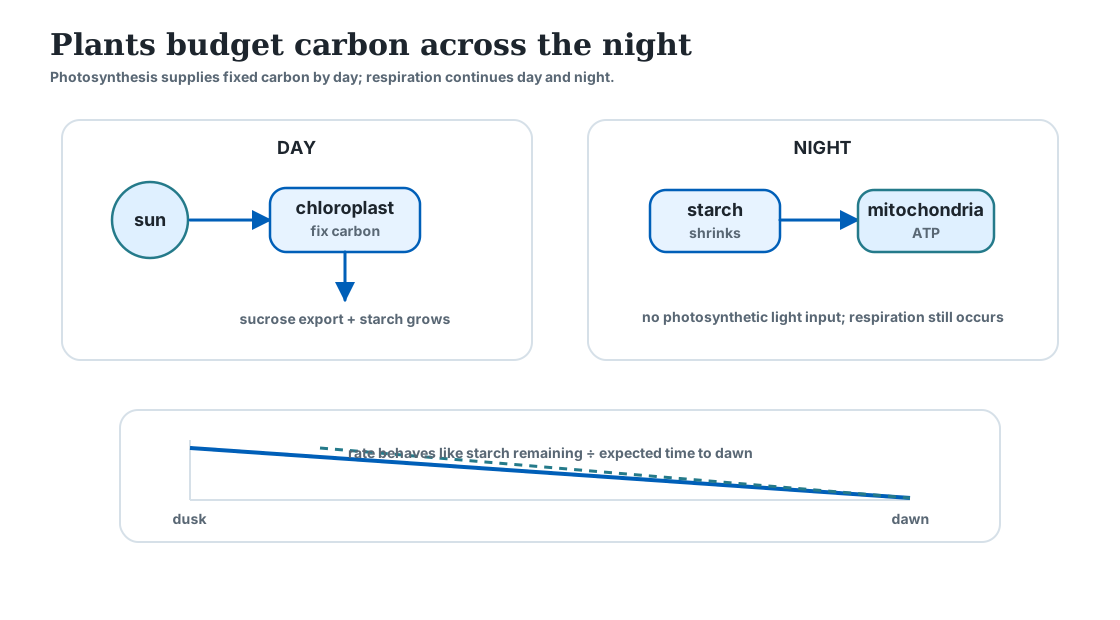
Daytime: earn and store
During the day, a leaf can photosynthetically fix carbon while growth and metabolism continue.
In Arabidopsis, a fraction of this carbon is stored temporarily as starch in chloroplasts.
That reserve has a clear purpose.
Night is predictable.
Photosynthesis will stop when light disappears, but metabolism and growth cannot simply stop until sunrise.
So starch accumulates during the day and becomes a nighttime carbon source.
Nighttime: spend the reserve
In darkness, leaf starch is degraded and carbon is released into metabolic pathways.
A naive strategy would be:
use starch whenever you need it and hope it lasts.
Plants do something more controlled.
In Arabidopsis, starch often declines approximately linearly through the night.
The reserve is nearly exhausted around expected dawn.
That suggests active budgeting rather than accidental depletion.
The arithmetic-division experiment
In 2013, Scialdone and colleagues manipulated two crucial variables:
- how much starch was available;
- how long the plant should expect to wait until dawn.
They found that the rate of starch degradation adjusted to both.
- If night came unexpectedly early, the plant slowed starch use.
- If the available reserve changed, degradation adjusted again.
The dynamics were consistent with a calculation equivalent to:
The authors described this as arithmetic division.
This does not mean a plant has a tiny calculator or consciously performs arithmetic.
It means the biochemical regulatory network produces dynamics mathematically equivalent to dividing the remaining reserve by the expected remaining time.
The result is remarkable:
the plant avoids both starving too early and reaching dawn with a needlessly large unused reserve.
A biological budgeting problem
Imagine having:
with:
A crude perfect budget would spend:
Now imagine darkness arrives four hours early.
- If the plant continued spending at its previous expected-night rate, the reserve could run out before dawn.
- The observed regulatory system adjusts.
The analogy is not perfect, but the control problem is real:
use stored chemical energy at a rate matched to the expected no-input interval.
The comparison with animal fasting
There is a useful sideways connection to human metabolism.
Both systems face:
energy/carbon input now
→ predictable or unpredictable interval without input
→ stored reserve must bridge the gap
Humans use:
- liver glycogen;
- adipose triglyceride;
- gluconeogenesis;
- ketogenesis
to maintain fuel availability during fasting.
Plants can use daytime starch accumulation and regulated nighttime degradation.
The specific molecular mechanisms are different.
Do not force the analogy too far.
The shared principle is:
metabolism is partly about when to spend stored chemical resources, not merely whether those resources contain energy.
Why plants do not simply store everything as starch forever
Temporary leaf starch is not the only plant energy reserve.
Plants move carbon among many forms and organs.
Longer-term storage can include:
- starch in seeds or storage organs;
- oils;
- structural carbohydrates;
- other carbon compounds.
The nighttime Arabidopsis result is interesting precisely because it concerns a short-term working reserve that is actively budgeted over one predictable dark interval.
That makes it a good plant analogue to a working fuel buffer rather than a complete theory of all plant energy storage.
Main message: Plants solve a scheduling problem as well as an energy problem. Daylight builds chemical carbon reserves; nighttime metabolism spends them at a regulated rate, and Arabidopsis can adjust starch use so the reserve lasts almost precisely to expected dawn.