Propositional Logic
Propositional logic begins by deliberately throwing away most of what sentences mean.
Take:
The cat is asleep.
Call the entire statement P.
And:
The door is open.
Call that Q.
Propositional logic treats P and Q as indivisible blocks and studies what happens when we combine them.
Five basic operations
| Symbol | Meaning | Example |
|---|---|---|
| ¬ P | NOT P | The cat is not asleep |
| P ∧ Q | P AND Q | The cat is asleep and the door is open |
| P ∨ Q | P OR Q | The cat is asleep or the door is open |
| P → Q | IF P THEN Q | If the cat is asleep, the door is open |
| P ↔ Q | P IFF Q | The cat is asleep exactly when the door is open |
Here OR normally means inclusive OR: P, Q, or both.
That differs from conversational statements such as "soup or salad," where context often implies one but not both.
Truth tables
With one proposition P, there are only two possibilities:
- true
- false
With two independent propositions P,Q, there are:
possible combinations.
With three:
In general, n propositions require:
truth-table rows.
That exponential growth is our first tiny taste of why brute-force logical reasoning eventually becomes computationally expensive.
The strange one: IF P THEN Q
The truth table for implication is:
| P | Q | P → Q |
|---|---|---|
| True | True | True |
| True | False | False |
| False | True | True |
| False | False | True |
The last two rows usually feel odd initially.
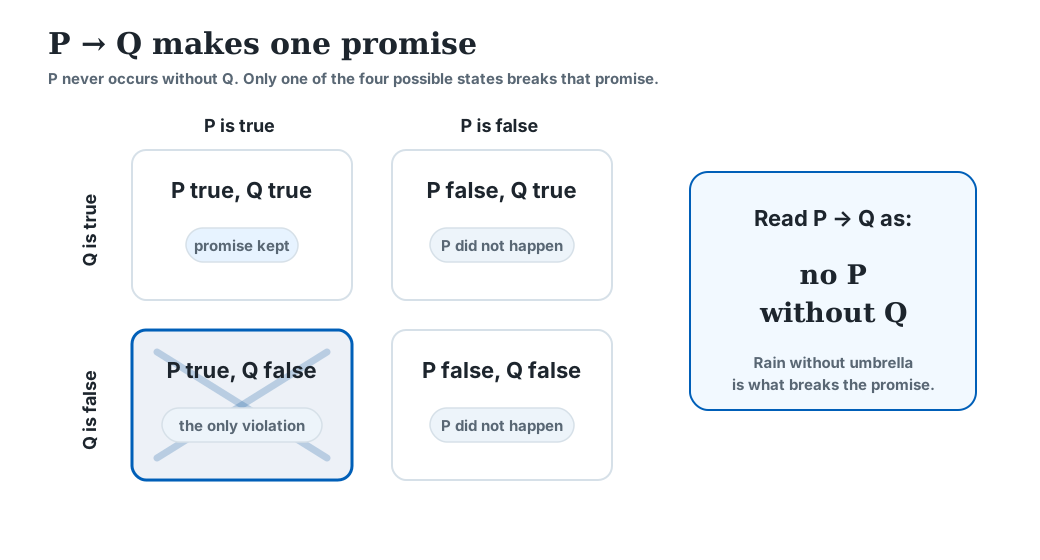
A better intuition is to treat:
If P, then Q
as imposing one prohibition:
P is not allowed to occur without Q.
Only the combination
violates the rule.
If P never happens, the condition has not been violated.
Think of:
If it rains, I will bring an umbrella.
The one situation that proves the promise false is:
it rains, and I do not bring an umbrella.
A sunny day tells you very little about the promise.
That is why formal implication differs from the richer causal implications of ordinary English.
Modus ponens
Now we can represent a classic valid pattern:
therefore
Example:
If the switch is closed, current flows. The switch is closed. Therefore current flows.
This form is called modus ponens.
The subject matter does not matter to validity. Cats, electrons, governments and imaginary dragons all behave identically once represented by the same logical structure.
That abstraction is the point.
A tempting invalid argument
Compare:
therefore
This is not valid.
If it rains, the street gets wet. The street is wet. Therefore it rained.
Maybe.
Or perhaps a sprinkler ran.
This mistake is called affirming the consequent.
Formal notation is useful partly because it strips away a convincing story and exposes that two arguments have the same underlying structure.
Tautologies and contradictions
Some compound propositions are true however their components turn out.
is a tautology in classical propositional logic.
Others can never be true:
is a contradiction.
Everything else is contingent: sometimes true, sometimes false.
These ideas will matter enormously when we eventually ask what is necessarily true rather than merely actually true.
Main message: Propositional logic ignores the internal structure of statements and studies the logical machinery connecting whole statements.
That simplification makes truth-table reasoning possible, but it also creates the limitation that motivates predicate logic.