Rotational Energy and Angular Momentum
Rotation has close analogues of the energy and momentum ideas used for translation.
For a rigid body rotating about a fixed axis:
Compare with translational kinetic energy:
The correspondence is:
mass m                 ↔ rotational inertia I
linear speed v         ↔ angular speed ω
force F                ↔ torque τ
linear momentum p      ↔ angular momentum L
The analogy is useful, but it is not perfect; rotational quantities depend on an axis or origin.
Angular momentum
For a rigid body about a fixed principal axis:
More generally for a particle:
External torque changes angular momentum:
Therefore:
If net external torque is negligible:
The spinning-skater effect
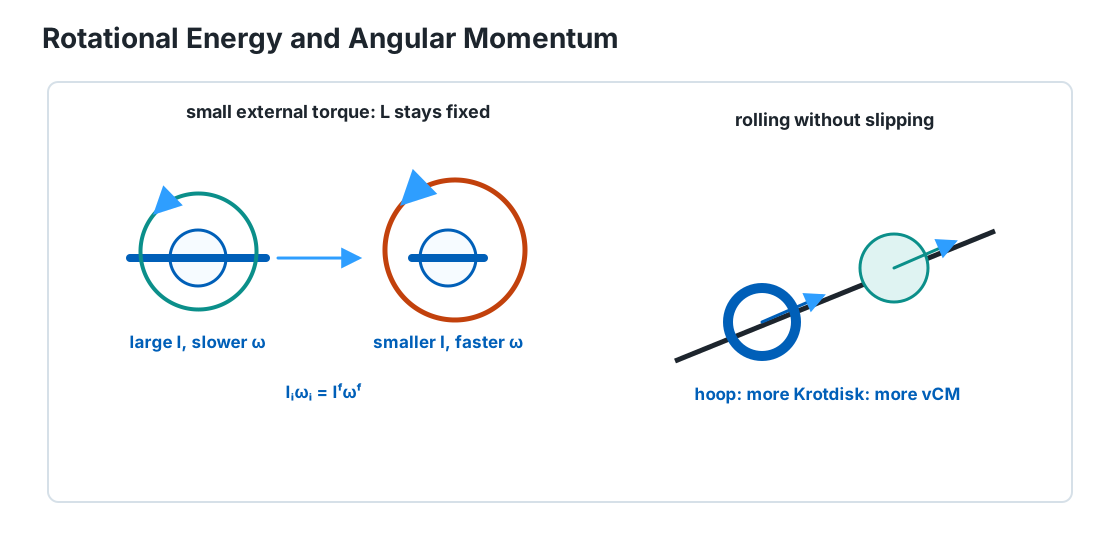
Suppose a skater pulls their arms inward.
Their mass does not change, but I decreases because more mass lies closer to the rotation axis.
If external torque is small:
So decreasing I increases ω.
This does not mean rotational kinetic energy must remain constant.
The skater does internal work while pulling the arms inward, so Krot can increase even while angular momentum stays constant.
That distinction is important: conservation of angular momentum and conservation of mechanical energy are different statements with different conditions.
Rolling without slipping
For a rolling wheel:
Its kinetic energy contains both translation and rotation:
Two objects with the same mass and radius can roll down a ramp differently if their mass distributions — and therefore their moments of inertia — differ.
A hoop has more rotational inertia than a solid disk of the same mass and radius, so more of its gravitational potential-energy loss goes into rotation and less into center-of-mass speed.
Rotational work and power
For fixed-axis rotation:
Instantaneous rotational power:
This equation is extremely practical in engines and motors: power depends on both torque and rotational speed.
Main message: Angular momentum is the rotational conservation law associated with external torque, while rotational kinetic energy tracks the energetic cost of spinning mass around an axis.
Useful connection
This entry can have a curated sideways relationship to the engine/drivetrain material because P=τω is the clean bridge between mechanics and engine torque/power.