The Scientific Method
There is no single universal six-step scientific method that every scientist follows. Real science includes experiments, natural observations, simulations, historical reconstruction, instrument building, model comparison, and exploratory work.
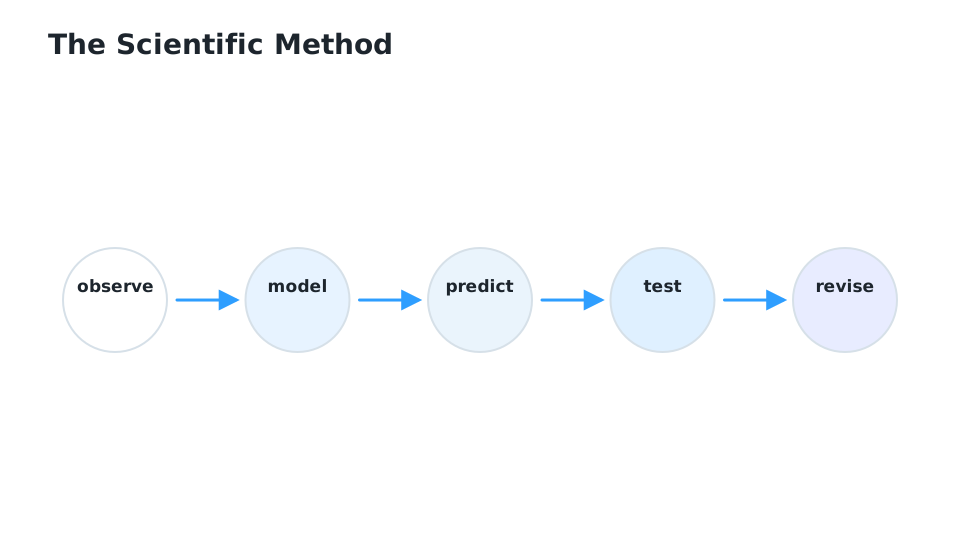
What unifies the enterprise is a set of harder constraints:
- explanations must confront observations rather than be protected from them;
- hypotheses/models should make discriminating predictions or retrodictions;
- measurements and methods should be exposed to checking and criticism;
- results become stronger through replication, independent evidence, and successful novel predictions;
- models remain revisable when better evidence appears.
Falsifiability, associated with Karl Popper, captures something important: a claim that is compatible with every possible observation cannot be strongly tested by observation. But “one failed test instantly falsifies a theory” is too simple because experiments also depend on instruments, auxiliary assumptions, statistics, and background models.
Big idea: Science is not a recipe for producing certainty. It is a social and methodological system for making explanations answerable to the world and making error discoverable.
Evidence can support one hypothesis over alternatives without logically proving it forever. Mature science therefore accumulates confidence through converging evidence rather than graduating a theory into an unquestionable fact.