Torque and Rotational Dynamics
A force can change an object's translational motion. But for an extended object, where the force acts also matters.
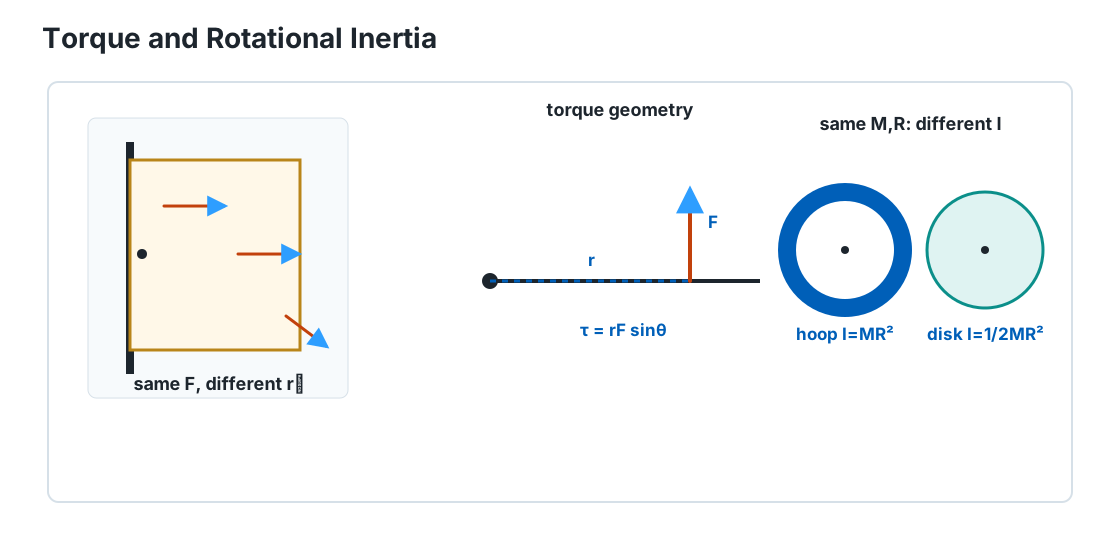
Push a door near its hinge and little happens. Apply the same force near the handle and the door rotates readily.
Torque captures this rotational leverage.
Torque
For a force vec(F) applied at position vec(r) from the chosen axis:
Magnitude:
Equivalently:
where r_⊥ is the perpendicular lever arm.
The SI unit is N·m. Although dimensionally the same as a joule, torque is not energy.
Rotational inertia
Mass measures resistance to translational acceleration.
Moment of inertia I measures resistance to angular acceleration about a chosen axis.
For point masses:
Mass farther from the axis matters much more because distance is squared.
This is why moving a skater's arms inward can strongly change rotational behavior without changing total mass.
Newton's second law for rotation
For a rigid body about a fixed axis:
where:
- τ = net torque
- I = rotational inertia
- α = angular acceleration
This is the rotational partner of:
Angular kinematics
For constant angular acceleration:
Linear and angular quantities connect through:
Points farther from the axis move faster for the same angular speed.
Static equilibrium
An extended object is in static equilibrium only if both conditions hold:
and:
Zero net force alone is not enough. Equal opposite forces applied at different locations can produce a pure turning tendency.
Why axis choice matters
Torque and moment of inertia depend on the chosen axis.
The same door, wheel or rod can be easy or hard to rotate depending on the axis.
That is not a defect in the concept; rotation is inherently motion about an axis.
Physics C bridge
For a continuous mass distribution:
That integral is the origin of familiar tabulated results such as:
- hoop about center: I=MR²
- solid disk about center: I=1/2MR²
- uniform rod about center: I=frac1{12}ML²
Those formulas should not feel like unrelated facts: each is the same mass-distribution integral applied to a different geometry.
Big idea: Rotation depends not only on how much force or mass exists, but on how each is distributed relative to an axis.