Gearing, Clutches, and Automatic Transmissions
A combustion engine cannot deliver useful operation at every possible wheel speed. It must keep rotating while the car stops, and its useful torque and power vary with rpm. The powertrain solves two different problems: disconnect or permit slip when necessary, and choose the speed-to-torque conversion.
A ratio changes torque, not the energy budget
Define a reduction ratio (G=ω(in)/ω(out)). With negligible acceleration of the gears themselves and efficiency η,
The ideal result follows directly from P=τω. Gear teeth constrain relative motion; the larger output torque acts through a smaller angle. A 3:1 reduction does not triple power.
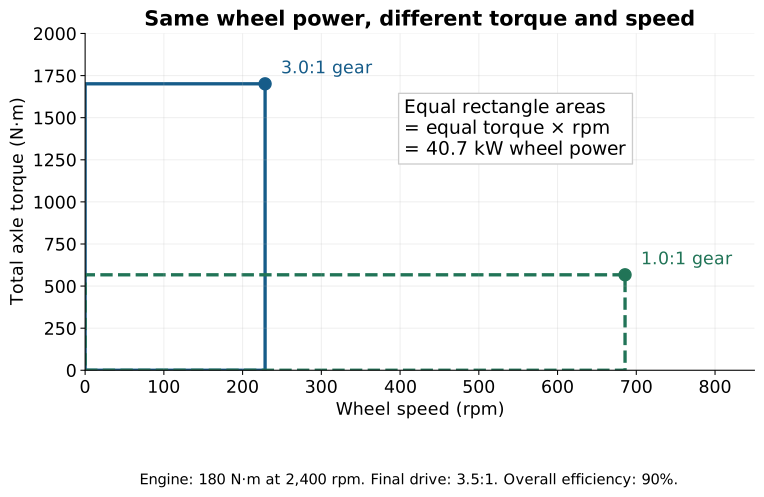
The gearbox ratio multiplies the final-drive ratio. For a hypothetical engine at 2,400 rpm and 180 N·m, a 3.0:1 gear with a 3.5:1 final drive gives an overall 10.5:1 reduction. At 90% total drivetrain efficiency, the axle receives 1,701 N·m at 228.6 rpm. With a 0.30 m effective rolling radius, that corresponds to 25.9 km/h and approximately 5,670 N total drive force, before road resistance and rotational-inertia effects.
Using a 1.0:1 gear at the same engine operating point gives 567 N·m, 685.7 wheel rpm, and 77.6 km/h. The wheel power is the same 40.7 kW in both examples. The first offers more force at lower speed; the second more speed with less force. Real engines do not maintain arbitrary torque at any rpm, and road grip may limit the force before the engine does.
At a fixed road speed, selecting a lower gear raises engine rpm. That can place the engine in a more powerful operating region, which is why acceleration depends on the complete engine curve and gearing, not just the engine's advertised peak torque.
What a manual transmission actually selects
A friction clutch clamps a disc between rotating surfaces to couple engine and gearbox. While fully engaged without slip, both sides have the same speed; during slipping, the speed difference dissipates power approximately as
Slip permits a stationary car to begin moving while the engine continues rotating, but it generates heat. It is a transitional state, not free speed conversion.
In a common constant-mesh manual gearbox, the gear pairs remain meshed. Selection locks the appropriate freely rotating gear to its shaft through a coupling. Synchronizers use friction to bring relevant rotational speeds together before dog teeth engage; they are not the main clutch between engine and gearbox. TREMEC describes the constant-mesh mechanism and synchronizer sequence. Neutral leaves no selected through-power path, even though some internals may still rotate. ZF's clutch overview supplies the component context; the energy equations explain the tradeoff.
An automatic has two mechanisms, not one
A conventional hydraulic automatic often combines a torque converter with planetary gearsets.
The converter's engine-driven impeller transfers angular momentum to fluid; fluid drives a turbine connected to the transmission. A stator redirects returning flow and supplies a reaction torque during torque multiplication. The reaction is why a converter can do more than a simple two-element fluid coupling. As speeds converge, multiplication falls. With the output stationary, output power is zero even if output torque is large: input power becomes heat. A lock-up clutch can connect input and output mechanically to reduce ongoing slip losses. Converter fluid paths and ZF lock-up context.
Planetary gearing contains a central sun, planet gears carried on an arm, and an internally toothed ring. Its ratio depends on which member is driven, held, or connected to another member. Clutches and brakes alter those constraints; the gears need not slide into and out of mesh.
For a simple ideal set with tooth counts Ns,Nr,
This is the ordinary sun-to-ring gear relationship viewed from the moving carrier. Holding the carrier gives the familiar opposite rotations; adding carrier speed back yields the equation. With a 30-tooth sun and 70-tooth ring held stationary, ωc=0.30ωs: a 3.33:1 reduction. Locking sun and ring together forces all three members to rotate together at 1:1. Holding the carrier and driving the sun makes the ring rotate oppositely at -30/70 of sun speed. MathWorks' explicit planetary constraints.
Actual automatics combine sets to obtain several useful ratios. Dual-clutch transmissions and continuously variable transmissions achieve automatic operation differently. “Automatic” describes how the driver experiences ratio selection, not one universal internal construction.
The differential is a separate kind of freedom
After the selected overall reduction, a differential allows left and right driven wheels to turn at different speeds. Gear selection chooses their average speed relative to the engine; the differential accommodates the difference required by a turn. Confusing those tasks hides the elegance of the system.