From Whist to Contract Bridge
Contract bridge belongs to a long family of trick-taking card games.
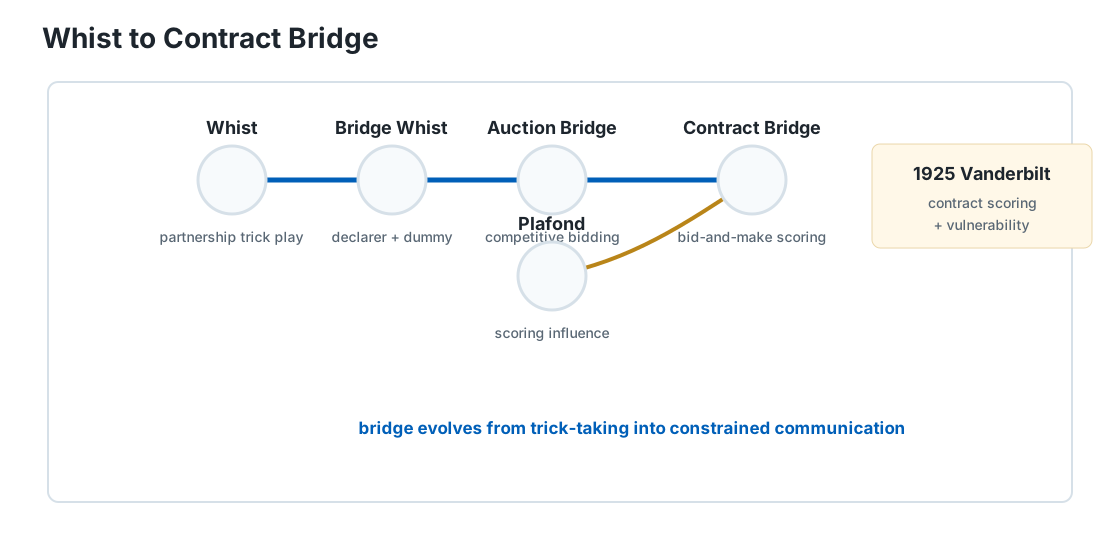
Its direct historical spine is approximately:
whist
→ bridge / bridge whist
→ auction bridge
→ plafond influences
→ contract bridge
The important evolution is not the trick-taking itself.
That part is old.
The great innovation was progressively turning bidding and scoring into a strategic commitment before the cards are played.
Whist
Whist was a four-player partnership trick-taking game using a standard 52-card deck.
Partners sat opposite one another.
Players followed suit when able, and tricks were won by the highest card of the led suit unless trump intervened.
There was no modern auction.
That means modern bridge players would recognize much of the card play but miss one of bridge's defining intellectual structures: bidding.
Bridge / bridge whist
Late-19th-century bridge variants added features including:
- a declarer
- a dummy hand exposed after the opening lead
- choice of trump/no-trump mechanisms
The game began to resemble modern bridge structurally.
Auction bridge
Auction bridge made competitive bidding central.
Players bid to determine the contract and declarer.
But its scoring still rewarded tricks in a way that did not fully require bidders to commit to the level they actually intended to make.
Contract bridge
In 1925, Harold Stirling Vanderbilt formalized the scoring system that became modern contract bridge.
The decisive principle was:
only tricks bid for and made count toward game.
This changed bidding incentives dramatically.
If a partnership could make four spades but bid only two, the extra tricks no longer advanced them toward game in the same way.
The auction became a commitment problem:
How high can we safely promise?Vanderbilt also incorporated vulnerability and a scoring structure derived partly from earlier games including auction bridge and plafond.
The World Bridge Federation dates the pivotal development to Vanderbilt's 1925 voyage aboard the SS Finland.
Why vulnerability is strategically brilliant
Vulnerability changes the reward/penalty landscape.
The same contract can have different consequences depending on vulnerability.
That creates asymmetric risk:
- vulnerable game bonuses are larger
- vulnerable undertricks are more expensive
- sacrifice decisions change
A single binary state therefore alters bidding strategy across an entire deal.
Duplicate bridge changes what "winning" means
Rubber bridge asks:
Did our side score more points in this rubber?Duplicate bridge largely removes luck of the deal by having multiple pairs play the same boards.
Performance becomes comparative.
At matchpoints:
How did our result compare with other pairs holding the same cards?At IMPs:
How costly was our score difference in bridge-point terms?This creates an additional evolutionary layer: the same basic game produces different strategic incentives under different scoring formats.
Bridge as a communication game
Bridge is unusual because partners have hidden information but can communicate only through legally constrained bids and card choices.
A bidding system therefore acts like a shared language built on top of the formal game.
Modern conventions evolve rapidly even though the laws of bridge do not.
This gives bridge two simultaneous evolutionary timescales:
slow: laws and scoring
fast: bidding theory and partnership methods
Big idea: Bridge evolved from trick-taking into a game of constrained communication and calibrated commitment. Contract scoring made the auction matter as much as the play.