Work, Energy, and Power
Force is a local description: what interaction acts right now?
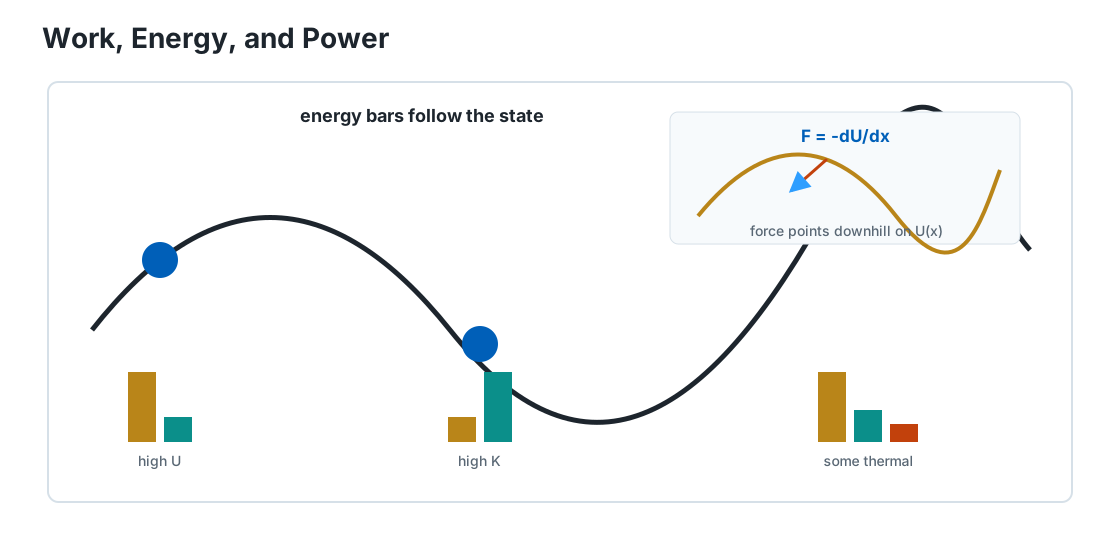
Energy often lets us ignore the detailed motion between two states and ask instead:
What energy entered, left, or changed form?
Work transfers energy through displacement
For a constant force:
where θ is the angle between force and displacement.
The general form is:
Only the component of force along the displacement contributes to work.
A person carrying a suitcase horizontally at constant height may exert a large upward force on it, but that upward force does essentially zero mechanical work on the suitcase because the displacement is horizontal.
Kinetic energy
For a particle:
The work-energy theorem is:
Because speed is squared, doubling speed multiplies kinetic energy by four.
A car at 60 mph therefore has four times the translational kinetic energy it had at 30 mph, assuming the same mass.
Potential energy belongs to a system
Near Earth's surface:
For an ideal spring:
For two gravitating point masses:
Potential energy does not reside mysteriously "inside the object." It belongs to an interacting system and depends on configuration.
Conservation of energy
For an isolated system:
Mechanical energy K+U is conserved only when the chosen accounting excludes transfers that change mechanical energy, such as thermal dissipation.
Friction does not destroy energy. It commonly transfers organized mechanical energy into less organized internal/thermal energy.
Power is a rate
Average power:
Instantaneously:
A machine can perform the same work with different power depending on how quickly it does it.
Example: climbing stairs
Suppose an 80 kg person climbs 3.0 m vertically.
The increase in gravitational potential energy is:
If this takes 5 s, the average mechanical power delivered against gravity is roughly:
The body's metabolic power is larger because muscles are not 100% efficient.
Physics C bridge
Calculus clarifies what work means when force varies with position:
For a conservative one-dimensional force:
That compact equation says the force points "downhill" on the potential-energy landscape.
Stable equilibrium occurs near a local minimum of (U(x)). That connection leads naturally to oscillations.
Main message: Energy is a state-accounting tool. It can solve problems without reconstructing every moment of the motion.
Misconceptions
- Force and energy are not interchangeable.
- Work in physics is not the same as effort.
- Friction does not violate energy conservation.
- Potential energy depends on system choice and reference.
- Power is not energy; it is energy transferred per unit time.