Capacitors and RC Circuits: Energy Storage Takes Time
A capacitor stores energy by separating opposite charges, creating an electric field between conductors. In the ideal two-terminal model the plates hold +Q and -Q; the device can remain neutral overall while storing energy.
Geometry becomes capacitance
For linear materials and fixed geometry, Q=CV, where V is the potential difference between plates. Capacitance C is measured in farads, or coulombs per volt. It is not a universal maximum charge rating; breakdown and construction impose separate limits.
Large parallel plates of area A, gap d, and vacuum between them have approximately E=Q/(ε₀A). Ignoring edge fields, V=Ed, so
A linear dielectric completely filling the gap replaces ε₀ by its permittivity ε. This approximation excludes leakage, dielectric nonlinearity, and breakdown. Increasing plate area gives more charge at the same voltage; reducing separation reduces the voltage needed for a given charge.
Capacitors in parallel share a voltage, so their stored charge magnitudes add: Ceq=C₁+C₂. In a simple series chain with initially neutral intermediate conductors, each capacitor has the same charge magnitude and the voltages add, giving 1/Ceq=1/C₁+1/C₂. These are the reverse of the resistor rules because capacitance relates charge to voltage, while resistance relates voltage to current.
Why stored energy has a factor of one-half
As the capacitor charges, adding each increment dq requires work dU=V(q)dq=(q/C)dq. Integrating from empty to Q,
The final voltage was not present throughout the charging process. For parallel plates, substitution also gives energy density u=U/(Ad)=(1/2)ε E²: the energy can be described as residing in the electric field.
A resistor turns charging into a differential equation
Connect an initially uncharged capacitor in series with resistance R and a constant ideal emf ℰ. Kirchhoff's loop rule and I=dQ/dt give
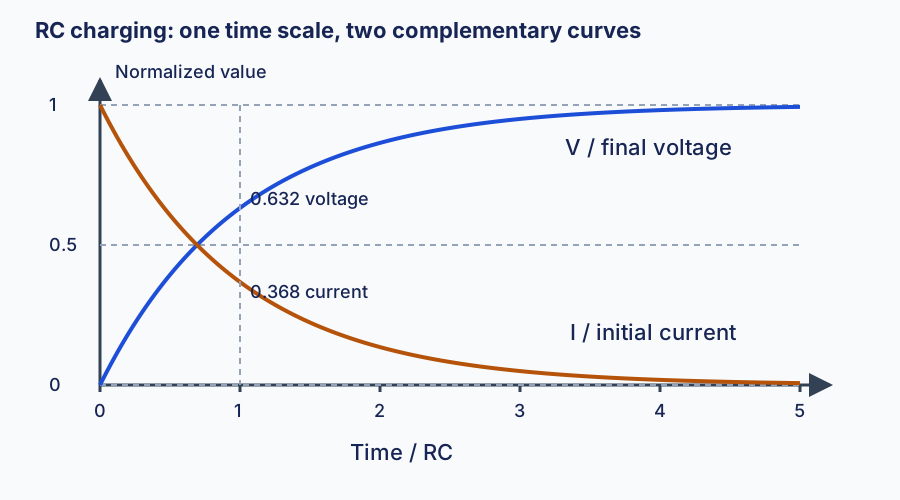
The unfilled amount Cℰ-Q shrinks at a rate proportional to itself. The solution is
The time constant τ=RC has units of seconds. At one time constant the voltage reaches 63.2% of its final value; at five it reaches 99.3%. Charging slows because the capacitor's rising voltage leaves less voltage across the resistor.
For R=10 kΩ, C=100 μ F, and ℰ=12 V, τ=1.0 s. Initially current is 1.20 mA; at one second capacitor voltage is 7.59 V and current 0.441 mA. Its eventual energy is 7.20 mJ.
On discharge through the resistor, V(t)=V₀exp(-t/RC), so energy decays as U(t)=U₀exp(-2t/RC). The energy time constant is half the voltage time constant; squaring matters.
The missing half is a lesson about the source
The fixed-voltage source supplies total energy ℰ Qfᵢnal=Cℰ², twice the final stored energy. The remainder is resistor heating. For any nonzero R in this ideal model, reducing R changes how rapidly energy is dissipated, not its total.
This does not mean all charging schemes must lose half their energy. A gradually adjusted source or suitable energy-transfer circuit changes the process. Nor can we set R=0 in the transient and ignore everything else: inductance, radiation, and source dynamics then matter.
An ideal capacitor blocks sustained DC after charging but permits transient current in the connected wires without charges crossing its insulating gap. This distinction makes capacitors useful for timing and filtering and is a first encounter with circuits whose behavior depends on history.