How We Know the Age of Earth
Earth is about 4.54 billion years old. The important part is not memorizing the number; it is understanding why we trust it.
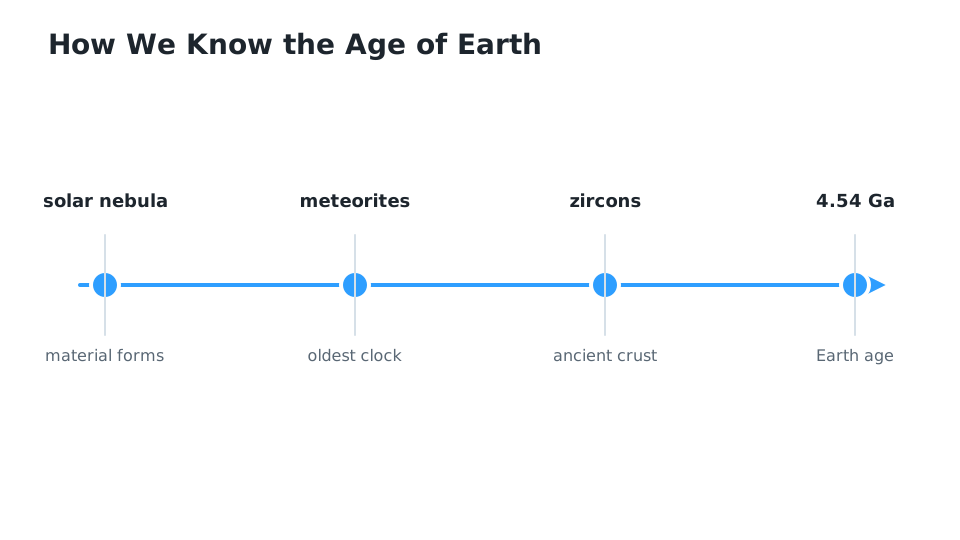
Earth's oldest surviving rocks cannot simply be treated as Earth's birthday certificate. Plate tectonics, melting, erosion, and metamorphism continually recycle the crust. Instead, geologists use radiometric clocks in ancient minerals, Moon material, and especially primitive meteorites that formed with the early Solar System.
The decisive logic is that radioactive parent isotopes transform into daughter isotopes at known rates. Different isotope systems provide independent clocks, and concordant ages from meteorites and Solar-System materials converge near 4.54–4.57 billion years.
A useful historical anchor is geochemist Clair Patterson, whose lead-isotope measurements of meteorites in the 1950s produced an age close to the modern value. Earth's oldest known zircon crystals are about 4.4 billion years old — extraordinarily ancient, but still younger than the planet itself.
Takeaway: We date Earth by reconstructing the birth of the Solar System, not by finding a single “first rock.”
What is actually measured?
Modern geochronology generally measures isotope abundances and ratios, usually by mass spectrometry. There is no instrument that directly reads “age.” The age is calculated from parent-daughter ratios, decay constants, mineral behavior, and assumptions that can be checked against other systems.
For example, U-Pb dating can use the paired clocks ²⁰⁶Pb/²³⁸U and ²⁰⁷Pb/²³⁵U. Pb-Pb dating can use ²⁰⁷Pb/²⁰⁶Pb. Patterson's 1956 meteorite work reported concordant meteorite results by three independent radiometric approaches; the most precise Pb isotope result gave 4.55 ± 0.07 billion years.
Agreement among independent clocks is far stronger evidence than one isotope pair producing one attractive number.
Some major radiometric clocks
| Parent | Daughter | Approx. half-life |
|---|---|---|
| ²³⁸U | ²⁰⁶Pb | 4.5 billion yr |
| ²³⁵U | ²⁰⁷Pb | 704 million yr |
| ²³²Th | ²⁰⁸Pb | 14.0 billion yr |
| ⁸⁷Rb | ⁸⁷Sr | 48.8 billion yr |
| ⁴⁰K | ⁴⁰Ar | 1.25 billion yr |
| ¹⁴⁷Sm | ¹⁴³Nd | 106 billion yr |
There is not one canonical count of “all radiometric clocks.” Geochronologists use many isotope systems, minerals, laboratory methods, and cross-checks. This table is a useful set of classic long-lived geological systems, not the complete universe of isotope geochronology. Carbon-14 is another famous clock, but it works on a much shorter archaeological/recent-organic timescale.