Forces and Newton's Laws
Kinematics says how motion changes. Dynamics asks why.
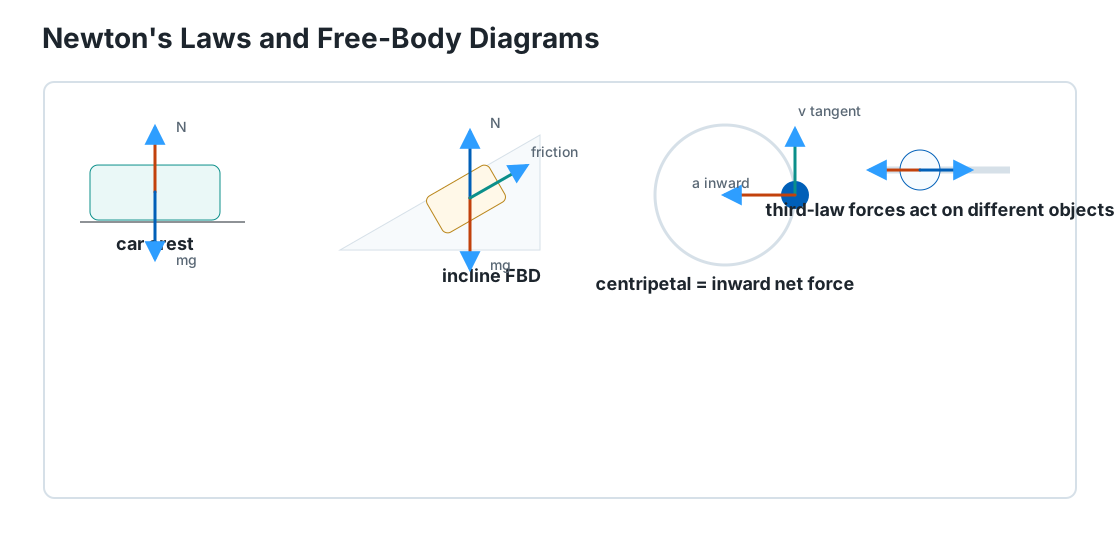
Newton's central idea is not that "force causes motion." Objects do not need a force to keep moving. Net force causes acceleration — a change in velocity.
First law: inertia
If the net external force on an object is zero:
then its velocity is constant.
Constant velocity includes the special case of rest.
The first law therefore rejects an everyday intuition produced largely by friction: moving objects do not naturally "run out of motion."
Second law: interaction changes momentum
For constant mass, the familiar form is:
The more general statement is:
where:
Force is therefore a rate of momentum change.
Third law: forces come in interaction pairs
If object A exerts a force on object B, then B exerts an equal-magnitude, opposite-direction force on A.
These forces do not cancel each other on a free-body diagram because they act on different objects.
A book resting on a table illustrates two different pairs:
- Earth pulls the book downward; the book pulls Earth upward.
- The table pushes the book upward; the book pushes the table downward.
The upward normal force and downward weight on the book are not a third-law pair. They happen to balance in this situation because the book's acceleration is zero.
Free-body diagrams
A free-body diagram contains only forces acting on the chosen object or system.
Common forces include:
- weight mg
- normal force
- tension
- friction
- spring force
- drag
- electric or magnetic forces in broader physics
Then apply Newton's second law separately by component:
Friction is not always μ mg
The usual models are:
for kinetic friction, and:
for static friction.
Static friction adjusts up to a maximum. It is not automatically equal to μsN.
Also, N=mg only in particular geometries. On a slope, in an accelerating elevator, or during curved motion, the normal force may differ substantially from weight.
Circular motion
An object moving in a circle of radius r at speed v has inward acceleration:
Therefore the inward net force must satisfy:
"Centripetal force" names this required inward net force; it is not an additional physical interaction.
For a satellite, gravity supplies it. For a car turning on a level road, static friction often supplies it. For a mass on a string, tension may supply it.
Gravitation
For point masses or spherically symmetric bodies:
Near Earth's surface this becomes approximately:
because r changes little compared with Earth's radius.
Physics C bridge
The deeper Newtonian statement is:
For a constant-mass particle this reduces to mvec(a). Calculus becomes essential when force varies with position, velocity or time.
Big idea: Forces describe interactions. The vector sum of the external interactions on a system determines how its momentum changes.
Quantitative anchor
A 70 kg person standing still on level ground has weight of about:
That is roughly 154 pounds-force, though newtons and pounds-force are different units.