Galileo Thermometer: Temperature Read Through Buoyancy
A Galileo thermometer looks like a sealed glass column containing several floating glass bulbs, each carrying a temperature tag.
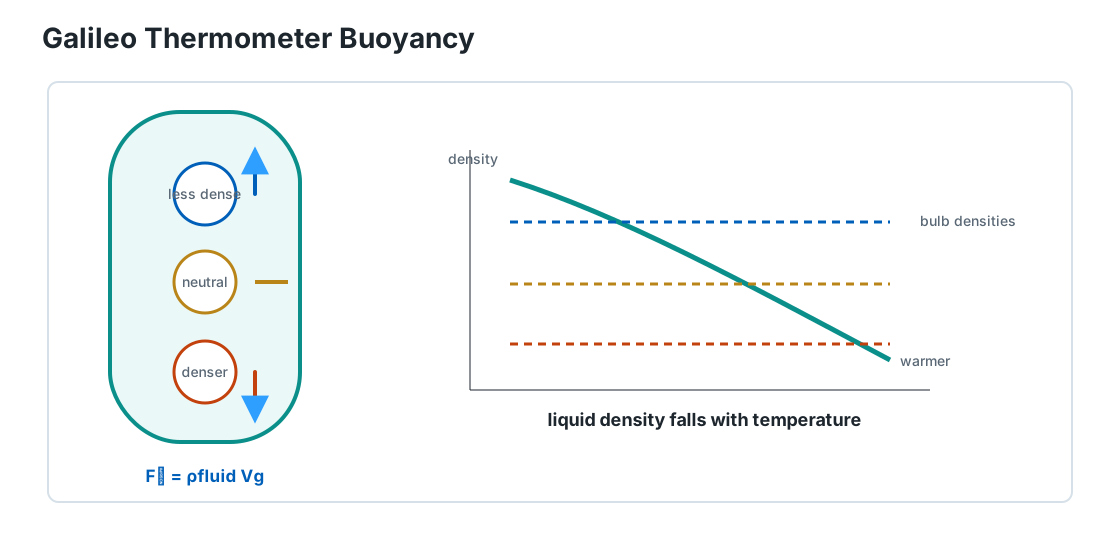
The bulbs rise and sink as the surrounding liquid changes temperature.
The mechanism is a compact demonstration of density and buoyancy.
The central trick
Each bulb has a fixed average density set by:
- its glass shell
- the liquid/air inside it
- its metal tag
The surrounding liquid changes density with temperature.
For the usual working liquids, warming causes thermal expansion:
temperature rises
→ liquid volume increases
→ liquid density decreases
Cooling does the reverse.
Archimedes decides whether a bulb rises
A submerged object experiences buoyant force:
Its weight is:
Since the bulb's own average density is:
the comparison becomes:
ρbulb < ρfluid → rises
ρbulb > ρfluid → sinks
The bulb itself does not need to change density much.
The surrounding liquid is the temperature-sensitive reference.
Why several bulbs?
The bulbs are manufactured with slightly different average densities.
Suppose one bulb is tuned to become neutrally buoyant near 20 °C and another near 22 °C.
As the liquid density moves through those values, the bulbs sort themselves vertically.
The temperature is read from the calibrated bulb or group of bulbs at the transition between floating and sinking, according to the thermometer's design.
Why the metal tags matter
The little temperature labels are not merely labels.
Their masses help fine-tune the average density of each bulb.
A tiny mass difference can determine the temperature at which buoyancy changes sign.
The name is historically awkward
The commercial object commonly called a "Galileo thermometer" was not literally a modern instrument designed by Galileo in the familiar form sold today.
Galileo and his circle were central to early thermoscopy and to observations involving temperature, density and buoyancy.
The modern floating-bulb thermometer is named for those principles rather than being a straightforward surviving Galileo design.
Avoid saying:
Galileo invented this exact thermometer.
Why it is not a precision laboratory thermometer
Its resolution is limited by:
- the number of calibrated bulbs
- manufacturing tolerances
- thermal equilibration time
- properties of the working liquid
- how the transition is read
Its value is partly pedagogical: it makes a density change visible through buoyancy.
A useful scale
Water's density changes only modestly across ordinary room temperatures, and water has its own anomalous density behavior near 4 °C.
Commercial Galileo thermometers therefore use liquids chosen to produce useful, predictable density changes in the intended temperature range.
Big idea: A Galileo thermometer does not measure temperature because the bulbs expand visibly. It converts a small temperature-dependent change in liquid density into an obvious rise-or-sink buoyancy threshold.