Radiometric Dating
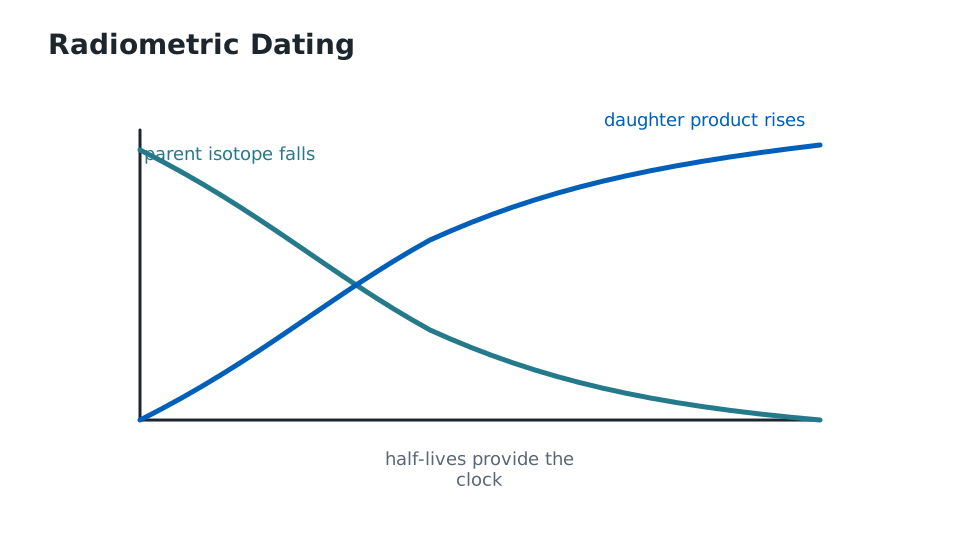
Radiometric dating turns radioactive decay into a clock. If a parent isotope decays with constant decay constant λ, then
and the half-life is
The hard part is not knowing the decay law; it is reconstructing the sample's starting conditions and asking whether the mineral behaved as a sufficiently closed system after it formed.
Geologists therefore use isotope systems and minerals chosen for particular jobs. Uranium–lead dating of zircon is especially powerful because zircon readily incorporates uranium when it crystallizes but strongly rejects ordinary lead. Multiple uranium decay chains also provide internal cross-checks.
Different isotope clocks cover different timescales. Carbon-14, with a half-life of about 5,730 years, is excellent for relatively recent organic material but useless for dating a 4.5-billion-year-old planet: after millions of years, essentially no original C-14 remains.
Takeaway: Radiometric ages are strongest when different isotope systems and samples converge, not when one magical measurement produces a date.